


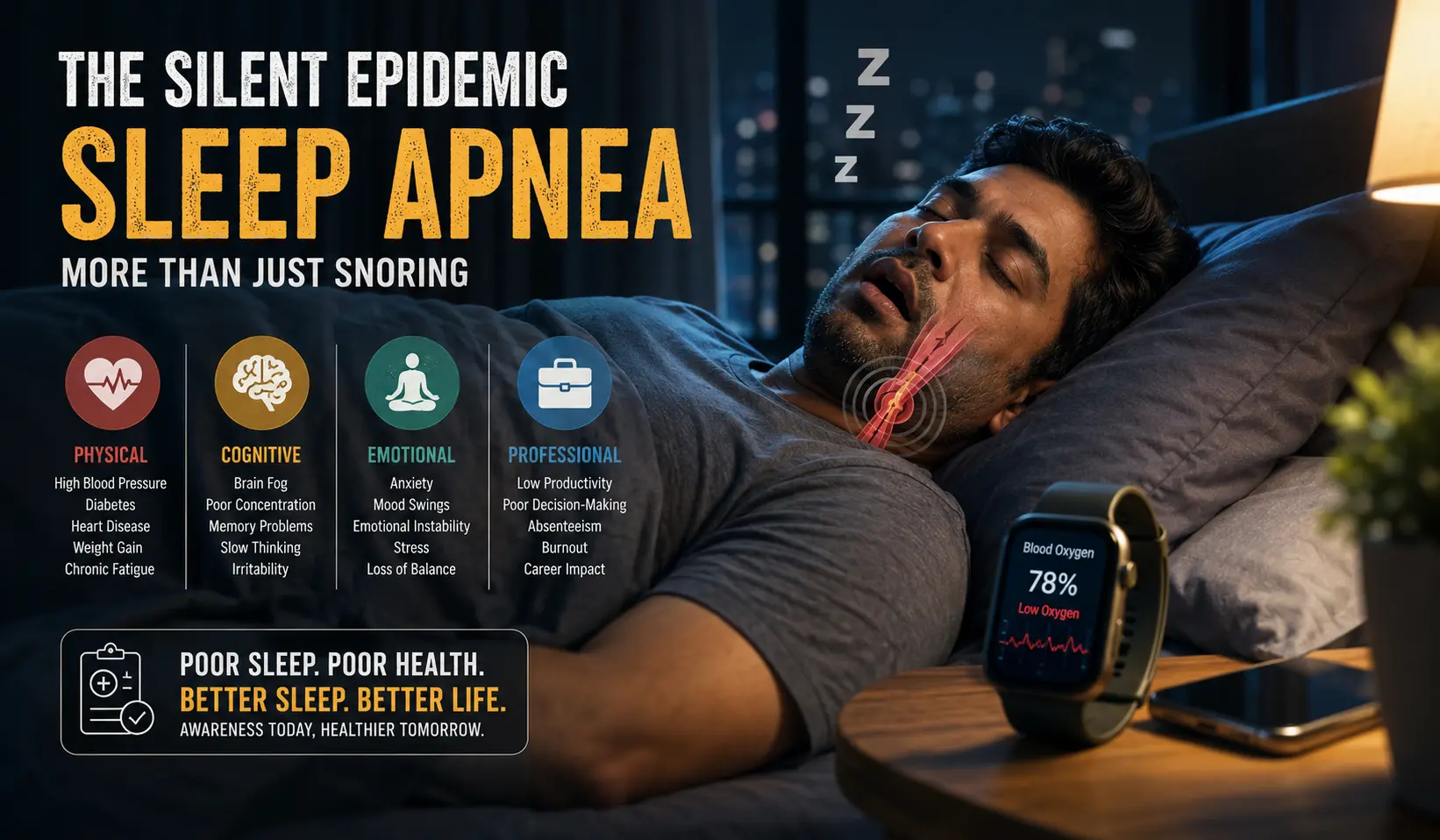
From Chronic Snoring to Corporate Burnout: How a Lifestyle Disorder is Quietly Eroding Urban India’s Brainpower, Vitality, and Business Performance—and the Rise of the Next Preventive Health Revolution.
KYB India Team
In many Indian households, loud snoring is still treated almost like a harmless family joke. “He sleeps so deeply.” Loud snoring isn’t healthy sleep. Discover why Obstructive Sleep Apnea (OSA) is urban India’s silent epidemic and a massive opportunity for the wellness business.
For generations, snoring has been associated with sound, peaceful sleep. A tired office worker falling asleep after dinner and snoring loudly is often seen as someone finally getting proper rest after a long day.
But modern medicine tells a very different story.
In millions of cases, loud snoring is not a sign of healthy sleep at all. It is a warning signal of a dangerous condition called Obstructive Sleep Apnea (OSA), a disorder that silently disrupts breathing throughout the night.
And India may already be facing a major public health crisis without fully realizing it.
Why Obstructive Sleep Apnea (OSA) Is Growing Rapidly in Urban India
Sleep apnea occurs when the airway repeatedly becomes blocked during sleep, causing breathing to stop and restart again and again.
- The body struggles for oxygen.
- The brain keeps waking the person up.
And yet most people have no memory of these interruptions the next morning. A corporate executive may believe he slept for eight hours, while in reality his body spent the night under constant physiological stress.
Urban India has created the perfect environment for this disorder to spread rapidly:
- Sedentary work culture
- Rising obesity
- Chronic stress
- Alcohol consumption
- Irregular sleep schedules
- Heavy screen exposure
- Increasing diabetes rates
Doctors are now seeing a sharp rise in sleep apnea symptoms in men and women aged 30 to 50, specially in metro cities where work pressure and digital dependency dominate everyday life.
The most dangerous part is that the majority of cases remain undiagnosed. Many people continue living for years with fatigue, headaches, poor concentration, and emotional instability without realizing that the root problem begins during sleep.
Charles Richet and Anaphylaxis: The Poison on the Yacht That Changed Medicine Forever
The Four-Dimensional Damage of Sleep Apnea
Sleep apnea is often misunderstood as a simple sleep disorder. In reality, it affects every major dimension of human functioning. It quietly damages the body, the mind, emotional balance, and professional performance, all at the same time.
1. Physical Damage (Body): The Link Between Obesity and Sleep Apnea
India is already battling two major health challenges: obesity and type-2 diabetes. Sleep apnea sits dangerously at the center of both.
When breathing repeatedly stops during sleep, oxygen levels drop. This triggers stress hormones, increases inflammation, and disrupts the body’s metabolic system. Over time, the physical effects become visible:
- Weight gain
- High blood pressure
- Insulin resistance
- Constant fatigue
- Heart-related risks
- Increased belly fat
What makes sleep apnea especially dangerous is the vicious cycle it creates. Poor sleep contributes to weight gain, and weight gain further worsens sleep apnea. The condition keeps feeding itself.
Case Study: The Successful Professional Who Was Secretly Exhausted
The Successful Professional Who Was Secretly Exhausted Take the example of Rajesh, a 41-year-old senior marketing professional in Gurugram. On the surface, his life looked successful:
- High-paying corporate job
- Stable family life
- Growing career
- Active social circle
But internally, his health was collapsing. He woke up tired every morning despite sleeping for seven to eight hours. He gained nearly 15 kilograms in three years. Afternoon headaches became routine. His blood sugar levels started rising. His wife noticed frightening pauses in his breathing during sleep.
Initially, he blamed stress and workload. But after a medical sleep study, he was diagnosed with severe sleep apnea. Within months of structured treatment, lifestyle correction, and weight management, several problems improved together:
- Energy levels
- Blood pressure
- Mood stability
- Weight control
- Workplace performance
The real issue had never been “just snoring.” It was a complete lifestyle-driven health breakdown.
2. Cognitive Damage (Brain): When the Mind Stops Operating Efficiently
Modern urban professionals survive on mental performance. Clear thinking, decision-making, focus, creativity, and communication are now economic assets. Sleep apnea quietly destroys all of them.
Because the brain never enters restorative deep sleep properly, the person wakes up mentally exhausted even after spending hours in bed. The symptoms often appear gradually:
- Brain fog
- Poor memory
- Slow thinking
- Lack of focus
- Reduced creativity
- Irritability
- Poor decision-making
Many professionals normalize these symptoms as “work stress” and increase caffeine intake to compensate. But the real issue is chronic sleep disruption and oxygen deprivation during the night. This becomes especially dangerous in fields requiring high concentration:
- Healthcare
- Finance
- Media
- Technology
- Driving and transportation
- Leadership roles
A tired brain does not make intelligent decisions consistently. And when millions of professionals operate under chronic fatigue, the economic consequences become enormous.
3. Emotional and Inner Well-Being (Being): The Loss of Internal Balance
One of the most overlooked consequences of sleep apnea is emotional instability. People suffering from chronic sleep disruption often experience:
- Anxiety
- Mood swings
- Emotional exhaustion
- Impatience
- Low motivation
- Reduced emotional resilience
Many people assume they are emotionally weak or mentally burned out, while the actual problem is physiological exhaustion. The nervous system simply never gets proper recovery time.
Modern urban lifestyles have made this problem worse. Late-night scrolling, binge-watching, constant notifications, and work emails extending past midnight have created what experts increasingly describe as a “rest deficit culture.” People are physically present but internally depleted.
No mindfulness practice can fully work if the brain and body never receive genuine rest. True emotional balance begins with healthy sleep.
4. Professional Damage (Business): India’s Hidden Productivity Crisis
Sleep apnea is not only a medical issue. It is also a business and economic issue. Employees suffering from poor sleep are more likely to:
- Make workplace mistakes
- Experience burnout
- Lose concentration
- Deliver lower productivity
- Feel disengaged during work hours
Many companies invest heavily in leadership programs, motivational workshops, and wellness seminars. But very few organizations seriously address sleep health. That may be one of the biggest blind spots in India’s corporate wellness industry.
An exhausted employee may appear physically present in meetings while mentally operating at half-capacity. For entrepreneurs, executives, startup founders, and high-performance professionals, sleep quality directly affects:
- Strategic thinking
- Communication skills
- Emotional intelligence
- Innovation
- Crisis management
Businesses cannot optimize performance while ignoring biological recovery. Sleep is not laziness. Sleep is infrastructure.
Technology Is Finally Bringing Awareness
Until recently, diagnosing sleep apnea required expensive sleep laboratory testing that many Indians avoided due to cost, inconvenience, or lack of awareness. That is beginning to change rapidly. Smartwatches and wearable health devices are now introducing millions of people to:
- Sleep tracking
- Oxygen monitoring
- Sleep interruption alerts
- Recovery scores
For the first time, sleep health is entering mainstream lifestyle conversations. Young professionals who once ignored their sleeping habits are now paying attention to sleep quality as seriously as fitness and nutrition. Technology alone cannot solve the problem, but it is helping expose a hidden epidemic that remained invisible for years. Awareness is becoming the first stage of prevention.
Can the Human Brain Rewrite Its Own Future?
Why Medical Treatments Alone Cannot Solve the Problem
Medical treatments such as CPAP machines remain highly effective for moderate and severe sleep apnea cases. But treatment alone is not enough.
A machine can improve breathing during sleep, but it cannot fully solve the lifestyle patterns that created the condition in the first place. The deeper drivers remain:
- Physical inactivity
- Obesity
- Chronic stress
- Excessive screen exposure
- Poor eating habits
- Alcohol and smoking
- Irregular sleep schedules
This is why the future of sleep wellness will extend far beyond hospitals and clinics. It will become part of a larger preventive wellness movement.
The Rise of Preventive Sleep Wellness & India’s Next Major Opportunity
India now has a major opportunity to redefine wellness through lifestyle correction rather than symptom management alone. One emerging idea is “digital restraint before sleep” (Digital Sanyam) consciously reducing screen exposure and mental stimulation before bedtime.
Simple lifestyle interventions can create powerful improvements:
- Regular exercise
- Weight management
- Reduced late-night eating
- Consistent sleep timing
- Breathwork and meditation
- Limiting screens before bed
The future wellness economy will increasingly focus on helping people build sustainable energy, emotional stability, and long-term vitality. Consumers are no longer searching only for treatment. They are searching for healthier ways to live.
The sleep wellness sector in India is still significantly underdeveloped compared to the scale of the actual problem. This creates enormous opportunities for:
- Health-tech startups
- Preventive wellness platforms
- Fitness brands
- Corporate wellness programs
- Nutrition experts
- Sleep clinics
- Wearable technology companies
- Mindfulness and recovery coaches
The companies that succeed in the coming decade will not simply sell products. They will help people restore energy, focus, emotional balance, and long-term health. Because in modern urban India, energy itself has become one of the most valuable resources. And quality sleep is its foundation.
KYB Final Thought
The loud snoring once dismissed as harmless may actually represent a society struggling under the pressure of modern lifestyles.
Sleep apnea forces India to confront a deeper truth:
Healthy bodies, sharp minds, emotional balance, and professional excellence cannot exist without restorative sleep.
And that is why the real conversation is no longer just medical.
Sleep apnea is not merely a health condition. It is the by-product of a broken lifestyle. For the health and wellness industry, this is not only an opportunity to treat disease, but a powerful and profitable opportunity to help people build disciplined, healthier, and more energetic lives.
स्लीप एपनिया सिर्फ एक मेडिकल कंडीशन नहीं है, बल्कि यह एक खराब लाइफस्टाइल का बाय-प्रोडक्ट है। एक हेल्थ और唯लनेस प्लेटफॉर्म के लिए यह सिर्फ बीमारी के इलाज से आगे बढ़कर, लोगों को एक अनुशासित, स्वस्थ और ऊर्जावान जीवनशैली देने का एक बहुत बड़ा और लाभदायक व्यावसायिक अवसर है।
KYB India Team
#SleepApnea #SleepHealth #WellnessIndia #CorporateWellness #PreventiveHealthcare #HealthTech #SleepAwareness #WellnessBusiness #KYBINdia #UntoldTheTruth
- Obstructive Sleep Apnea India
- Sleep disorder in urban India
- Snoring and health risks
- Sleep wellness industry India
- Corporate fatigue and sleep health
- Digital lifestyle and poor sleep
- Sleep apnea symptoms
- Wellness business opportunities
- India Urban lifestyle diseases
- Sleep health awareness India
- Untold The Truth
Medical Disclaimer
This article is intended for educational and awareness purposes only. It should not be considered medical advice, diagnosis or treatment. Sleep apnea is a serious health condition that requires proper medical evaluation and professional guidance. Symptoms such as loud snoring, daytime fatigue, breathing interruptions during sleep, morning headaches or poor concentration should not be ignored. Readers are strongly advised to consult a qualified sleep specialist, physician or healthcare professional for accurate diagnosis and personalized treatment.
The lifestyle suggestions mentioned in this article, including fitness, weight management, stress reduction and digital discipline before bedtime are supportive wellness approaches and should not replace professional medical care where necessary.
KYB India is a Better Life Platform helping people understand the connections between Body, Brain, Being and Business. Through practical insights, ethical storytelling and the questions others often overlook, we make health, human behaviour and modern life easier to understand and better choices easier to make.