


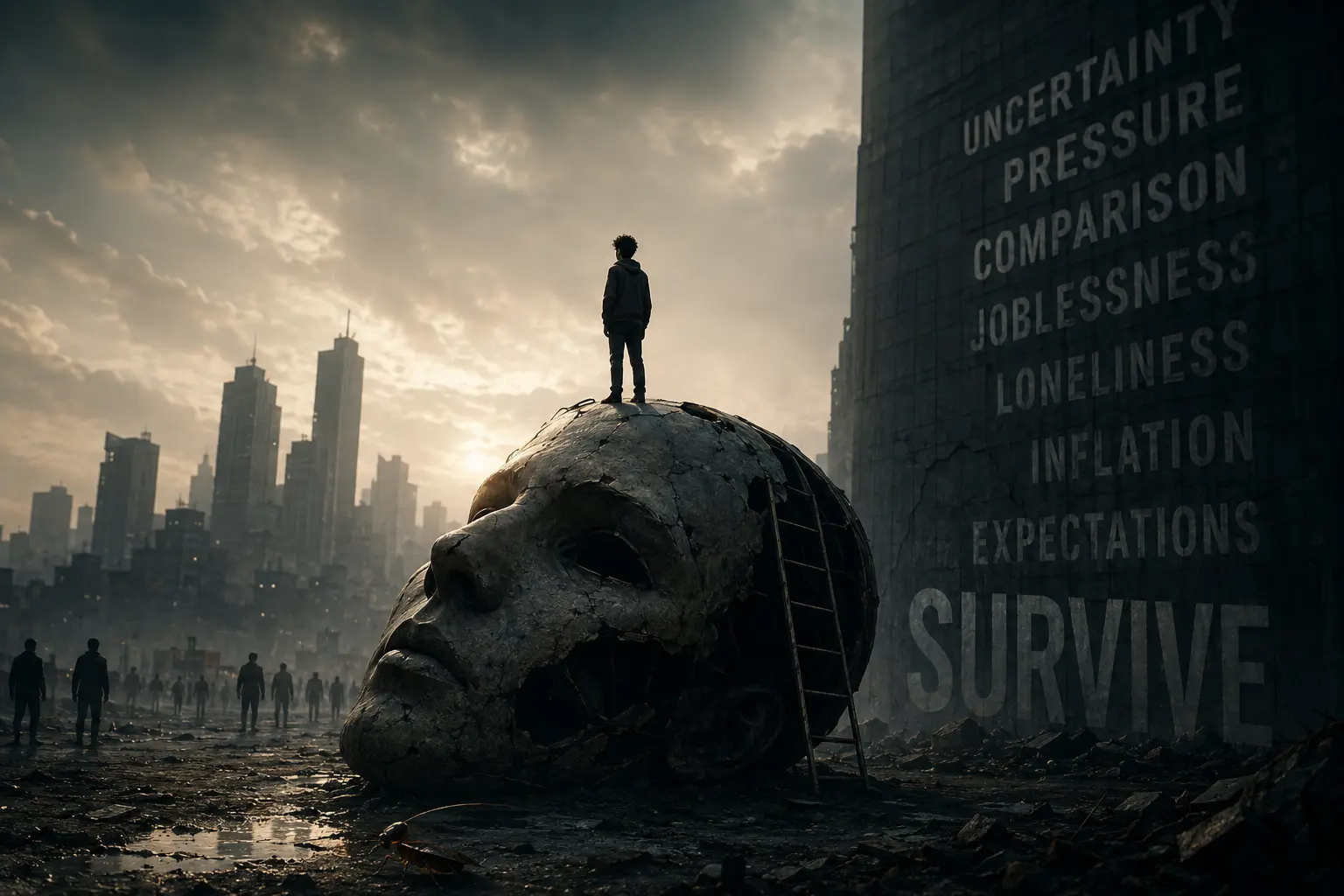
Behind every viral meme lies a deeper human story — one about exhaustion, belonging, resilience, and a generation struggling to believe in its future.
Bikas Pandey, Editor – KYB India
For centuries, human beings compared themselves to lions, eagles, warriors, and kings.
We admired strength.
We celebrated courage.
We built our identities around symbols of power.
Then something strange happened.
In the age of smartphones, algorithms, economic uncertainty, and endless scrolling, millions of ordinary people began identifying with a cockroach.
Not because they admired it.
Not because they wanted to become it.
But because they understood it.
What started as an internet joke eventually became something much deeper.
To understand this shift, one must look closely at the sudden rise of the Cockroach Janta Party across digital platforms. What initially appeared to be a bizarre internet trend rapidly evolved into a cultural phenomenon.
Millions of people gathered around a symbol that, on the surface, made absolutely no sense.
Why would educated graduates, job seekers, professionals, entrepreneurs, and students willingly associate themselves with one of the most disliked creatures on Earth?
The answer has very little to do with insects.
And everything to do with what it feels like to be human in the twenty-first century.
The rise of the Cockroach Janta Party may look like another viral movement destined to disappear into the endless stream of online content.
But beneath the humor lies an uncomfortable truth.
The cockroach is not the story.
The story is the human being who looked at that symbol and quietly whispered:
“That feels like me.”
For generations, society offered a simple promise.
Study hard.
Work hard.
Stay disciplined.
Be patient.
Trust the process.
The message was clear.
If you invested enough effort, the future would eventually reward you.
Today, millions of people are no longer certain that promise still exists.
They have degrees.
They have certifications.
They have skills.
They have spent years preparing for examinations, interviews, careers, and opportunities.
Yet many wake up every morning carrying the same invisible burden:
“I have done everything right, but I still have no control over what happens next.”
Life no longer feels difficult.
For many, it feels suspended.
Applications have been submitted.
Exams have been cleared.
Skills have been acquired.
Years have been invested.
Yet the future remains trapped behind a locked door that nobody seems able to open.
This feeling is more dangerous than anger.
Anger has direction.
Anger wants change.
Prolonged uncertainty slowly drains belief itself.
Human beings can survive extraordinary hardship.
History proves that repeatedly.
People survive wars.
Economic collapses.
Natural disasters.
Personal tragedies.
But there is something uniquely exhausting about living inside permanent uncertainty.
Not knowing whether your efforts will matter.
Not knowing whether your sacrifices will pay off.
Not knowing whether the future you prepared for even exists anymore.
When uncertainty becomes a permanent condition, a quiet transformation begins.
Hope turns into caution.
Confidence turns into anxiety.
Dreams turn into calculations.
And eventually, survival begins replacing ambition.
This is where the cockroach enters the story.
The cockroach survives.
It survives difficult environments.
It survives neglect.
It survives conditions that seem impossible.
Most importantly, it survives without recognition.
For millions of people, that experience feels painfully familiar.
When ordinary people feel ignored, symbols become powerful.
And when powerful systems stop listening, even the smallest symbol can become a sword.
That is why the cockroach matters.
Not because it represents weakness.
But because it represents persistence in a world where certainty has become a luxury.
The Silent Epidemic: Why Sleep Apnea in India is a Hidden Crisis & A Big Wellness Opportunity
Memes — The New Emotional Painkillers
There is a common belief that modern society has become obsessed with humor.
Every crisis becomes a joke.
Every disappointment becomes a meme.
Every frustration becomes shareable content.
At first glance, that seems healthy.
Humor has always helped people navigate difficult times.
But something feels fundamentally different today.
The internet is not simply producing more humor.
It is producing highly efficient emotional painkillers.
And a painkiller does not heal a wound.
It simply helps you tolerate it.
That distinction matters.
Think about the most relatable memes circulating online today.
Burnout.
Unemployment.
Financial pressure.
Loneliness.
Career anxiety.
Mental exhaustion.
The very things hurting people most are often the exact things they joke about most.
Why?
Because vulnerability feels dangerous.
A meme feels safer.
Sarcasm feels safer.
A joke feels safer than publicly admitting that you feel lost, overwhelmed, or exhausted.
So people laugh.
They share.
They scroll.
Not because the situation is funny.
But because laughter briefly makes the burden easier to carry.
From a psychological perspective, this is a form of emotional self-protection.
We separate ourselves from pain through irony.
We transform fear into humor.
We convert helplessness into content.
The meme becomes a socially acceptable way to say:
“I am struggling.”
Without ever having to use those words.
This is why the Cockroach Generation matters.
It is not simply creating memes.
It is creating emotional survival tools.
The modern internet has created an evolutionary mismatch.
Human beings were designed to compare themselves with a small number of peers.
Instead, we now compare ourselves with millions.
Every scroll presents another success story.
Another promotion.
Another achievement.
Another carefully curated life.
Every scroll silently asks:
“Are you doing enough?”
“Are you falling behind?”
“Are you wasting your life?”
Most people never say these questions aloud.
But they feel them.
Every day.
The brain absorbs these comparisons.
The emotional friction accumulates.
And eventually, that friction mutates into memes.
The meme says:
“Things are difficult.”
But it also says:
“You are not alone.”
And sometimes that feeling is powerful enough to help someone survive another day.
That is the beauty of digital humor.
But it also contains a danger.
Painkillers create relief.
They do not create healing.
A society that becomes expert at numbing its symptoms may eventually forget how to address its causes.
That is the uncomfortable question hiding beneath modern meme culture.
Are we processing reality?
Or are we simply learning how to anesthetize ourselves more efficiently?
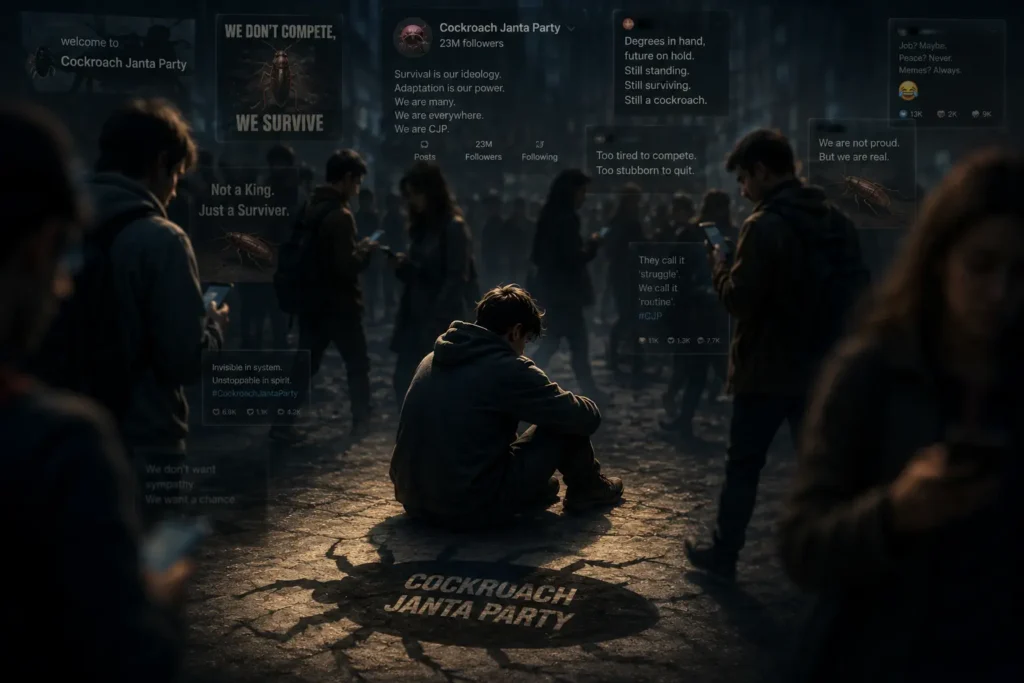
Cockroach Janta Party and the Rise of Digital Survival
The Rise of the Neo-Tribes
Human beings have always needed belonging.
For centuries, people found identity through family, community, faith, profession, or nation.
These structures answered a fundamental question:
“Who am I?”
Today, many of those traditional anchors feel weaker than before.
Families are smaller.
Communities are fragmented.
Institutional trust is declining.
People are more connected digitally than any generation in history.
Yet many feel profoundly alone.
This contradiction sits at the center of modern life.
We can communicate instantly with thousands of people.
Yet struggle to find a handful who truly understand our reality.
Whenever human beings lose belonging, they begin searching for it elsewhere.
That search is creating a completely new social structure.
Digital tribes.
Neo-Tribes.
These tribes are not defined by geography.
Their members may never meet.
They may live on different continents.
Speak different languages.
And belong to different cultures.
Yet their connection feels immediate.
Why?
Because they share an emotional reality.
The Cockroach Generation is a perfect example.
Its members are not connected by location.
They are connected by experience.
Shared uncertainty.
Shared exhaustion.
Shared frustration.
Shared humor.
The moment an individual realizes that their struggle is not a personal failure, something powerful happens.
“I am suffering.”
Transforms into:
“We are suffering.”
And the moment that transformation occurs, a tribe is born.
This is the hidden architecture of modern internet culture.
People are no longer gathering around ideology alone.
They are gathering around emotions.
Every share says:
“I feel this.”
Every comment says:
“Me too.”
Every meme becomes a digital handshake between strangers.
That sense of belonging can be deeply comforting.
Especially for people who feel invisible elsewhere.
But it also carries a serious psychological risk.
When communities form around shared pain, they can become attached to the very pain that created them.
The struggle becomes the identity.
The grievance becomes the glue.
The tribe becomes a permanent shelter.
And eventually, people begin surviving inside the story instead of changing reality.
That is why the rise of Neo-Tribes deserves serious attention.
Because they reveal something profound about our era.
People are not merely searching for entertainment.
They are searching for recognition.
They are searching for belonging.
They are searching for proof that they are not facing uncertainty alone.
And in an age where traditional institutions increasingly struggle to provide that reassurance, digital tribes are stepping in to fill the vacuum.
The question is whether they will become launchpads for change.
Or permanent shelters from reality.
Charles Richet and Anaphylaxis: The Poison on the Yacht That Changed Medicine Forever
The Billion-Dollar Business of Human Exhaustion
Every generation in human history has been exploited for something.
Some were exploited for physical labor.
Some for land.
Some for natural resources.
The digital generation is the first generation to be systematically exploited for its attention.
Attention has become the most valuable currency of the twenty-first century.
Every notification.
Every recommendation.
Every scroll.
Every click.
A vast economic machine is competing for it.
The internet often presents itself as a tool designed to connect humanity.
And in many ways, it succeeds.
But it is also a business.
And businesses follow incentives.
A platform earns money when people stay engaged.
The longer users remain on the screen, the more valuable they become.
This creates an uncomfortable question.
If loneliness keeps people online, what incentive exists to eliminate loneliness?
If anxiety increases engagement, what incentive exists to reduce anxiety?
If outrage generates clicks, why would the system reward calm reflection?
This does not require a conspiracy.
It requires only a basic understanding of incentives.
Algorithms are not evil.
They are optimized.
And optimization rarely asks what is good for human flourishing.
It asks a much simpler question:
“What will keep this person scrolling?”
Human psychology provides a predictable answer.
Fear.
Status anxiety.
Conflict.
Comparison.
Uncertainty.
These emotions capture attention because they are deeply rooted in human evolution.
The result is a strange cycle.
A young graduate worries about employment.
A professional worries about layoffs.
An entrepreneur worries about survival.
They open their phones seeking relief.
Instead, they encounter endless reminders of what they supposedly lack.
More success.
More wealth.
More beauty.
More achievement.
More certainty.
The human brain was never designed to compare itself with thousands of carefully curated lives every day.
Yet that has become normal.
And so emotional exhaustion grows.
This is why the Cockroach symbol became so powerful.
Because it rejected the performance.
It refused the fantasy.
It mocked the polished illusion of perfection.
The cockroach does not pretend.
It does not project success.
It does not claim to have life figured out.
It simply survives.
And in a digital landscape overflowing with artificial perfection, brutal honesty feels revolutionary.
But the system adapts quickly.
Once algorithms discover that exhaustion generates engagement, exhaustion becomes content.
Pain becomes content.
Loneliness becomes content.
Frustration becomes content.
Even resistance becomes content.
The internet absorbs rebellion and sells it back to the rebels.
That is the hidden genius—and danger—of the attention economy.
It monetizes not only our desires.
It monetizes our wounds.
And when human exhaustion becomes profitable, society must ask a difficult question:
Are we using technology to navigate reality?
Or has reality become so exhausting that we now use technology to escape it?
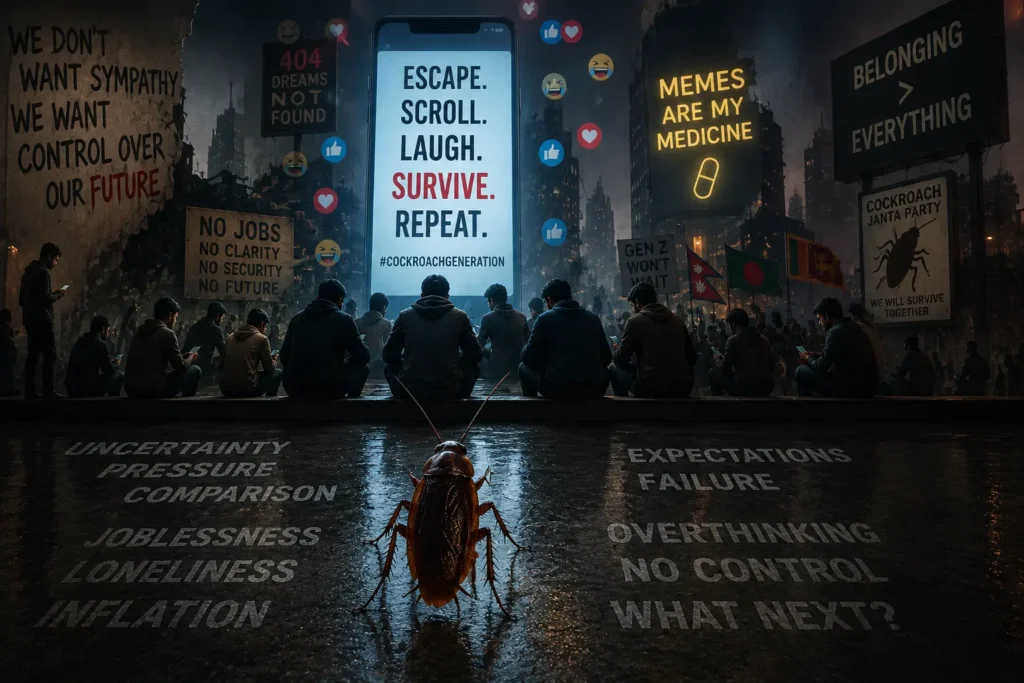
The Cockroach Generation in the Attention Economy
When Survival Replaces Hope
Every generation faces hardship.
But not every generation experiences the same psychological shift.
There is a profound difference between struggle and hopelessness.
A struggling person still believes tomorrow can improve.
A hopeless person begins doubting whether improvement is possible at all.
That single difference changes everything.
Human beings are powered by future possibility.
Students study because they believe effort matters.
Workers sacrifice because they believe progress is achievable.
Entrepreneurs take risks because they believe a better future can be created.
Hope is not a luxury.
Hope is infrastructure.
Remove it, and society continues functioning on the surface.
The offices remain open.
The trains continue moving.
The markets continue operating.
But something essential begins disappearing beneath the surface.
People stop dreaming.
People stop imagining.
People stop building.
Instead of asking:
“What can I create?”
They begin asking:
“What can I protect?”
One question expands life.
The other shrinks it.
This is the hidden danger behind survival culture.
The normalization of endurance.
The celebration of coping.
The quiet belief that merely getting through the day is enough.
Of course survival matters.
Every human being must survive.
But survival was never supposed to be the destination.
It was supposed to be the starting point.
History offers a warning.
Civilizations rarely collapse because they run out of resources.
They collapse because they run out of imagination.
Before institutions fail, belief fails.
Before economies stagnate, ambition stagnates.
Before structures collapse, hope collapses.
Over the last few years, young populations across the world have repeatedly demonstrated something important.
Whether in protests, social movements, labor shifts, or digital uprisings, a common message keeps emerging:
“We are tired of waiting for a future that feels real.”
Different countries.
Different governments.
Different circumstances.
Yet the emotional frequency remains remarkably similar.
The issue is no longer patience.
The issue is belief.
Because when people stop believing in the horizon, they stop investing in it.
And when an entire generation does that simultaneously, the consequences extend far beyond individuals.
The Urban Loneliness Epidemic in Modern India
The future itself contracts.
This is why the Cockroach Generation deserves attention.
The symbol became powerful because it asks nothing from the future.
It does not demand fairness.
It does not expect recognition.
It does not assume opportunity.
It simply adapts.
It survives.
And while adaptation is necessary, a society that celebrates adaptation without transformation eventually traps itself in permanent stagnation.
The greatest danger is not public anger.
Anger can create reform.
The greatest danger is cynical adaptation.
The moment people become so accustomed to uncertainty that they stop expecting anything better.
The moment survival becomes the highest aspiration.
The moment endurance replaces imagination.
That is the moment a generation begins negotiating away its own potential.
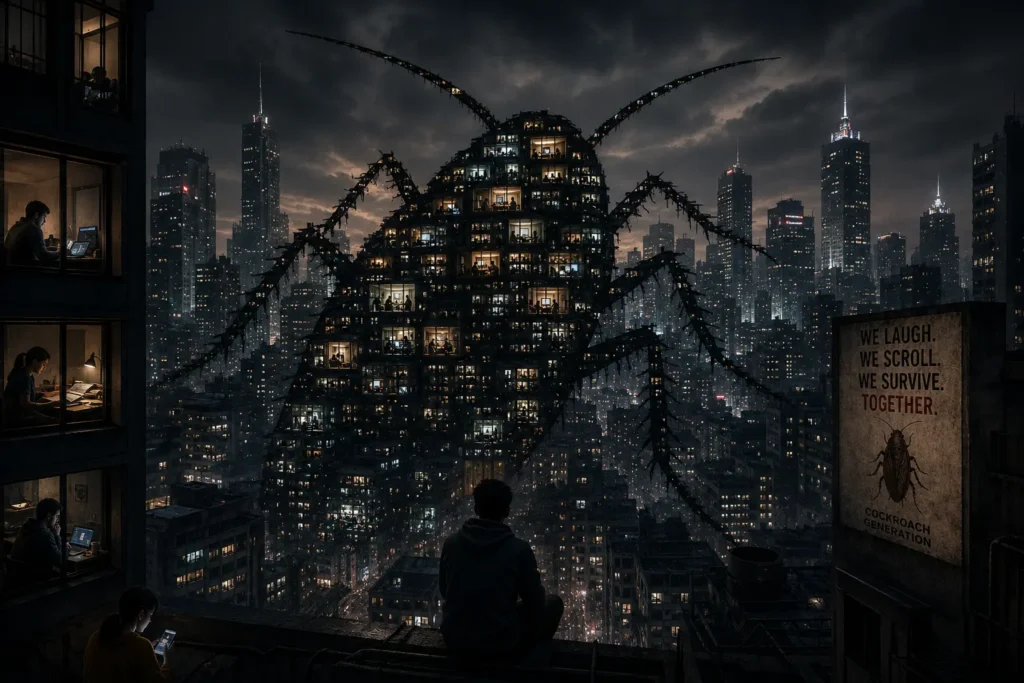
Urban Jungle Under Neon Skies
Can We Still Rebuild?
This is not really a story about a cockroach.
It is not even a story about memes.
It is a story about human beings.
The meme is not the story.
The story is the wound that required the meme.
The tribe is not the story.
The story is the loneliness that created the tribe.
The cockroach is not the story.
The story is the ordinary person who looked at that symbol and quietly whispered:
“That feels like me.”
That simple sentence contains the emotional DNA of an entire generation.
The reason millions of people connected with the Cockroach Janta Party is not because they admired an insect.
It is because they recognized a condition.
The exhausting condition of surviving without certainty.
The invisible condition of adapting without recognition.
The painful condition of doing everything right and still feeling powerless over the future.
Yet hidden inside that condition is another truth.
A truth far older than social media.
Far older than algorithms.
Far older than the internet itself.
Human beings are not merely survivors.
We are creators.
Builders.
Dreamers.
Meaning-makers.
Every civilization that transformed history was built by people who inherited uncertainty but refused to worship it.
People who faced darkness but refused to normalize it.
People who survived—but then chose to build.
The challenge before the Cockroach Generation is not survival.
It has already mastered survival.
The challenge is remembering what comes after survival.
Because surviving the storm and building the future are not the same thing.
One keeps you alive.
The other gives life meaning.
And perhaps that is the real lesson hidden beneath this entire phenomenon.
The cockroach survives the dark.
But it never dreams.
It never imagines a better architecture.
It never creates a new world.
Human beings can.
That is our responsibility.
And that is our advantage.
The real question facing this generation is not whether the future is uncertain.
Every generation inherits uncertainty.
The real question is whether we still believe we have the power to shape what comes next.
Because the future is never built by people who possess certainty.
It is built by people who possess courage.
The courage to act before guarantees arrive.
The courage to imagine before evidence appears.
The courage to build before success is visible.
And perhaps that is where this story truly ends.
Or maybe where it begins.
The rise of the Cockroach Generation is not a story about an insect.
It is a mirror.
A mirror reflecting the anxieties, exhaustion, humor, resilience, and hidden aspirations of millions of people trying to find their place in an increasingly uncertain world.
The question is what we do after looking into that mirror.
Do we remain there?
Or do we step beyond it?
You can conclude
When powerful systems stop listening, even the smallest symbol can become a movement.
When people feel invisible, even a joke can become an identity.
And when uncertainty becomes a way of life, survival can start looking like success.
But human beings were never meant to stop at survival.
We were meant to create meaning from chaos.
Order from confusion.
Possibility from uncertainty.
The Cockroach Janta Party may have started as a meme.
But the emotions behind it are real.
The frustrations are real.
The exhaustion is real.
The longing for dignity, belonging, and a future worth believing in is real.
And that is why this conversation matters.
Because the future will not be decided by algorithms.
It will be decided by the choices made by the human beings staring into those algorithms every day.
So look at the screen.
And ask yourself honestly:
Have we simply become better at surviving the darkness?
Or do we still believe we can build the light?
Editor’s Note
If this article resonated with you, share your thoughts in the comments.
Do you see yourself in the Cockroach Generation?
Do you think memes are helping society cope—or preventing it from heal?
And most importantly:
Have we become too comfortable with survival?
If this essay receives a meaningful response, I will publish Part 2, where we will explore an even deeper question:
What happens when a generation stops trusting institutions and starts trusting only its digital tribes?
The conversation has just begun. — KYB India ✦
@bikas-pandey
Editorial Disclaimer
The Cockroach Janta Party is discussed in this article as a cultural case study. The views expressed are solely those of the author and are intended to encourage critical thinking about modern society, digital behavior, identity formation, and the psychology of survival. This article should not be interpreted as an endorsement or criticism of any specific online community, organization, or movement.
#CockroachGeneration
#MemeCulture
#DigitalCulture
#HumanBehavior
#SocialPsychology
#FutureOfWork
#KYBIndia
#UntoldTheTruth
