


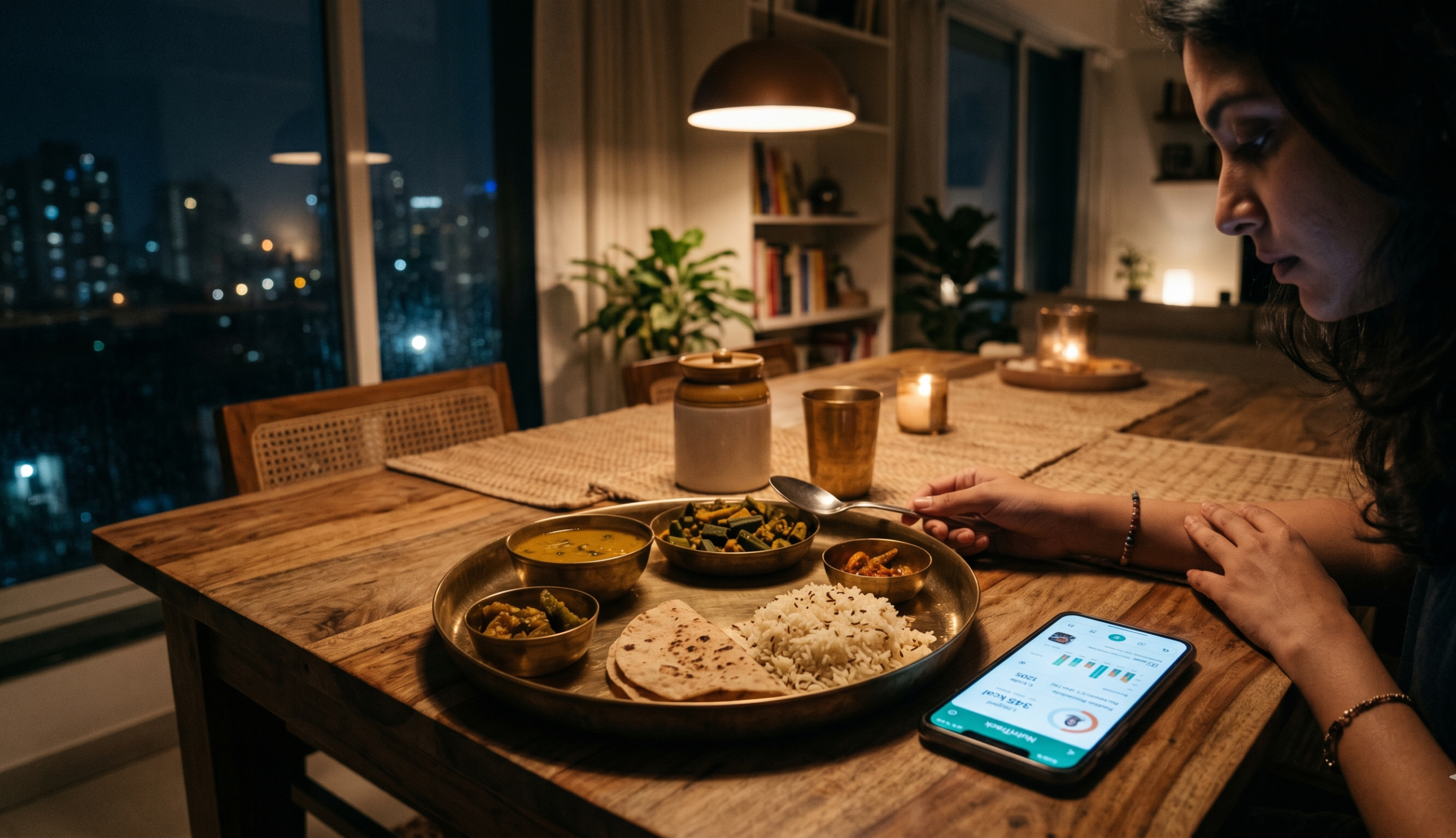
Eating for longevity starts with looking at what is on the plate, and a calorie count alone cannot tell us that. Every evening across urban India, a silent ritual unfolds. A young professional sits at a dining table, a homemade meal before them.
But they aren’t looking at the food. They are staring at a smartphone screen, logging grams of paneer, measuring tablespoons of rice, and counting calories.
READ MORE : How Poor Digestion Affects Your Mood
We have converted the sacred act of nourishment into a mathematical equation. In doing so, we have normalised a quiet anxiety that separates us from our bodies.
The Normalised Disconnection from Our Plates
We live in an era of nutritional hyper-awareness, yet we are profoundly undernourished. We track macros but ignore our moods. We calculate deficits but forget our heritage.
This is the heart of India’s silent crisis. We have outsourced our biological intuition to algorithms, believing that numbers alone hold the key to health.
But true wellness cannot be measured solely by what we restrict. When we view food only as fuel or a metric to control, we lose the joy that sustains life.
Shifting Focus: Eating for Longevity
Living a long, vibrant life requires more than just surviving on a deficit. Eating for longevity is an act of deep self-respect, not rigid restriction.
Longevity belongs to a body that feels safe, respected, and genuinely nourished. It thrives when we move past the stress of numbers and look at the quality of our sustenance.
In India, our traditional kitchens never counted calories; they measured balance. They understood that food speaks directly to our cellular health and emotional peace.
The Psychology of the Modern Diet
Why have we embraced this obsession? Because modern urban life is unpredictable, and numbers give us an illusion of total control.
We stress over a single calorie while ignoring chronic sleep deprivation, emotional exhaustion, and the loneliness of urban living.
Food has become a battleground instead of a sanctuary. To truly practice eating for longevity, we must heal this psychological relationship with our plate.
What a Calorie Cannot Tell Us
A calorie is a unit of energy, nothing more. It does not tell us about the fibre in a bowl of dal, how slowly a meal was eaten, or whether it was shared with family. Two plates with the same number can leave the body feeling very differently. The figure on the screen looks exact, yet it covers only a small corner of what nourishment means.
Returning to Our Roots and Senses
How do we reclaim our health from the digital noise? We begin by looking at our food again, rather than just our screens.
True nourishment starts with ancestral wisdom. It is found in seasonal vegetables, local grains, and spices that reduce inflammation naturally. Seasonal food has always followed the calendar: mangoes in summer, sarson ka saag in winter.
It means eating with awareness, honouring hunger cues, and understanding that our grandmother’s recipes carried generations of biological intelligence.
A Gentle Place to Begin
Start with one meal a day. Sit down, keep the phone in another room, and eat something simple: dal, a seasonal sabzi, a little curd, roti or rice. Chew slowly and notice when you are full. Let a few differently coloured vegetables find their way onto the plate through the week. None of this needs an app.
The Journey Back to True Nourishment
Reclaiming our health does not mean ignoring science. It means integrating science with human intuition and emotional intelligence.
Let us step away from the anxiety of the tracker. Let us focus on how food makes us feel, heal, and connect.
Ultimately, eating for longevity is about cultivating a life worth living longer. It begins when we put down the app and finally taste our food.
This article is for general awareness and does not replace advice from your doctor or a qualified dietitian.ating a life worth living longer. It begins when we put down the app and finally taste our food.
Reference
WHO: Healthy diet fact sheethttps://www.who.int/news-room/fact-sheets/detail/healthy-diet
. ICMR-NIN: Dietary Guidelines for Indians (2024)https://www.nin.res.in/dietaryguidelines/pdfjs/locale/DGI24thJune2024fin.pdf
Calorie tracking aur khane ki chinta (PubMed)https://pubmed.ncbi.nlm.nih.gov/28214452/
#MindfulEating #EatingForLongevity #IndianWellness #HumanCenteredHealth
KYB India is a Better Life Platform helping people understand the connections between Body, Brain, Being and Business. Through practical insights, ethical storytelling and the questions others often overlook, we make health, human behaviour and modern life easier to understand and better choices easier to make.