


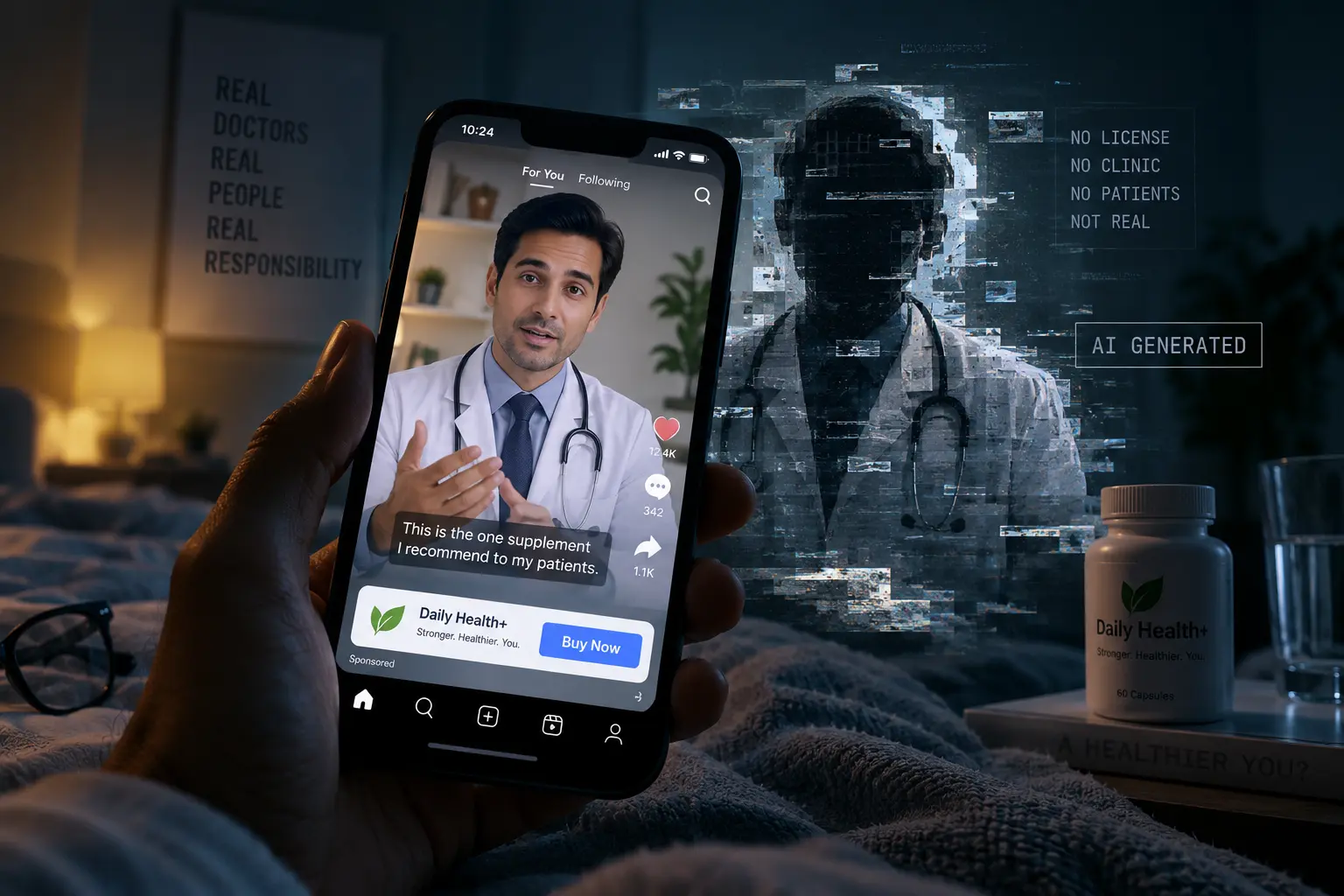
AI-generated doctors are promoting health products online. The faces are artificial. The trust and the money behind them are real.
You are scrolling before bed when a man in a white coat appears on your screen. He has a calm voice, kind eyes and a stethoscope around his neck. He sounds confident as he explains what people are getting wrong about their health before recommending a supplement, a remedy or a wellness product.
You may save the video. You may send it to someone in your family. You may even buy what he recommends because the advice does not appear to come from an ordinary influencer. It comes from someone who looks and sounds like a doctor.
There is just one problem: the doctor may not exist.
There may be no clinic, no patients and no medical career behind the face you trusted. In some cases, there may not even be a real human being. The face, voice, setting and apparent medical authority can all be created or manipulated using artificial intelligence.
That raises a question much bigger than whether AI can make a convincing video: Who built this person and who decided he should be trusted?
AI-Generated Doctors: What’s Really Happening
Artificial intelligence has made it possible to manufacture something health advertising has always wanted: authority. Not simply a digital face or a computer-generated voice, but the visual language we have been trained to associate with medical expertise — the white coat, the clinic, the confident explanation and the reassuring recommendation.
This is no longer a theoretical concern. A June 2026 India Today investigation identified more than two dozen AI-generated doctors and health influencers on Instagram who appeared to have no real-world existence. Together, the accounts had attracted more than one million followers. Some offered health advice, some promoted products and some were open to brand collaborations. The investigation also documented manipulated content involving the identity of a real physician, Dr William Li, making the problem broader than completely fictional characters alone.
The attraction is easy to understand. Health is an unusually trust-sensitive market. A fashion influencer can tell you that a shirt looks good. A travel creator can recommend a hotel. But when someone appears to be a doctor and tells you that a supplement, test, diet or remedy is good for your body, the recommendation carries a different psychological weight.
AI can now reproduce many of those signals of authority without reproducing the years of education, professional registration and accountability that normally sit behind them.
That is the turning point.
The question is no longer simply whether an advertisement is persuasive. It is whether the person providing the persuasion is a person at all.
Follow the Money
There is a business model sitting behind this technological shift.
A real medical professional has professional obligations and a reputation to protect. A qualified expert can question a script, demand evidence for a claim or refuse an endorsement altogether. A synthetic personality has no independent judgement. It says what its creator makes it say.
It can also be reproduced at scale. The same digital personality can appear in multiple videos, speak different languages, deliver revised scripts and be adapted for different audiences without the practical limitations of a human creator. For marketers, those capabilities can make synthetic personalities commercially attractive.
The India Today investigation found AI-generated health accounts that were promoting products or inviting commercial collaborations. This is important because it reveals that synthetic medical authority is not merely an interesting experiment in generative AI. In at least some cases, it is connected to a commercial funnel.
The path can be remarkably simple: a convincing face creates attention, apparent expertise creates trust, trust strengthens a recommendation, and the recommendation can lead to a purchase.
The doctor may be fictional. The transaction is not.
This is why KYB believes the right question is not only “Is this AI?” We also need to ask: Who benefits when we believe it?
Follow the Evidence
This investigation needs an important distinction. AI-generated health content is not automatically false, and artificial intelligence itself is not the villain in this story.
AI has legitimate and potentially valuable applications across healthcare, including medical imaging, clinical decision support, administrative workflows, patient communication and research. A clearly identified virtual presenter can also be used responsibly to explain basic health information or deliver public-health messages in several languages.
A synthetic presenter is therefore not automatically deceptive. The problem begins when a fabricated or manipulated identity is presented in a way that encourages viewers to attach medical authority to someone whose credentials, expertise or even existence cannot be verified.
The regulatory picture is also more nuanced than saying that India has no rules. The Advertising Standards Council of India (ASCI) already recognises virtual influencers in its influencer advertising guidelines. Its guidance says virtual influencers should disclose upfront and prominently that consumers are not interacting with a real human being. ASCI also has specific requirements for influencers providing technical health and nutrition advice in advertising: relevant qualifications and credentials matter when commercial content involves technical advice relating to health claims.
That changes the real question.
It is not simply, “Where are the rules?”
It is: Can disclosure, verification and enforcement keep pace with synthetic health personalities that can be created and distributed at extraordinary speed?
The Accountability Gap
Imagine that an apparently qualified doctor recommends a supplement in a video and the claim later turns out to be misleading. With a real professional, there is at least an identity to investigate. You may be able to verify the doctor’s registration, qualifications, workplace and professional history.
Now replace that person with an AI-generated face.
Who owns the advice then? Is responsibility with the person who wrote the script, the agency that generated the character, the company selling the product, the account publishing the video or the platform distributing it?
Existing consumer-protection and advertising frameworks can still apply to misleading commercial claims. But synthetic identity creates an additional layer of difficulty because the apparent source of authority visible to the consumer may not be the actual source of the message.
This is perhaps the most important gap created by AI health influencers: technology has made authority easier to manufacture without making responsibility equally visible.
The Other Side: AI Is Not the Problem
There is a danger in taking this argument too far.
Not every virtual health presenter is an attempt to fool consumers. A hospital could use an openly labelled AI avatar to explain how patients should prepare for an appointment. A public-health organisation could use synthetic presenters to communicate in multiple Indian languages. A healthcare company could use an obviously artificial character to explain a product without pretending that the character is a doctor.
Those uses should not be placed in the same category as fabricated medical authority.
Transparency changes the relationship. When people know they are watching an AI-generated presenter, they can evaluate the information with that knowledge. When they believe they are listening to a genuine doctor, however, they may give the same words much greater credibility.
So this is not a human-versus-AI argument.
It is a transparency-versus-deception argument.
And in healthcare, that distinction matters because the consequences of misplaced trust can involve more than wasted money.
Platforms Are Beginning to Respond
Social platforms are starting to recognise the wider problem of synthetic personalities. In September 2026, Instagram moved towards clearer identification of AI-generated influencer profiles, including a more explicit “AI-generated profile” label and measures affecting the recommendation reach of synthetic influencer accounts that do not properly disclose their nature.
That is an important development, but a label can solve only part of the problem.
Knowing that a presenter is AI-generated tells you something about the identity on the screen. It tells you nothing about whether the medical claim being made is scientifically sound. It does not tell you whether the product has meaningful evidence behind it, whether a qualified professional reviewed the script, or whether the recommendation is primarily educational or commercial.
The next stage of this debate therefore cannot be only about identifying AI.
It must also be about identifying accountability.
Follow the Impact
For consumers, synthetic doctors challenge one of the oldest shortcuts in health communication: the assumption that visible medical authority means verified medical expertise.
A white coat, a clinical background and confident medical language can make advice feel safer before we have examined a single piece of evidence. This matters especially on social media, where decisions are made quickly and health content sits alongside entertainment, advertising and personal recommendations.
If that authority can be generated on demand, consumers need a different way to judge what deserves their trust.
There is an immediate financial risk. People can spend money on supplements, wellness products or services because they believe an apparently qualified person recommended them. There can also be a health risk if questionable advice causes someone to delay appropriate medical care, misunderstand a condition or rely on an unsuitable product.
But there is another consequence that may be harder to measure.
If synthetic medical personalities become common enough, the damage may eventually spread beyond the fake accounts themselves. Consumers may begin questioning genuine doctors and legitimate health educators because the visual signals that once helped establish credibility have become easy to imitate.
The cost of manufactured trust could therefore be a decline in real trust.
What KYB Found
The first finding is that medical authority can now be manufactured visually. AI can reproduce many of the signals people associate with healthcare professionals without creating the qualifications behind those signals.
Second, this is already visible in Indian social media. Investigative reporting in 2026 documented more than two dozen apparently synthetic doctors and health influencers whose combined following exceeded one million, including accounts involved in product promotion and commercial collaborations.
Third, India is not starting from a regulatory blank page. Advertising standards already address virtual influencers, disclosure and qualifications in commercial health-influencer content. The harder challenge is whether consumers can easily recognise synthetic authority and whether rules can be consistently applied as the technology evolves.
Finally, the central problem is not that artificial intelligence is becoming better at creating people. It is that the appearance of expertise is becoming easier to create than the expertise itself.
That distinction should matter to every consumer, advertiser, health company and platform operating in this space.
Before You Trust the White Coat
The next time someone who appears to be a doctor gives health advice on your feed, do not begin by asking whether the video looks real. Generative technology is making that question increasingly unreliable.
Instead, try to verify the person. Search for a full name, professional history, clinic or hospital affiliation and, where appropriate, medical registration. Look at the account itself. Does it provide a clear identity? Does it disclose that the presenter is virtual or AI-generated? Is the content educational, or does every piece of advice eventually lead towards a product?
Then separate the person from the claim. Even a genuine doctor appearing in a video does not automatically make every commercial claim correct. Look for evidence, disclosures and conflicts of interest. Be especially cautious when a video offers certainty where real healthcare normally requires context — one remedy, one supplement or one product presented as the answer for almost everyone.
And there is one simple question worth keeping in mind:
Would you trust the same advice if the person were not wearing a white coat?
The KYB Question
For generations, the white coat represented something that could not easily be manufactured. Behind it were supposed to be years of study, professional responsibility and a real human being whose identity and reputation were attached to the advice.
Artificial intelligence has changed the first part of that equation. The appearance of medical authority can now be created faster, cheaper and at a scale that would have been impossible only a few years ago.
That does not mean we should stop trusting doctors. It means we need to become more careful about what makes someone a doctor in our eyes.
The biggest question, therefore, is no longer whether AI can look and sound like a medical professional. We already know that it can.
The real question is this: when trust itself can be manufactured, who is responsible for telling us what is real?
Explore more from Know Your Business →
KYB India Team
Disclaimer
This article is for informational and editorial purposes only. It is based on publicly available reports, research and sources available at the time of publication. References to AI-generated health personas, platforms, products or industry practices are intended to examine broader issues of advertising, transparency and consumer trust, and should not be interpreted as allegations against any individual or organisation unless specifically supported by cited evidence. Readers should independently verify medical claims and consult a qualified healthcare professional before making health-related decisions.
#AIinHealthcare #HealthTech #DigitalHealth #HealthMisinformation #ResponsibleAI
Continue Exploring
Why Meditation Apps Are Losing Users in an Age of Endless Stress
Can AI Predict Your Health Before You Feel Sick?
The Business of Attention: Why Your Focus Is Being Sold
KYB India is a Better Life Platform helping people understand the connections between Body, Brain, Being and Business. Through practical insights, ethical storytelling and the questions others often overlook, we make health, human behaviour and modern life easier to understand and better choices easier to make.