


Close your eyes, breathe, empty your mind: easy advice, until the mind is full of tomorrow’s meeting and tonight’s unread messages.
Some of us simply cannot be still on command.
Perhaps the answer is to stop fighting the mind and keep the hands busy.
Can punch needle embroidery for stress relief really quieten a tired mind? Most of us carry the day home with us. The office is shut, but the mind is still at the desk, going over a mail we should have worded differently, a deadline on Monday, a family function nobody has planned yet. Then the phone lights up with one more WhatsApp group and whatever quiet we had is gone.
When we say we are stressed, someone suggests meditation. It is good advice, but sitting still with a racing mind can become one more task. Punch needle embroidery for stress relief offers a gentler route, and our own homes have always known the idea behind it.
Think of grandmothers knitting sweaters in the winter sun, or a phulkari, kantha or chikankari piece growing slowly over many months. Give the hands a simple, steady job and the mind often settles by itself. Punch needle is a newer craft, and among hobbies for stress relief it asks for very little, which makes it a good start for beginners.
How Hands-On Hobbies Can Calm a Busy Mind
Stressful thoughts run in loops. We go back over the same conversation and worry about next month’s expenses. Telling yourself to stop thinking about it rarely works.
A hands-on task gives attention another place to go. When your fingers follow a pattern, you slowly start noticing the feel of the yarn, the colours, the shape coming up on the cloth. The worries do not vanish. They just stop filling every corner of the mind.
READ MORE ; Tai Chi Walking: Can Slowing Down Your Steps Improve Balance and Well-Being?
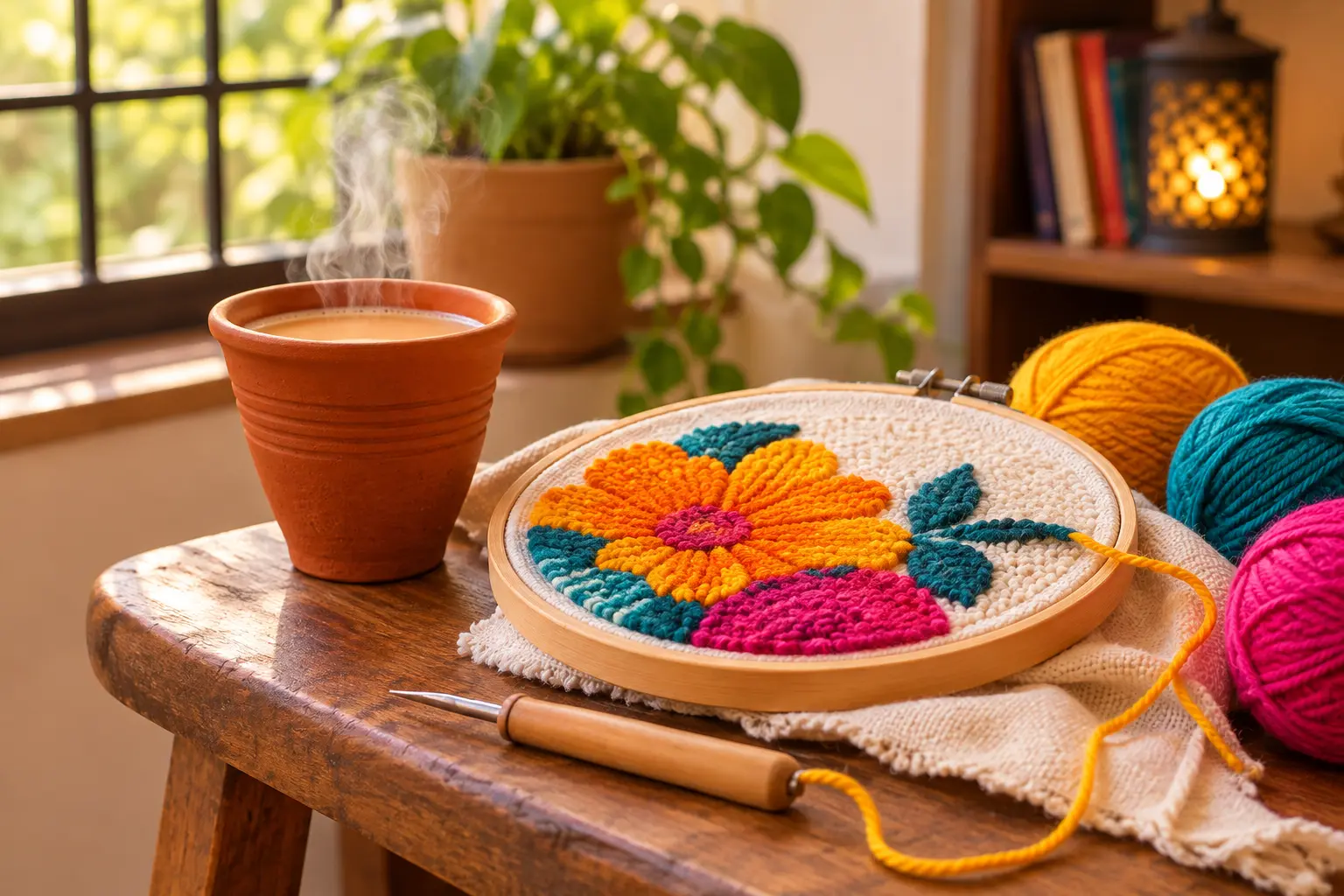
Punch needle embroidery uses a hollow needle threaded with yarn, which you push through stretched fabric to make rows of loops. It is quick to learn, and a wrong loop can be pulled out and done again without damage. After a day on screens, holding something you made yourself is a satisfaction worth having.
What Does Research Say About Punch Needle Embroidery for Stress Relief?
No study has looked at it directly. What we have is research on creative activity in general.
A 2024 study in Frontiers in Public Health looked at 7,182 adults in England. People who took part in arts and crafts reported more happiness, more satisfaction with life and a stronger feeling that their lives were worthwhile. This shows an association, not a cause, since someone who already feels good may simply be more likely to pick up a hobby.
A 2016 Drexel University study in the United States measured cortisol, a hormone linked with the body’s stress response. Thirty-nine adults spent 45 minutes making art, and cortisol fell in about 75 per cent of them. The study was small, the participants used markers, clay and collage rather than embroidery, and roughly a quarter showed a rise instead.
A 2025 scoping review in Issues in Mental Health Nursing connected hobbies with relaxation, social interaction and parts of psychological wellbeing, and said more research is needed. So creative hobbies for mental health can be a useful part of daily life, but they are no substitute for professional care.
Why Small Creative Activities Matter in Everyday Life
Much of our time goes into outcomes. We work for deadlines, answer messages to close tasks and use weekends to catch up on what was left behind. Even rest can become one more item on the list.
A hobby loosens that grip. You are not making something to earn from it, to impress the relatives or to reach a professional standard. It can also bring company: a stitching group, a neighbour who wants to learn, a finished piece shown to a friend.
Punch Needle Embroidery for Beginners:
A Simple 20-Minute Practice
- Choose a comfortable time: Keep 20 minutes when nobody is likely to call you.
- Reduce distractions: Put the phone in another room and make this a screen-free half hour.
- Prepare your materials: Fix the fabric tightly in an embroidery hoop.
- Start with a simple pattern: Follow an easy outline before trying anything complicated.
- Focus on the movement: Watch the rhythm of the needle and the pattern slowly appearing.
- Finish without judging yourself: Stop when time is over. The aim is to enjoy the process, not to produce a perfect design.
Jot a line on how you feel before and after each session. After two weeks, the notes will show whether it helps.
Keep the Hobby Enjoyable, Not Another Responsibility
Punch needle embroidery for stress relief stops helping when it becomes a source of pressure. Beginners often worry so much about perfect patterns that they forget to enjoy the work itself. Begin small, let yourself make mistakes and go at your own speed. If embroidery does not suit you, knitting, painting, rangoli or gardening can hold your attention in a similar way, and so can Tai Chi Walking if you prefer slow movement to stitching.
Know the limits as well. Constant anxiety, a low mood that does not lift, disturbed sleep or difficulty in managing daily responsibilities need proper professional attention. A hobby can go alongside treatment, but it cannot replace it.
Final Thoughts
Taking a break from life’s demands does not always mean doing nothing. A few minutes of punch needle embroidery for stress relief will not solve every source of stress, but it can give you a small space in the day where attention rests on something simple. That is reason enough to put the phone down, pick up a needle and begin.
KYB Perspective
A hobby is not a cure, and this article does not claim it is. What stands out to us is how much of Indian life already has a hands-on rhythm built into it: stitching, rangoli, kneading atta, watering the tulsi in the morning. As screens took over the evenings, many of these small habits slipped away, and with them some of the quiet that came free with the work. At KYB India, this sits under Being, the part of health that is about giving the mind a place to rest, next to sleep, movement and honest conversation. Try it for two weeks with small expectations. If it helps, keep it. If it does not, try another.
Team KYB India
Disclaimer : This article is for general information and awareness only. It is not medical advice, and it does not diagnose, treat or prevent any condition. Punch needle embroidery and other creative hobbies are not a substitute for professional care. The studies mentioned here describe general findings on creative activity and may not apply to every individual. If you are struggling with persistent stress, anxiety, low mood or poor sleep, please speak to a registered doctor or a qualified mental health professional.
Reference links:
- Keyes et al. (2024), Creating arts and crafting positively predicts subjective wellbeing: https://www.frontiersin.org/journals/public-health/articles/10.3389/fpubh.2024.1417997/full
- Kaimal, Ray & Muniz (2016), Reduction of Cortisol Levels and Participants’ Responses Following Art Making: https://doi.org/10.1080/07421656.2016.1166832
- Cleary et al. (2025), Exploring the Impact of Hobbies on Mental Health and Well-Being: A Scoping Review: https://doi.org/10.1080/01612840.2025.2512006
KYB India is a Better Life Platform helping people understand the connections between Body, Brain, Being and Business. Through practical insights, ethical storytelling and the questions others often overlook, we make health, human behaviour and modern life easier to understand and better choices easier to make.