


Power, Protest, Public Trust and the Portraits of Indian Democracy
By Bikas Pandey
Senior Journalist | Founder & Editor, KYB India
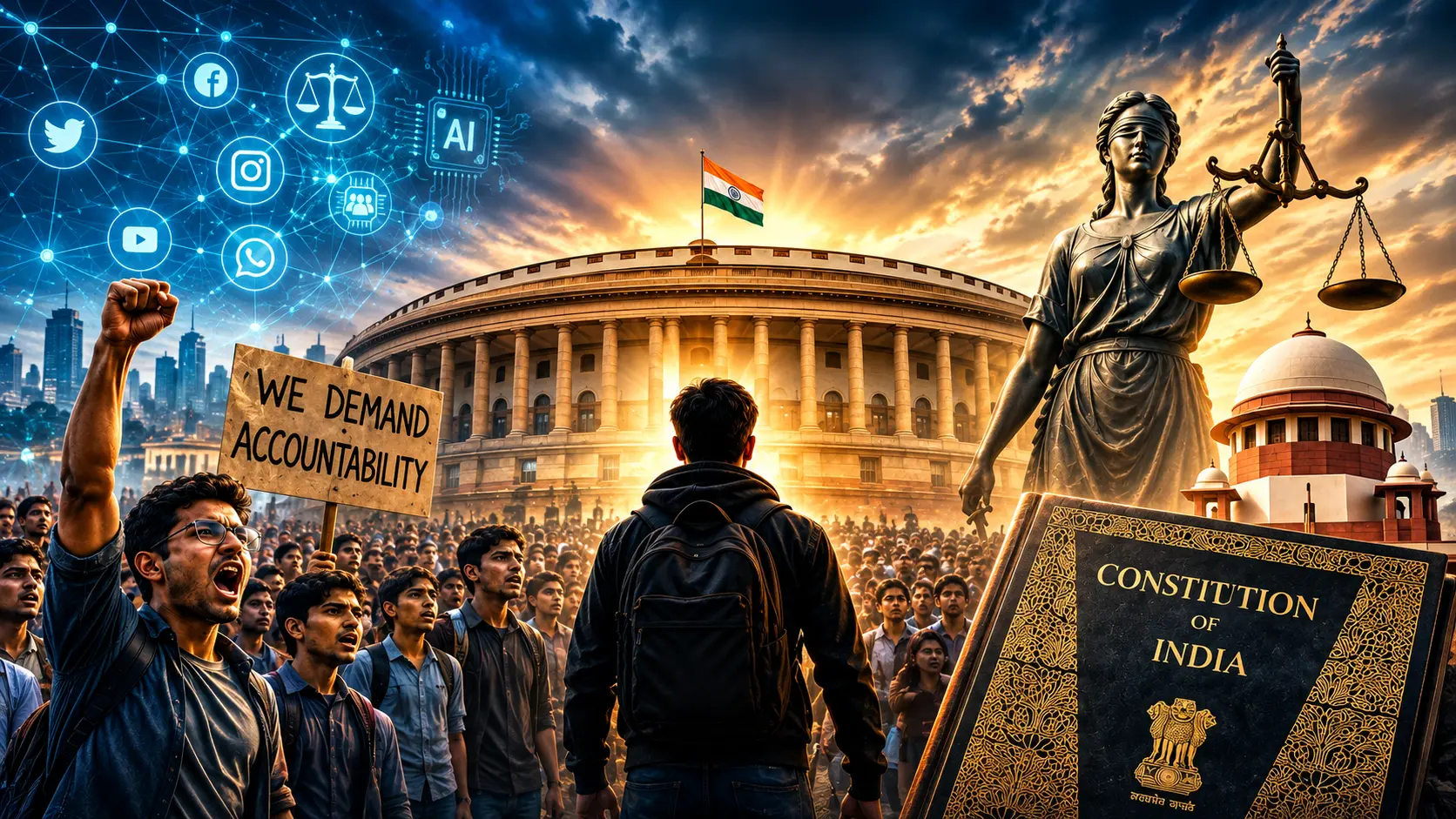
History never announces the beginning of democratic transformation. It is recognised only in retrospect, when ordinary events reveal that a republic has quietly begun to redefine itself.
It does not arrive with a constitutional amendment, a celebratory gazette notification, or a unanimous voice in Parliament. True democratic transformations arrive quietly. They begin in the friction between ordinary citizens asking extraordinary questions and institutions compelled to explain themselves more frequently than the political rhythm of the past allowed. When a generation refuses to inherit public life exactly as it was handed down, the Republic enters a new season.
India is living through one of those defining constitutional moments.
Over the past several weeks, the national landscape has been dominated by a confluence of high-stakes developments: an intense education crisis, widespread student mobilisation, sharp parliamentary confrontations, urgent demands for ministerial accountability, complex debates surrounding the policing of public protests, and a wider, deeply uncomfortable national reckoning over the responsibilities of constitutional institutions.
To view these events merely as transient political controversy or seasonal friction between opposing parties is to misunderstand the gravity of the hour. Headlines will inevitably shift; hashtags will dissolve into digital history; and governments, opposition strategies, and electoral calculations will evolve, as they always do in a vibrant republic.
Yet beneath the immediate noise of daily politics lies a deeper, more enduring inquiry that deserves rigorous intellectual attention:
Is India witnessing not merely a political confrontation, but the birth of a new democratic contract led by a generation that views citizenship not as a five-year electoral ritual, but as a continuous, daily responsibility?
This question transcends any single administration, any particular political coalition, and any isolated controversy. Because a constitutional democracy is ultimately judged not by the frequency of its elections or the decibel level of its television debates, but by the quality of the distance between state power and the people it governs.
For decades, the Indian Republic has demonstrated extraordinary resilience. It has absorbed wars, economic shocks, federal strains, ideological polarization, and profound social upheavals. The Constitution has stood as our moral anchor, while institutions—despite their imperfections, pressures, and institutional drift—have provided continuity through changing political landscapes.
Yet every mature republic eventually encounters moments when its foundational assumptions begin to weaken under the weight of time, technology, and social change. One of the oldest and most comfortable assumptions of modern representative democracy was that political participation began inside the voting booth and largely concluded once the results were declared.
That assumption no longer holds.
Beyond the Headlines
Behind every constitutional debate stands an ordinary citizen whose future depends upon the quality of democratic institutions. Every headline about an examination, a protest or a parliamentary confrontation ultimately affects the life of a student, a family or a citizen who may never enter the corridors of power.
To understand the current national mood, one must move past the immediate polarising binaries that dominate public discourse. The contemporary political environment is frequently compressed into a simplistic battleground: supporters versus critics, state authority versus public defiance, absolute order versus unbridled liberty.
Such binaries make for compelling television and rapid social media engagement, but they obscure the tectonic structural shifts occurring underneath.
As John Stuart Mill observed in his defence of intellectual freedom, the contest of ideas is essential because societies are inherently fallible; without open inquiry, institutional certainty easily degenerates into dogmatism.
Consider the recent controversies surrounding public education, academic administration, and institutional oversight. At first glance, they appear to concern specific administrative decisions, examination protocols, or ministerial responsibilities. Yet the velocity and depth of the public reaction indicate something far more fundamental.
For many young Indians, the issue extends beyond the immediate mechanics of academic governance. It touches upon deeper, unyielding questions of fairness, institutional credibility, equal opportunity, and the core expectation that public authority must remain transparent, empathetic, and answerable when trust is shaken.
This is no longer simply a debate about education or administrative competence. It has transformed into a profound debate about democratic confidence.
Parliament held governments to account. Courts interpreted the Constitution. Journalists investigated power. Citizens delivered their verdict through elections.
That classical institutional cadence remains essential. Without it, governance fractures into administrative paralysis. Yet another layer has emerged above it.
Public scrutiny has become instantaneous. Administrative decisions are analysed within minutes across millions of smartphones; a university campus or a public square can become a national town hall overnight; and information travels faster than institutional bureaucracies can absorb.
In this hyper-connected environment, political legitimacy is no longer measured solely by electoral mandates. It is continuously tested by responsiveness, institutional transparency, and the perceived moral authority of those who hold power.
This development is neither an administrative nuisance nor a passing media storm. It is the emergence of continuous accountability.
The New Politics of Accountability
Power seeks stability. Democracy seeks accountability.
Great republics survive only when they discover the delicate equilibrium required to protect both.
When Alexis de Tocqueville observed the workings of democratic societies, he warned of the immense danger posed by public apathy on one hand, and the tyranny of unmediated public passion on the other. He understood that democratic institutions require more than legal safeguards; they require a political culture capable of balancing the imperatives of governance with the rights of the governed.
In contemporary India, this classical tension has assumed a distinctly modern form. The Indian State holds vast executive, legislative, and coercive authority. It maintains national security, drives economic development, administers justice, and enforces public order.
Without an effective, empowered State, liberty itself collapses into vulnerability. Yet the very authority that enables the State to govern creates the absolute necessity for constitutional restraint. Power was never intended to be absolute; it was designed to be answerable.
The current political landscape reflects a public impatience with institutional opacity. Citizens today demand explanations with a speed and intensity that previous generations could scarcely imagine. Every major policy initiative, every legislative confrontation, and every institutional response is subjected to immediate public examination.
This creates a dual challenge for the Republic.
On one side, the State faces the pressure of governing in real time, where every administrative misstep or perceived delay is amplified across digital networks before institutional mechanisms have time to deliberate.
On the other side, citizens face the intellectual challenge of ensuring that public scrutiny remains anchored in facts, constitutional values, and civic restraint rather than digital outrage and reactionary polarization.
A democracy in which the State refuses criticism is a democracy in structural decay. Equally, a democracy in which public discourse abandons verifiable facts in favor of emotional performance risks hollowing out its own institutions from within.
The health of a republic depends on neither absolute state immunity nor perpetual confrontation, but on a shared commitment to institutional integrity and rational debate.
Gen Z and the Democratic Shift
Every generation discovers its political voice through a defining crucible. For our founding generation, it was the struggle for national liberation and the drafting of a sacred constitutional charter. For another generation, it was the defense of democratic liberties during the dark months of the Emergency. For subsequent generations, it was economic liberalization, the assertion of social justice, or the digital revolution.
For India’s Generation Z, the defining crucible is the crisis of institutional trust in an age of information velocity.
Unlike their predecessors, Gen Z did not inherit politics primarily through traditional party meetings, print editorials, or localized street rallies. They inherited politics through the illuminated screen of a smartphone—through live streams, social media algorithms, digital communities, and instant networks of solidarity.
They have grown up in a world where authority is continuously interrogated, where institutional flaws are exposed in real time, and where every young graduate or first-time voter possesses the technical capacity to broadcast a grievance to millions.
This has fundamentally transformed the nature of political participation.
For many young Indians, citizenship is no longer confined to casting a ballot once every five years and remaining silent in the interim. It includes demanding transparency, questioning administrative decisions, engaging in digital and physical public discourse, and insisting that constitutional authority remain answerable.
Whether one agrees with every specific protest, every slogan, or every political demand raised by young citizens is secondary. The more profound historical development is that a generation often accused of digital insularity or political apathy has demonstrated an unmistakable willingness to care deeply about the Republic.
Yet this generational awakening carries its own profound contradictions.
The same digital ecosystem that empowers democratic participation can also accelerate misinformation, reinforce ideological echo chambers, and reward emotional radicalism over thoughtful deliberation. Algorithms are designed to maximize engagement, not to cultivate constitutional wisdom. Virality is often mistaken for truth, and public sentiment, however passionate, is not always aligned with constitutional principle.
This is where the maturity of Gen Z—and of the society that surrounds them—will be rigorously tested.
A confident democracy does not fear the questions of its youth. Equally, a responsible citizenry understands that sustainable democratic reform requires patience, intellectual discipline, and deep respect for the institutional framework that makes dissent possible in the first place.
Gen Alpha and the AI Republic
If Generation Z is actively reshaping the present conversation on democracy, Generation Alpha will inherit the structural consequences of it.
Consider a hypothetical morning in the year 2035 or 2040: a young citizen prepares for an academic assessment or a professional credentialing examination, guided entirely by personalized AI assistants that curate civil discourse, legal updates, and state notifications within seconds.
For today’s children, political reality will not be mediated primarily by newspapers, textbooks, or even human political leaders, but by AI-assisted interfaces, algorithmic feeds, and digital ecosystems capable of generating narrative realities at unprecedented scale.
The question confronting India is not simply what kind of economy or society Gen Alpha will inherit, but what kind of democratic citizens they will become.
This is a profoundly philosophical dilemma. When political information is curated, filtered, and sometimes distorted by algorithms designed to capture attention rather than enlighten the mind, the traditional pathways of civic education face an unprecedented stress test.
If citizens rely entirely on AI-driven summaries and polarized digital feeds, the shared factual foundation necessary for democratic debate begins to dissolve.
Democracy requires a common reality.
When different segments of society inhabit entirely distinct, algorithmically reinforced informational universes, political compromise becomes exceedingly difficult.
For Generation Alpha, the challenge of democratic citizenship will therefore be cognitive and ethical as much as it is political.
Artificial intelligence can assist in administration, analyze data, and optimize public services, but it cannot cultivate civic virtue. No algorithm can replace human empathy, constitutional conscience, or democratic judgment.
This places an extraordinary burden on India’s educational institutions, families, and civil society.
If schools do not teach critical thinking, media literacy, and constitutional philosophy with renewed vigor, tomorrow’s digital citizens may find themselves rich in technological capability but impoverished in civic wisdom.
The Cost of Silence
Democracies do not decline only because governments accumulate power or because state apparatuses overreach. They also weaken when ordinary citizens stop asking difficult questions.
Silence in a republic is rarely neutral; it is an active consent to drift. When public fatigue sets in, when the sheer noise of daily survival or political cynicism persuades people that inquiry is futile, institutional accountability quietly withers.
A populace that stops demanding transparency eventually finds itself governed by decree rather than deliberation.
The true currency of freedom is not merely the absence of coercion, but the presence of civic courage. It is the persistent, uncomfortable refusal to accept complacency as normality.
When citizens surrender their right to question, they do not just relieve power of its obligations—they surrender the very essence of self-governance.
The health of a constitutional democracy depends entirely on the willingness of its people to bear the weight of vigilance.
Political Philosophy Meets Contemporary India
To view these developments purely through the lens of modern news cycles is to miss the timeless philosophical currents that underpin them. Throughout history, political thinkers have wrestled with the exact dilemmas confronting India today.
When Aristotle argued that the quality of a political community depends fundamentally on the civic virtue and education of its citizens, he was pointing to a principle that no constitution can bypass.
Laws on parchment are inert unless animated by the moral character of those who enforce them and those who obey them. Education must therefore serve as the nursery of civic responsibility.
When institutional trust fractures, the warnings of Hannah Arendt resonate with stark urgency. Arendt demonstrated how fragile public freedom is when institutions collapse and citizens retreat into atomized isolation or destructive polarization.
Politics retains its democratic character only when public spaces are anchored in mutual respect for law and shared civic responsibility.
In the Indian context, these philosophical insights find their most profound indigenous expression in the vision of Dr. B. R. Ambedkar.
When Ambedkar addressed the Constituent Assembly, he famously warned that constitutional morality is not a natural sentiment; it must be cultivated. He reminded the nation that political democracy cannot last unless there lies at the base of it social and institutional democracy, governed by a deep reverence for constitutional methods rather than violent disruption.
And we must recall the enduring legacy of Mahatma Gandhi, who taught that the moral authority of a political movement derives entirely from its commitment to truth, self-discipline, and non-violent adherence to ethical principles.
Gandhi understood that the methods used to challenge power inevitably shape the character of the society that emerges afterward.
When these philosophical traditions are brought into conversation with contemporary India, the institutional picture becomes clear:
- Parliament must reclaim its historic role as the grand deliberative heart of the nation, where difficult national questions are debated with intellectual rigor rather than drowned out in partisan noise.
- The Judiciary must remain the fearless, unyielding guardian of constitutional boundaries, ensuring that executive power remains checked by fundamental rights.
- The Civil Services must balance administrative efficiency and loyalty to constitutional principles with genuine, empathetic responsiveness to public grievances.
- Universities must be fiercely protected as sanctuaries of independent thought, scientific inquiry, and rigorous debate, rather than arenas of partisan compliance or ideological regimentation.
- The Media, functioning as an independent pillar of democracy, must rise above the temptation of manufactured spectacle and return to the austere discipline of verified truth—resisting both uncritical subservience and partisan weaponization.
Beyond the Newsroom
As journalists and editors, we spend much of our professional lives recording the immediate surface of events: the election results, the parliamentary walkouts, the ministerial statements, the street protests, and the rapid cycles of public anger and institutional defense.
These are the visible waves upon the surface of the political ocean.
Yet an editor’s true responsibility lies deeper. It is to discern the undercurrents—to ask what these surface disturbances reveal about the deeper tectonic plates of the Republic.
The political controversies of our time will eventually recede. New governments will take office; new policies will be framed; and the great wheel of Indian democracy will continue its relentless rotation.
But the underlying shift in how citizens view their relationship with the State will not simply vanish.
India is quietly altering its understanding of itself. It is moving from a democracy defined strictly by the mechanics of five-year electoral cycles to one defined by continuous public participation, digital scrutiny, and an unyielding expectation that public authority must be transparent, accountable, and constitutionally restrained.
This transition is neither simple nor painless. It is noisy, contentious, and often uncomfortable for those who hold power.
Yet it is precisely through such periods of friction that republics renew their commitment to their foundational ideals.
The true measure of constitutional confidence is not the suppression of dissent or the elimination of public debate, but the capacity of institutions to respond to questioning through reason, transparency, and unyielding adherence to the rule of law.
That responsibility cannot be outsourced. It belongs equally to those who govern and those who are governed.
The Republic’s Moment of Truth
Every generation inherits a Constitution. Only a rare, consequential generation is called upon to test whether its promises still breathe in the daily life of the nation.
India stands at that precise intersection today.
History will not ask whether India faced difficult questions. Every democracy does.
History will ask whether, when those questions finally arrived, the Republic possessed the wisdom to answer them without losing itself.
Power must remain accountable.
Institutions must remain credible.
Citizens must remain vigilant.
And the Constitution must remain greater than all of them.
Because every generation inherits a Republic.
Only a few generations are entrusted with renewing its democratic conscience.
About the Author
Bikas Pandey
Senior Journalist | Founder & Editor, KYB India
Bikas Pandey is a senior journalist, editor and ethics consultant with two and half decades of experience in journalism, public affairs and ethical communication.
KYB India Editorial
Ideas. Questions. Better Understanding.
Disclaimer:
This article is an independent editorial and represents the author’s analysis, interpretation and perspective. It is intended to encourage informed discussion on democracy, public accountability, constitutional institutions and civic responsibility. References to political developments, institutions, individuals, generations or historical thinkers are presented in an editorial and analytical context and should not be understood as an endorsement of any political party, government, ideology or individual. Readers are encouraged to consult original and authoritative sources for verification of specific facts, quotations and historical claims.
Continue Reading
→ The Cockroach Generation: How Memes Became Painkillers, Tribes Became Identity, and Survival Became a Way of Life
→ The Business of Fear: Why Anxiety Has Become a Profitable Industry
→ Can The Human Brain Rewrite Its Own Future? How Neuroplasticity Is Reshaping Humanity
EXTERNAL REFERENCES
- Constitution of India
- Parliament of India
- Dr. B. R. Ambedkar — Constituent Assembly Debates
- John Stuart Mill — On Liberty
- Aristotle — Politics
- Mahatma Gandhi — writings on Truth, non-violence and political ethics
About KYB India
KYB India — Know Your Body. Know Your Brain. Know Your Being. Know Your Business.
KYB India is a Better Life platform exploring the four dimensions that shape a meaningful, healthier and more conscious life — Body, Brain, Being and Business.
Through thoughtful journalism, practical insights and deeper conversations, KYB India looks beyond information to ask better questions about how we live, think, work and grow.
Know more. Live better.
