


HEALTH CLAIMS UNDER THE LENS
In a BCG survey across 15 countries, nearly 60% of internet-connected respondents said they had used AI-powered tools for personal health; among respondents surveyed in India, the figure was 85%. These numbers do not represent the total population or mental-health apps alone, but they show how quickly AI is entering health decisions while regulators are still defining the line between wellness and clinical care.
Bikas Pandey I Senior Journalist and Ethical Strategist; Founder–Editor, KYB India
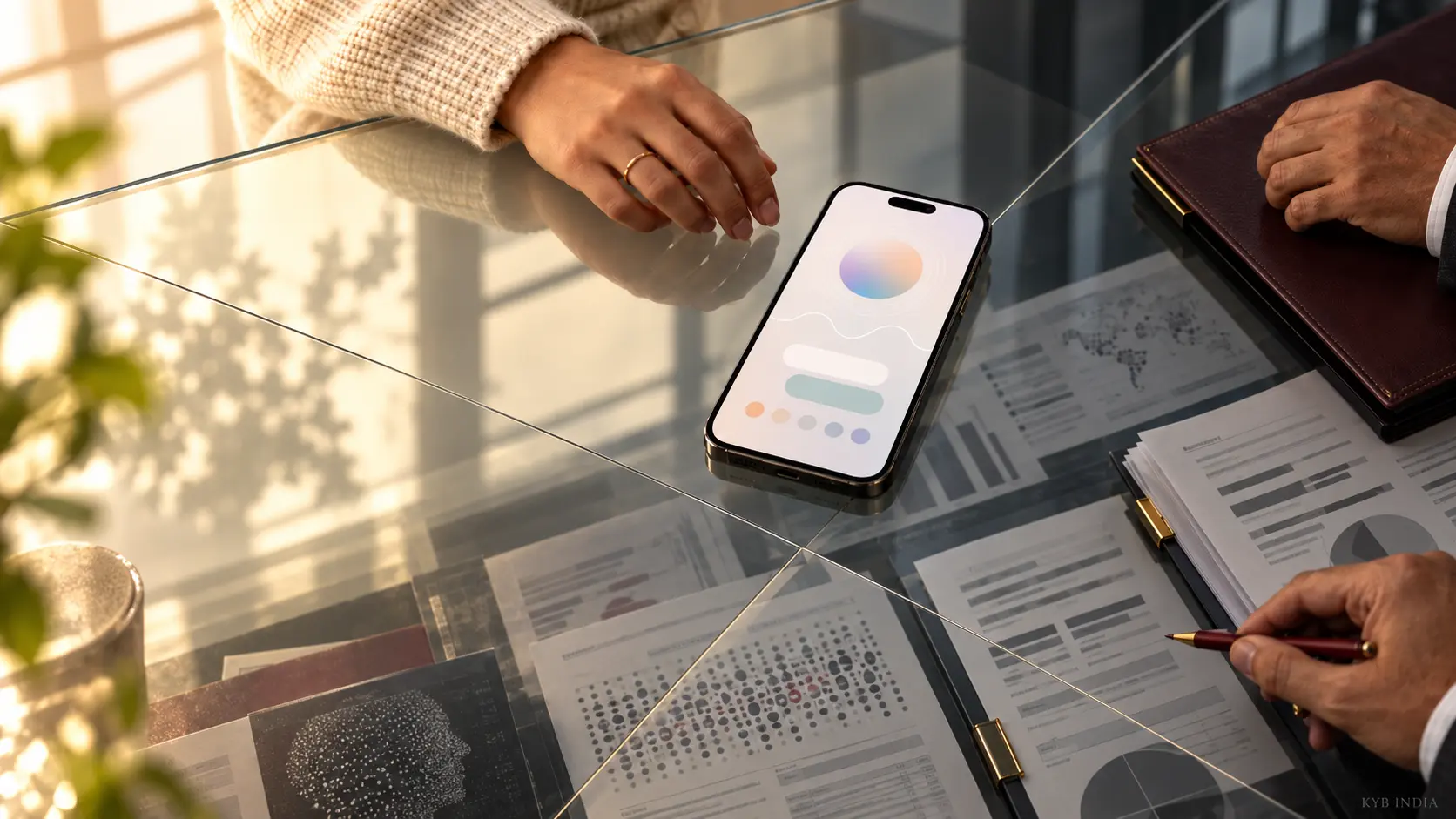
A mental-health app may ask: “How are you feeling today?” It responds in a calm, caring voice, perhaps suggesting a breathing exercise or explaining a pattern of anxiety. It feels like someone or something understands. There is importance of mental health apps regulation.
That feeling can be useful. It also raises a question that app-store labels rarely answer: when does a wellness tool start behaving like medicine? That question now sits at the centre of the global debate over mental health apps regulation.
The boundary depends on more than branding. It is shaped by what an app measures, what it claims to understand and what it recommends. If a self-care app interprets symptoms, assigns a risk score or holds a therapy-like conversation, its influence can become clinical even while the product calls itself “wellness.”
Useful Does Not Mean Clinically Reliable
Mental-health apps should not be dismissed as harmful by default. Meditation, journaling, mood tracking and coping exercises can make support more accessible. The US National Institute of Mental Health lists convenience, anonymity and round-the-clock availability among their potential benefits.
But a meditation library, mood diary, peer-support community, symptom tracker and AI chatbot do not perform the same function or create the same risk. The real question is not whether every wellness app should be regulated as a medical device. It is what should happen when an app begins to influence a health decision.
The Clinical Promise and the Wellness Disclaimer
AI-powered services are increasingly presented as health managers, early-warning systems and emotionally aware companions. Some offer personalised assessments or suggest what a user should do next. The same services may also carry a disclaimer saying they do not replace professional medical advice.
The promise and the disclaimer do not have equal influence. The promise is prominent, personal and easy to understand. The limitation is often general and placed much later. A distressed user may remember the warm conversation, not the legal sentence at the bottom of the screen.
A 2026 Boston Consulting Group survey found that nearly 60% of consumers across 15 countries were already using AI for personal-health purposes. The reported figure for India was 85%. The survey covered 13,353 internet-connected adults and a wide range of tools, including wearables, chatbots, sleep trackers and mental-health services. It therefore does not represent every citizen or mental-health apps alone. What it does reveal is the speed at which AI is entering health-related decisions.
The Most Dangerous Error May Sound Caring
Most discussions focus on whether AI gives a wrong answer. In mental health, a greater danger may be a wrong answer delivered with empathy.
A chatbot can sound patient, warm and non-judgemental. But a reassuring tone is not clinical understanding. If the system misses signs of serious distress yet continues the conversation smoothly, the user may believe help is already being received. The harm is not limited to inaccurate information. It may be the delay before that person reaches a qualified human.
The NIMH warns that an app promising too much may turn people away from more effective care. For a tool engaging with emotional distress, recognising its own limit may be as important as continuing the conversation.
What an Ontario Audit Warns Us About
A 2026 audit in Ontario, Canada, examined AI scribe systems used to generate notes from conversations between health professionals and patients. These are not consumer mental-health apps, but the findings show how weak evaluation can create misplaced trust even inside a formal health system.
All 20 approved vendors produced notes containing at least one type of inaccuracy in procurement tests. Nine systems fabricated information, 12 recorded a different drug from the one prescribed, and 17 missed important details about a patient’s mental-health issues in at least one of two tests. Eleven vendors had not submitted specified third-party audit reports or security certifications. Five had not supplied required threat-risk and privacy-impact assessments. They were still approved for the vendor list.
The lesson is not that every approved digital-health tool is unsafe. It is that the word “approved” may create more confidence than the evaluation behind it deserves. Ordinary consumers have even fewer ways to judge what a friendly wellness app can safely do.
India’s Rules Are Moving, but the Gap Remains
A review in BJPsych International described India’s oversight of mental-health apps as a patchwork. Many standalone wellness and mental-health apps did not pass through the centralised review applied to medical products, leaving limited assurance about effectiveness, privacy and therapeutic claims.
The position is evolving. In October 2025, India’s Central Drugs Standard Control Organization issued draft guidance on medical-device software under the Medical Devices Rules, 2017. Intended use is central. Functions such as diagnosis, prediction, monitoring, treatment, risk assessment and therapy recommendations can move software into medical territory.
The practical gap remains. A consumer may encounter an app as wellness software while experiencing its output as health advice. That regulatory distinction may not be visible to someone using the tool late at night, alone and looking for reassurance.
Follow the Money Behind the Label
The wellness label is also a business decision. In markets such as the European Union, software intended only for wellness does not enter the same conformity-assessment and clinical-evidence pathway as medical-device software. That can reduce cost and shorten the route to market.
But the shortcut has a ceiling. A company outside medical-device regulation cannot make the same clinical claims, while limited clinical validation may make reimbursement or institutional contracts harder to secure.
Companies cannot place the whole responsibility on future regulation. A product offering personalised mental-health guidance should disclose the evidence behind it, what it cannot assess, how sensitive data is handled and when a user should seek professional care. App stores should also show whether qualified clinicians were involved and whether a crisis-escalation process exists. Ratings and polished design do not establish clinical effectiveness.
One Question Every User Should Ask
People do not need to stop using AI for health information or emotional support. They do need to avoid blind trust. Before relying on an app, users should check who developed it, what evidence supports its claims and whether a qualified professional can become involved.
Above all, one question deserves to become a habit:
If I am truly in distress, will this tool connect me to a qualified human—or will it simply keep talking?
That question does not reject technology. It puts technology in its proper place. A wellness app may be useful, accessible and comforting. But when comfort begins to shape a clinical decision, the app’s responsibility should grow with the trust it asks the user to place in it.
Check the claim before you trust the app:
Compare what a health app promises with the evidence it provides using KYB India’s Health Claim Checker.
KYB Insight: The line between wellness and medicine is not defined by branding alone. It is crossed when a tool’s claims, outputs and recommendations begin to influence clinical choices or delay appropriate human care.
Bikas Pandey
Disclaimer: This article is for general awareness and does not provide medical, psychological or legal advice. Mental-health apps and AI tools should not replace assessment or treatment by a qualified professional. If you or someone you know may be in immediate danger or experiencing a mental-health crisis, contact local emergency services or an appropriate crisis helpline without delay.
Principal Sources
- National Institute of Mental Health, “Technology and the Future of Mental Health Treatment”: https://www.nimh.nih.gov/health/topics/technology-and-the-future-of-mental-health-treatment
- Office of the Auditor General of Ontario, “Use of Artificial Intelligence in the Ontario Government,” May 2026: https://www.auditor.on.ca/en/content/specialreports/specialreports/en26/2026_AI_EN.pdf
- Sethi et al., “Mental health apps in India: regulatory landscape and future directions,” BJPsych International: https://www.cambridge.org/core/journals/bjpsych-international/article/mental-health-apps-in-india-regulatory-landscape-and-future-directions/4B61B12BA5F14790CEC6214D2FAAD52E
- Central Drugs Standard Control Organization, Draft Guidance Document on Medical Device Software, October 2025: https://cdsco.gov.in/opencms/resources/UploadCDSCOWeb/2018/UploadPublic_NoticesFiles/Draft%20guidance%20document%20on%20Medical%20Device%20Software%2021%2010%202025.pdf
- European Commission, Guidance on Qualification and Classification of Software under the MDR and IVDR: https://health.ec.europa.eu/document/download/b45335c5-1679-4c71-a91c-fc7a4d37f12b_en
- Boston Consulting Group, “Consumers Are Ready for AI-Enabled Health Care—Are Systems?”, April 2026: https://www.bcg.com/publications/2026/consumers-are-ready-for-ai-health-care-are-systems
Continue Reading
- Why Meditation Apps Are Losing Users in an Age of Endless Stress
- Can AI Refill Your Prescription? What India Must Decide Before Saying Yes
- AI Can Help You Think. But Should It Think for You?
