


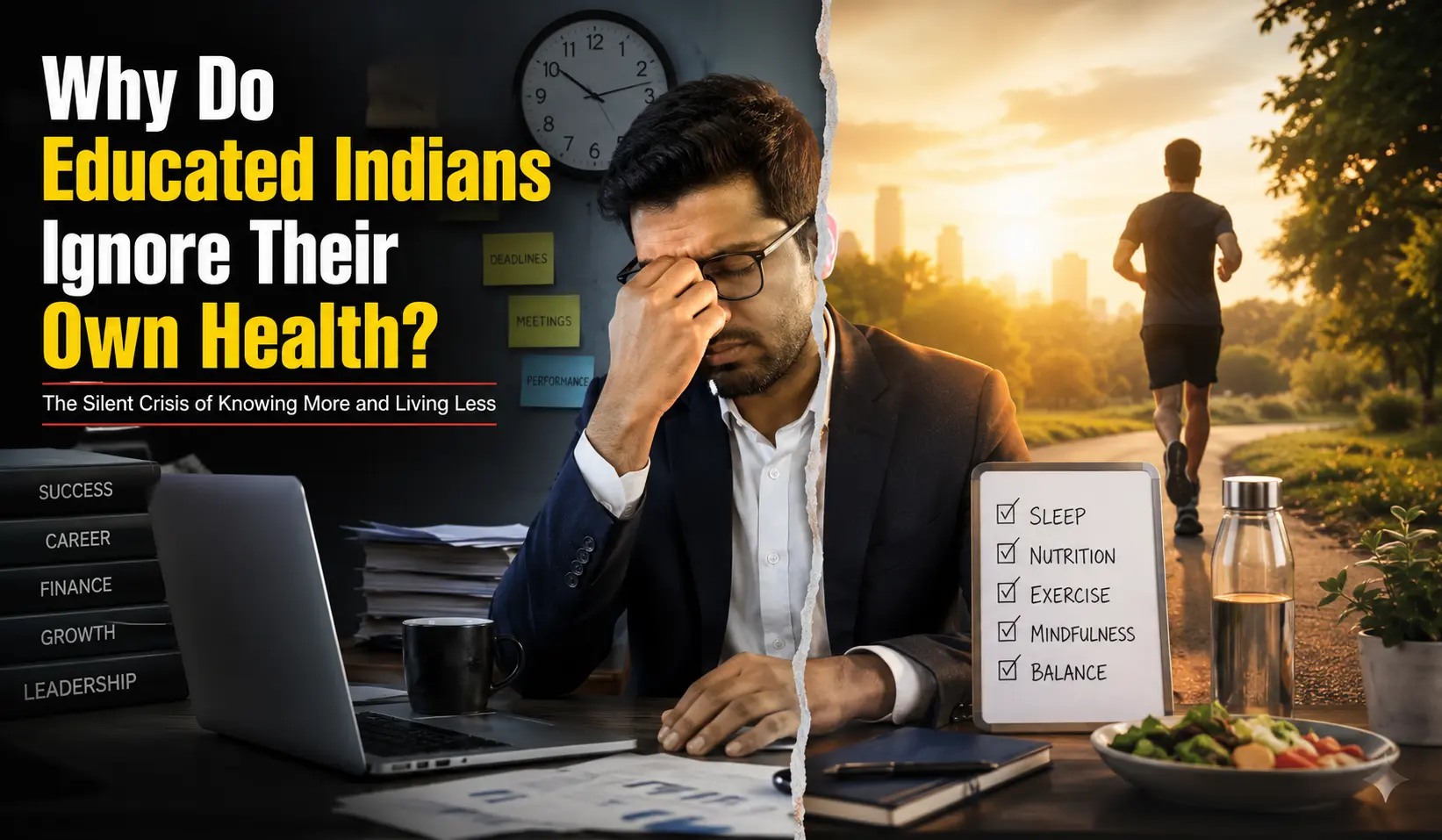
The Silent Crisis of Knowing More and Living Less
India has never been more educated, connected or informed.
We read health blogs. We watch fitness videos. We discuss nutrition, sleep, stress management, and mental well-being. Smartwatches track our steps, apps monitor our calories, and social media constantly reminds us to “take care of ourselves.”
Yet a strange contradiction continues to grow.
Many educated Indians know exactly what healthy living looks like, but struggle to practice it consistently.
We know that sleep matters, yet stay awake scrolling through screens.
We know that stress harms the body, yet wear busyness like a badge of honor.
We know that regular exercise improves health, yet postpone it until “next week.”
The problem is not ignorance.
The problem is something far more complex.
The Education Paradox
For centuries, education was viewed as a pathway to better decisions. The assumption seemed logical: the more people know, the better choices they will make.
But health does not always follow logic.
If knowledge alone created healthy behavior, highly educated professionals would be the healthiest people in society.
Yet reality tells a different story.
Many successful professionals live with chronic stress, poor sleep, sedentary lifestyles, digestive issues, anxiety, hypertension, and burnout.
The modern professional has become highly skilled at managing projects, clients, deadlines, and finances—but surprisingly ineffective at managing personal well-being.
This raises an uncomfortable question:
Why are intelligent people so often irrational when it comes to their own health?
India’s Sleep Crisis: The Country That Never Rests Anymore
When Success Becomes a Health Risk
Modern society rewards output.
The employee who responds to emails at midnight is often admired.
The entrepreneur who works weekends is celebrated.
The executive who survives on coffee and determination is seen as committed.
Over time, self-neglect begins to look like ambition.
The message becomes subtle but powerful:
Work harder.
Sleep later.
Push through fatigue.
Ignore discomfort.
Keep going.
The body, however, operates according to biological laws, not professional expectations.
It does not care about quarterly targets, social status, or career goals.
Eventually, every ignored signal demands attention.
The headache becomes chronic.
The fatigue becomes exhaustion.
The stress becomes illness.
The bill always arrives.
Only the timing remains uncertain.
The Real Problem: We Treat Health as a Backup Plan
Most people claim that health is their top priority.
Their calendar tells a different story.
Meetings are scheduled.
Business targets are reviewed.
Financial plans are updated.
Vacations are planned months in advance.
But health remains something we promise to address later.
After the promotion.
After the project.
After the children grow up.
After life becomes less busy.
The tragedy is that life rarely becomes less busy.
And health rarely improves through postponement.
The Death of Deep Thinking: Why Modern Attention Spans Are Collapsing
KYB INSIGHT
The greatest health challenge of modern professionals is not a lack of information. It is the growing gap between what we know and what we consistently practice.
Knowledge may create awareness, but only action creates well-being.
In a culture that rewards productivity, many people have learned how to succeed professionally while quietly failing themselves physically and mentally.
The KYB Perspective
At KYB, health is not simply the absence of disease.
It is the alignment of Body, Brain, Being, and Business.
Body
The body is not a machine designed for endless output.
It requires sleep, movement, recovery, nutrition, and balance.
Ignoring these needs may increase productivity temporarily, but it decreases sustainability.
Brain
Poor health directly affects decision-making, concentration, creativity, and emotional resilience.
Many professionals believe they have a productivity problem when they actually have a recovery problem.
Being
At a deeper level, health is a relationship with oneself.
When people repeatedly ignore fatigue, stress, pain, and emotional overload, they are not merely neglecting symptoms.
They are disconnecting from themselves.
Business
Organizations often discuss performance, innovation, and growth.
Far fewer discuss biological capacity.
No business can sustainably outperform the health of the people running it.
Human energy remains the foundation of every successful enterprise.
PAUSE & REFLECT
Before moving forward, take a moment to ask yourself:
• If health is important, why is it so often postponed?
• Why do we protect our careers more carefully than our bodies?
• Have we confused busyness with significance?
• What would success look like if health were included in its definition?
• If your current habits continue for the next five years, where will your health be?
A Different Definition of Intelligence
Perhaps intelligence is not measured by how much information we accumulate.
Perhaps it is measured by how wisely we apply what we already know.
The educated Indian of the future will not simply be someone who understands health.
It will be someone who lives according to that understanding.
Because the greatest asset you will ever manage is not your portfolio, your company, or your professional reputation.
It is the body and mind through which you experience your entire life.
And unlike most assets, it cannot be replaced.
The question is not whether you know enough about health.
The question is whether you are willing to act on what you already know.
KEY TAKEAWAYS
✓ Knowledge alone does not create healthy behavior.
✓ Modern success often rewards habits that undermine long-term well-being.
✓ Health should be treated as a daily investment, not a future project.
✓ Sustainable performance depends on recovery, sleep, movement, and balance.
✓ True intelligence is reflected not by what we know, but by how consistently we apply what we know.
The Urban Loneliness Epidemic in Modern India
FINAL THOUGHT
Modern India does not suffer from a lack of health information.
The real challenge lies in transforming knowledge into daily practice.
Success, achievement, and financial security are valuable goals, but they lose much of their meaning when pursued at the cost of physical and mental well-being.
Perhaps the future belongs not to those who know the most about health, but to those who consistently live according to what they already know.
Because in the end, the quality of our lives depends less on information and more on the choices we make every day.
ABOUT KYB INDIA
KYB India is an independent digital publication dedicated to exploring health, ethics, human development, emerging technologies, leadership, and conscious living.
Through thoughtful analysis and practical insights, KYB India seeks to encourage deeper reflection, informed decision-making, and meaningful conversations in an increasingly complex world.
Disclaimer
The views expressed in this article are intended for educational and informational purposes only. This content does not constitute medical, psychological, or professional healthcare advice. Readers are encouraged to consult qualified healthcare professionals regarding any specific health concerns, diagnoses, or treatment decisions. The perspectives presented reflect a broader discussion on health awareness, lifestyle choices, and personal well-being.
KYB India is a Better Life Platform helping people understand the connections between Body, Brain, Being and Business. Through practical insights, ethical storytelling and the questions others often overlook, we make health, human behaviour and modern life easier to understand and better choices easier to make.