


Why millions of urban Indians are losing their sleep to digital hustle and toxic productivity.
Fueled by toxic hustle culture, rising anxiety and endless screen time, millions of urban Indians are trapped in a cycle of sleep deprivation. This alarming Sleep Crisis is quietly breaking our physical health and emotional stability, proving that a nation that never rests can never truly thrive.
Late-night hustle culture, endless scrolling, and silent anxiety are slowly turning sleep deprivation into one of modern India’s most ignored health emergencies.
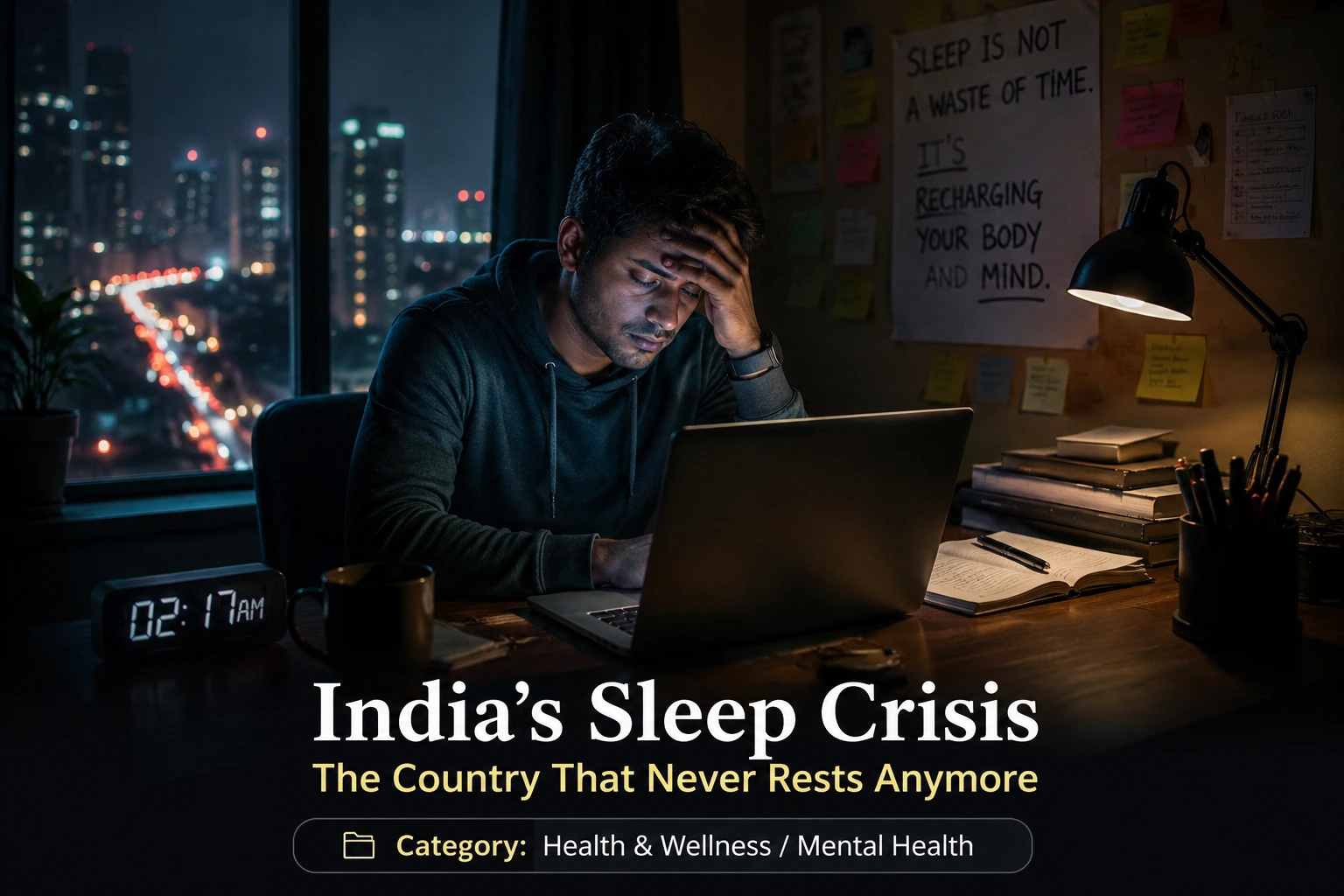
At 2:23 AM, the lights are still on.
A young employee stares at a glowing laptop screen inside a small apartment. Notifications continue to appear. Another email arrives. Another reel starts playing. Outside, the city is quieter now — but the mind is not.
Across urban India, millions of people are awake long after their bodies have asked for rest.
Some are working. Some are worrying. Some are simply unable to disconnect.
India’s sleep crisis is no longer just about poor routine. It is becoming a reflection of the kind of lifestyle modern society has slowly normalized.
The Rise of a Sleepless Generation
Sleep once used to feel natural.
Today, for many young Indians, proper rest feels almost unproductive. Hustle culture has quietly created an unhealthy belief that staying busy all the time is a sign of ambition.
Late-night work, endless screen exposure, and constant digital stimulation are now deeply woven into urban life.
Many people sleep with:
- phones beside their pillows,
- laptops still open,
- and anxious thoughts that continue even after midnight.
The body may be lying still, but the brain remains active.
This silent exhaustion is becoming increasingly visible in everyday life:
- irritability,
- low attention span,
- emotional burnout,
- chronic fatigue,
- and rising anxiety levels.
Yet most people continue calling it “normal.”
Over time, poor sleep quietly affects more than energy levels.
Mental health experts are increasingly observing how chronic sleep deprivation affects emotional balance, concentration, patience, and even long-term physical health. Many people continue functioning normally on the outside while internally feeling mentally exhausted almost every day.
The dangerous part is that constant tiredness has become socially acceptable. Being exhausted is often treated like proof of hard work instead of a warning sign from the body itself.
Hustle Culture Is Quietly Damaging Mental Health
Modern work culture rewards availability.
People feel pressured to respond instantly, stay online constantly, and remain productive even during personal time. The line between work and rest is slowly disappearing.
For many professionals, especially in metro cities, exhaustion has slowly become part of identity.
The problem is not only lack of sleep. The deeper issue is emotional recovery.
Human beings are not designed for nonstop stimulation.
But modern digital life rarely allows the nervous system to slow down. Even moments of rest are filled with scrolling, comparison, notifications, and mental noise.
This is one reason why many people wake up tired despite spending enough hours in bed.
India’s sleep crisis is also being intensified by night-time screen addiction. Bright screens, continuous information consumption, and digital overstimulation are slowly disturbing the body’s natural rhythm of rest.
The modern mind struggles to experience silence.
Screens Are Changing the Way We Rest
Night-time screen exposure is also affecting sleep quality in ways many people do not fully realize.
Short-form content platforms are designed to keep attention active. One reel becomes ten. Ten become fifty. The brain remains alert even when the body desperately needs rest.
Instead of slowing down before sleep, modern digital life keeps the nervous system overstimulated.
The result is a strange contradiction:
people are physically tired but mentally unable to disconnect.
Many young professionals now wake up feeling exhausted even after spending seven or eight hours in bed. Sleep duration exists, but deep recovery does not.
India’s Sleep Crisis Is Also a Psychological Crisis
Career pressure, financial insecurity, loneliness, social comparison, and digital overload are quietly affecting emotional stability across urban India. Sleep deprivation often becomes the visible symptom of a deeper psychological imbalance.
Many young Indians are carrying stress that never fully leaves the body.
And when rest disappears, emotional resilience also begins to weaken.
Small frustrations feel bigger. Patience becomes shorter. Relationships become emotionally distant. Even happiness starts feeling temporary.
The dangerous part is that society has normalized this condition so deeply that exhaustion now feels ordinary.
Many people no longer ask:
“Why am I constantly tired?”
Instead, they simply continue functioning through emotional fatigue because modern life leaves little space to pause.
What Happens When a Society Stops Resting?
India’s sleep crisis is forcing an uncomfortable question:
Are we building a society that looks productive from the outside while slowly becoming emotionally exhausted within?
Modern life has made people faster, more connected, and more ambitious. But somewhere in this race, rest has started disappearing from everyday existence.
Sleep is not laziness.
It is one of the most basic forms of human repair.
And perhaps the real crisis is not that people are staying awake longer.
Perhaps the real crisis is that modern life no longer allows people to feel mentally calm enough to truly rest.
KYB India Team
#India`sSleepCrisis #BurnoutGeneration #MentalHealthIndia #DigitalExhaustion #KYBIndia

KYB India is a Better Life Platform helping people understand the connections between Body, Brain, Being and Business. Through practical insights, ethical storytelling and the questions others often overlook, we make health, human behaviour and modern life easier to understand and better choices easier to make.
That help me a lot thank you sir