


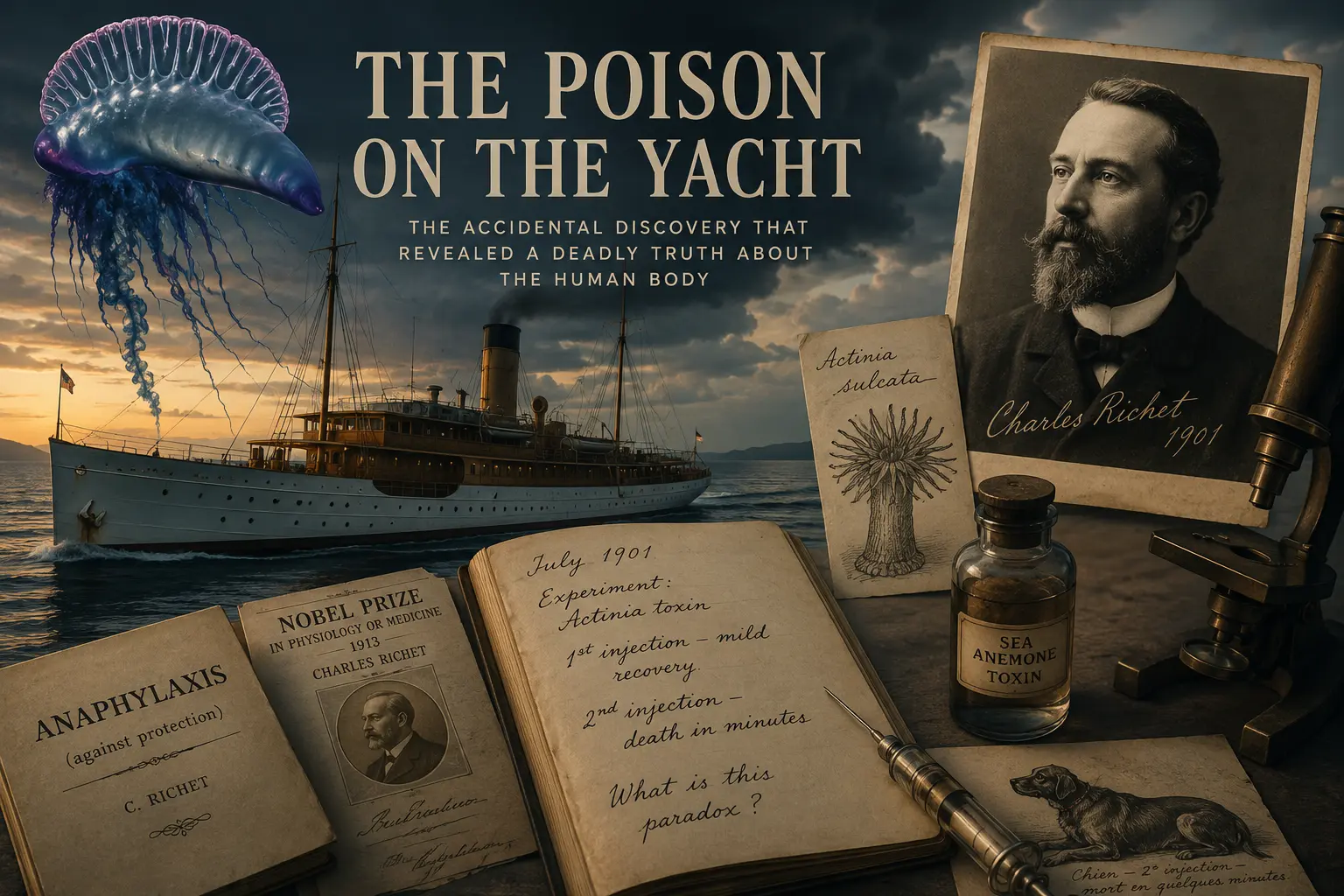
How a luxury sea voyage accidentally uncovered one of the deadliest secrets hidden inside the human body and perhaps inside civilization itself
KYB India Team
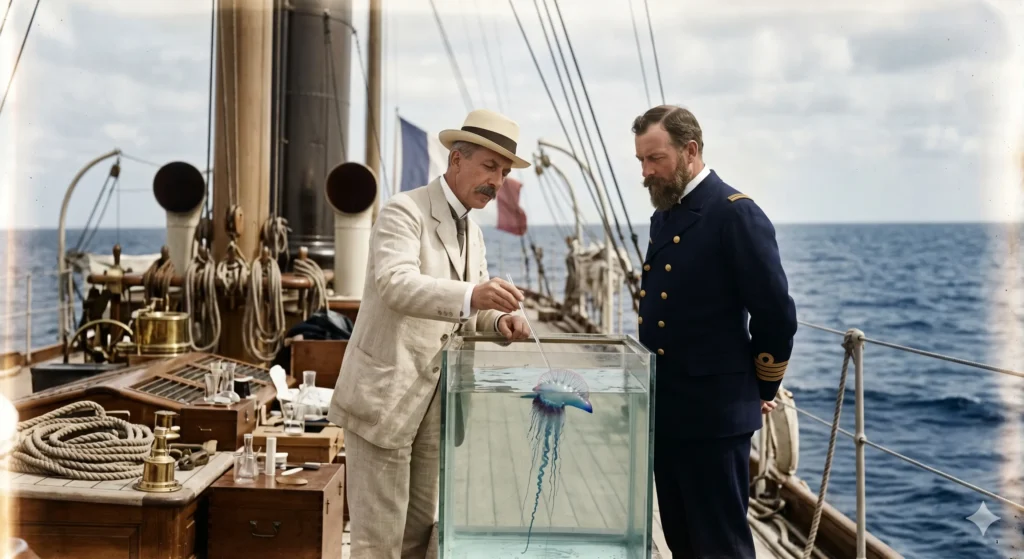
In the summer of 1901, a luxury steam yacht named Princesse Alice II sliced through the dark blue waters of the Atlantic.
On board was an unusual trio.
Prince Albert I of Monaco — an aristocrat obsessed with oceanography.
And beside him, two ambitious French scientists: Charles Richet and Paul Portier.
They were not sailing for pleasure.
Their mission was to study the Portuguese man-of-war, a mesmerizing marine predator whose floating tentacles carried one of nature’s most agonizing venoms. Sailors feared it. Scientists barely understood it.
But Richet and Portier believed the poison might contain a hidden medical breakthrough.
The world was entering the golden age of immunology. Louis Pasteur had already transformed medicine by proving that weakened exposure to disease could train the body to defend itself later. Vaccination had begun to look like a scientific miracle.
Richet thought the same principle could work against venom.
A tiny controlled dose today, protection tomorrow.
It sounded elegant. Rational. Revolutionary.
Instead, the experiment would expose one of the most terrifying flaws hidden inside human biology.
And it would change medicine forever.
The Experiment That Should Have Worked
When the expedition returned to France, obtaining enough Portuguese man-of-war toxin became difficult. To continue their research, the scientists switched to a closely related substitute: the venom of a common sea anemone, Actinia sulcata.
The procedure appeared straightforward.
Richet injected healthy laboratory dogs with a very small, non-lethal dose of the toxin. The animals became mildly sick but soon recovered completely.
Everything seemed to confirm the existing scientific model.
The immune system had encountered the enemy.
The body had learned.
Protection should now follow.
Weeks later, Richet administered a second dose.
This time the amount was even smaller.
What happened next stunned the laboratory.
Within moments, the dogs collapsed.
Violent vomiting.
Severe respiratory distress.
A catastrophic drop in blood pressure.
Asphyxiation.
Death.
Can the Human Brain Rewrite Its Own Future?
https://thekybindia.com/human-brain-digital-age/
A dose so tiny it should have been harmless killed healthy animals in less than thirty minutes.
The poison had not become stronger.
The body’s reaction had.
The Discovery That Flipped Medicine Inside Out
Charles Richet realized he was staring at a biological paradox no one had properly understood before.
The first exposure had not protected the animals.
It had sensitized them.
The immune system itself had become the danger.
Years later, in his Nobel lecture, Richet admitted with unusual honesty that the discovery was not the product of grand intellectual design:
“It is by no means the result of profound thought but a simple observation…”
Most scientists might have dismissed the event as an experimental error.
Richet did something rarer.
He paid attention.
To describe this horrifying reverse-immunity, he created a new word by turning the Greek idea of “protection” upside down:
Anaphylaxis — literally meaning against protection.
The implications were revolutionary.
Before Richet’s work, medicine largely imagined the immune system as a flawless internal army whose sole purpose was defense.
Richet proved something far more unsettling:
The same biological system designed to save human life could also destroy it with terrifying speed.
For this discovery, he received the 1913 Nobel Prize in Physiology or Medicine.
But the true impact of his work would only become clear decades later.
The Day Medicine Learned Fear
Anaphylaxis permanently changed how scientists understood immunity.
The body was no longer viewed as a perfectly rational machine.
It could panic.
It could overreact.
It could mistake harmless substances for existential threats and unleash catastrophic internal chaos.
Later research revealed the mechanism behind the disaster Richet had witnessed.
During the first exposure, the immune system quietly prepares itself by producing specialized antibodies against a foreign substance.
The person often feels completely normal.
But beneath the surface, the body enters a dangerous state of hypersensitivity.
When the same substance appears again, those antibodies trigger an explosive release of inflammatory chemicals throughout the bloodstream.
Blood vessels suddenly dilate.
Blood pressure crashes.
Airways tighten.
Oxygen collapses.
The body effectively turns its defensive weapons against itself.
In 1906, Austrian pediatrician Clemens von Pirquet expanded these ideas and introduced another word now woven into modern life:
Allergy.
From a French Yacht to the Modern Emergency Room
Today, Richet’s discovery lives everywhere.
In hospitals.
In school cafeterias.
In airplane emergency kits.
In the pockets of millions carrying epinephrine auto-injectors.
A peanut.
A bee sting.
A shellfish meal.
A dose of penicillin.
Any of them can trigger the same chain reaction first witnessed in Richet’s laboratory more than a century ago.
Modern medicine now fights anaphylaxis using epinephrine, a drug that rapidly forces constricted lungs to reopen and pushes collapsing blood pressure back toward survival.
Yet despite all medical advances, anaphylaxis still retains something deeply unsettling.
Because it reminds humanity of a fragile truth:
A human being can survive major external dangers—yet still be destroyed by an internal overreaction.
The Civilization of Overreaction
More than a century later, Richet’s discovery no longer feels confined to biology.
Modern civilization itself increasingly behaves like an anaphylactic organism.
A small disagreement becomes collective outrage.
A rumor becomes mass panic.
A digital comment becomes social warfare.
A difference of opinion becomes tribal hostility.
The reaction grows larger than the original trigger.
Entire societies now seem trapped in states of permanent hypersensitivity — politically, emotionally, psychologically, digitally.
Richet accidentally uncovered something larger than immunology.
He revealed a universal principle of collapse:
Systems designed for protection can become engines of destruction when they lose their sense of proportion.
The immune system is not evil.
It is simply reacting too violently.
Civilizations may sometimes do the same.
The Terrifying Humility of Charles Richet’s Discovery
There is something profoundly humbling about anaphylaxis.
Humanity survived plagues, wars, and predators across thousands of years.
And yet a microscopic trace of protein…
a spoonful of food…
or the sting of an insect…
can still bring the body to the edge of death within minutes.
Richet’s work forced medicine to confront an uncomfortable reality:
Power alone does not guarantee wisdom.
The immune system is extraordinarily powerful.
But it is not inherently wise.
It protects.
It misfires.
It saves lives.
It can also end them.
That is why Charles Richet remains one of the most quietly important figures in modern medical history.
On a yacht crossing the Atlantic, while searching for protection against poison, he discovered one of the oldest and most dangerous truths about life itself:
Sometimes destruction does not come from the poison.
It comes from the inability to stop reacting to it.
Final Reflection: The Biology of Misplaced Defense
Charles Richet’s anaphylaxis discovery continues to offer profound insights into the human body’s complex defense systems. Understanding how anaphylaxis works reveals that severe allergic reactions are rooted in a specific biological miscalculation. A look back at severe allergic reactions history underscores how groundbreaking Richet’s observations were in refuting the monolithic idea of a perfectly protective immune system.
KYB India Team
#CharlesRichet
#Anaphylaxis
- #MedicalHistory
- #Immunology
- #AllergyScience
- #BrainAndBeing
- #HumanCondition
- #ScienceAndSociety
- #Psychology
- Civilization
- #Healthcare
- #NobelPrize
- #PhilosophyOfScience
- #KYBIndia
Disclaimer: The information in this article is for educational and historical storytelling purposes only. It should not be taken as professional medical advice, diagnosis, or treatment. Always consult a qualified healthcare provider for any questions regarding medical conditions or allergies.
Continue Reading
Why Healthy Employees Build Strong Companies | Workplace Wellness I KYB India
Mental Rest: When Was The Last Time You Truly Rested? I KYB India
The Cockroach Generation: Why Millions Are Identifying With A Cockroach

KYB India is a Better Life Platform helping people understand the connections between Body, Brain, Being and Business. Through practical insights, ethical storytelling and the questions others often overlook, we make health, human behaviour and modern life easier to understand and better choices easier to make.