


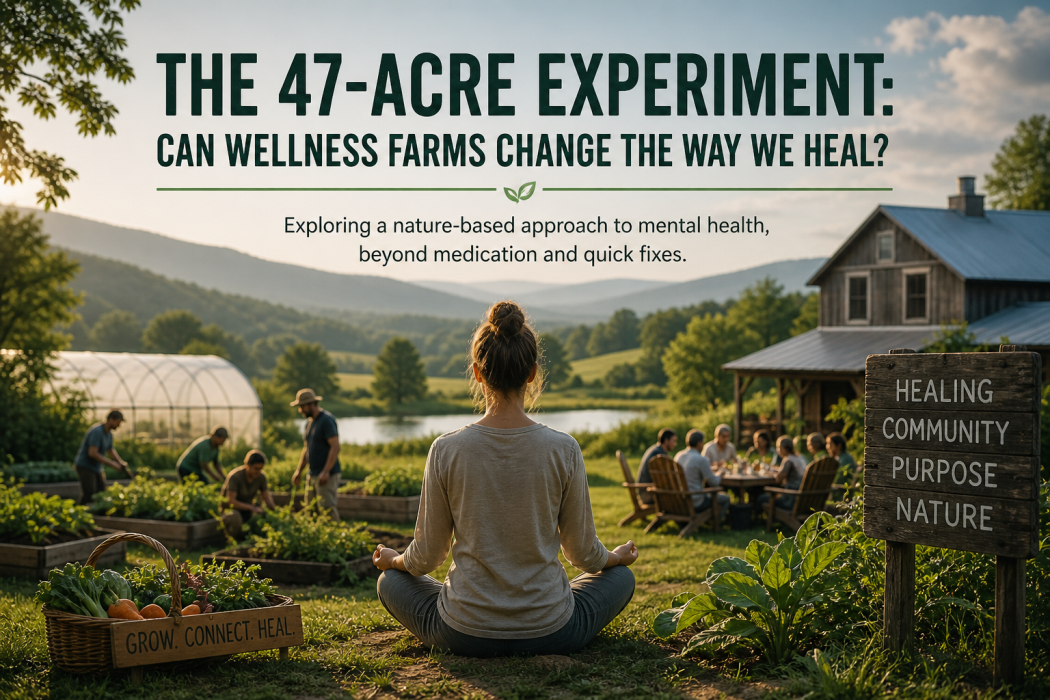
A nature-based approach to mental health is raising a deeper question, are we treating symptoms, or truly healing people? The answer is Wellness Farms
We’ve all been there: a brief doctor’s appointment, a quick checklist of symptoms, and a prescription in hand. For years, mental health has often been explained as a simple equation—a “chemical imbalance” that can be corrected with the right medication.
But what if healing is more complex than that?
What if the answer to rising anxiety, burnout, and depression does not lie in one solution alone, but in how we live, work, and connect with the world around us?
On a quiet, 47-acre stretch of land in Vermont, a different approach is taking shape. Here, far from clinical routines, a “wellness farm” is exploring whether reconnecting with nature, rhythm, and community can offer a new path to mental health.
Survival of the Calmest: Why Resilient Wellness Is the Only Way Forward https://thekybindia.com/resilient-wellness-india/
A System Under Pressure
Modern mental healthcare has helped millions—but it also faces growing criticism. In many parts of the world, consultations are brief, often leaving little time to understand the deeper causes of distress.
Medication becomes the first line of response. For some, it works well. For others, it leads to a cycle of dependency, side effects, and unresolved emotional struggles.
Recent scientific discussions have further challenged the idea that depression is simply caused by a chemical imbalance. While medicines remain important, experts increasingly agree that mental health is shaped by a combination of biological, psychological, and social factors.
The Rise of Wellness Farms
This is where wellness farms offer a different perspective.
In Vermont, individuals struggling with mental health challenges live on a 47-acre farm, not as patients—but as participants in a shared life. They commit to a structured routine that blends physical work, therapy, and community living.
There are no rushed appointments here. Healing is not treated as an emergency—it is treated as a process.
Healing Through Rhythm, Not Rush
Life on the farm follows a steady rhythm:
- Morning: Physical work—gardening, cooking, caring for the land
- Afternoon: Therapy, creative expression, self-reflection
- Evening: Community meals, music, and shared conversations
This structure may seem simple, but it is deeply intentional.
Supporters believe that when daily life becomes predictable and meaningful, the mind begins to stabilise naturally. Sleep improves. Anxiety reduces. A sense of control slowly returns.
More Than Symptom Relief
What makes this model unique is its focus on reconnection:
- Reconnection with the body through physical activity
- Reconnection with nature through environment
- Reconnection with people through community
- Reconnection with purpose through meaningful work
Participants often describe a shift—not just in symptoms, but in identity. They begin to see themselves not as patients, but as contributors.
A Global Conversation Begins
The idea of nature-based healing is gaining attention worldwide. From eco-therapy in North America to therapeutic farming in Europe, similar models are emerging.
At the same time, mental health concerns—especially among young people—are rising globally. Stress, isolation, and digital overload are becoming everyday realities.
This has led experts to ask an important question:
👉 Can healing environments be as important as medical interventions?
What We Can Apply in Daily Life
Not everyone can move to a wellness farm. But its core principles are surprisingly accessible:
- Create rhythm: Sleep and wake at consistent times
- Eat real food: Reduce processed intake
- Move daily: Physical activity, ideally outdoors
- Limit digital noise: Make space for silence
- Build community: Share time and conversations
- Do meaningful work: Engage in something purposeful
These are not quick fixes—but they are powerful foundations.
Rethinking the Future of Healing
Wellness farms are not a replacement for modern medicine. Nor are they a universal solution.
But they offer something the current system often lacks—a human-centered approach.
India’s $160 Billion Wellness Economy: Why Health is the New Gold Mine https://thekybindia.com/india-wellness-economy-gold-mine/
They remind us that healing is not just about removing symptoms. It is about rebuilding connection—with ourselves, with others, and with the world around us.
In a world searching for faster solutions, the answer may not lie in doing more—
but in returning to what we quietly left behind.
KYB India is a Better Life Platform helping people understand the connections between Body, Brain, Being and Business. Through practical insights, ethical storytelling and the questions others often overlook, we make health, human behaviour and modern life easier to understand and better choices easier to make.