


India’s healthcare system has never been more advanced, yet millions of families fear medical bills more than illness itself. Exploring the gap between healthcare, affordability, and the creation of real health.
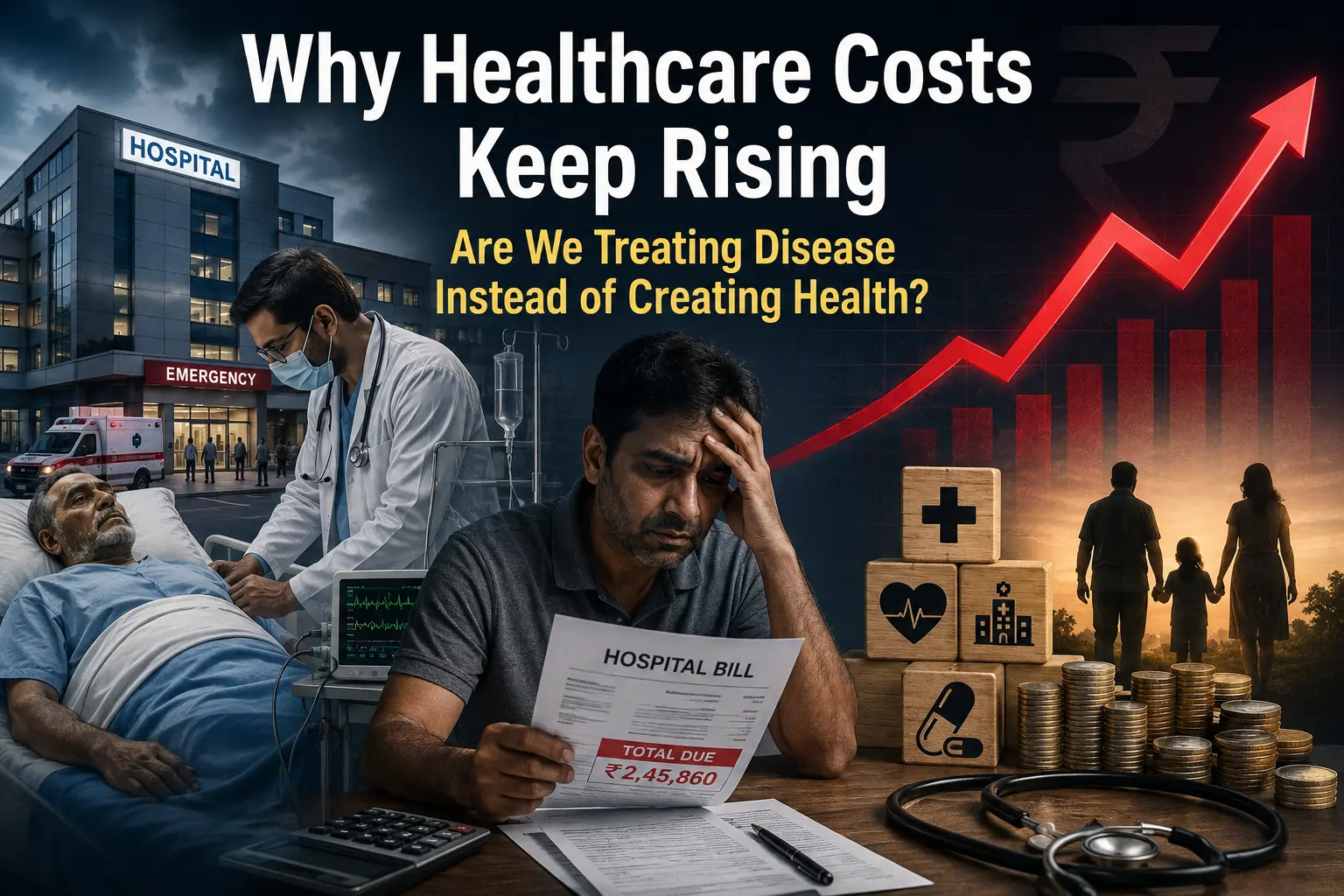
A few months ago, Rakesh Sharma, a middle-class professional, faced a situation that millions of Indian families can relate to.
His father suffered a cardiac emergency and was rushed to a reputed private hospital. The treatment was successful. The doctors did an excellent job. The family felt relieved that a life had been saved.
Then came the hospital bill.
Insurance covered part of the expense. Some money came from savings. The rest had to be arranged through loans and help from relatives.
The medical crisis lasted a few days.
The financial stress lasted several months.
Rakesh’s story is not unique. Across India, families often discover that recovering from an illness is easier than recovering from the cost of treating it.
This raises an important question.
If healthcare is improving every year, why does it feel increasingly unaffordable?
The Great Healthcare Paradox
There is no doubt that India’s healthcare system has made remarkable progress.
Today, patients have access to advanced diagnostic technologies, specialized treatments, minimally invasive surgeries, modern intensive care units, and highly trained medical professionals. Procedures that were once available only in a few metropolitan cities are now accessible in many parts of the country.
Corporate hospitals have played a major role in this transformation. They have invested heavily in infrastructure, technology, and medical expertise. Millions of lives have been saved because these institutions exist.
Yet despite these achievements, healthcare remains one of the biggest financial fears for Indian families.
The paradox is simple.
Healthcare is getting better.
But affordability is not improving at the same pace.
The Real Cost of Modern Healthcare
Many people believe that hospital bills are simply the cost of medicines and treatment.
In reality, patients are paying for much more.
A modern hospital operates like a complex ecosystem. It requires advanced equipment, specialized staff, round-the-clock services, digital systems, emergency preparedness, maintenance, regulatory compliance, and continuous technological upgrades.
None of these things are free.
The challenge is that patients often see only the final bill, not the hundreds of expenses that contribute to it.
As healthcare becomes more sophisticated, the cost of delivering that care naturally increases.
However, this is only part of the story.
The bigger question is whether healthcare systems are structured in a way that promotes health—or primarily responds to illness.
The KYB Healthy Dozen: 12 Habits That Separate the Healthy from the Unhealthy
When Healthcare Becomes an Industry
Healthcare is different from most businesses.
People do not choose to become patients.
Nobody plans for a heart attack. Nobody schedules a medical emergency. People enter hospitals during moments of fear, uncertainty, and vulnerability.
At the same time, hospitals must remain financially sustainable. They need revenue to pay staff, maintain facilities, invest in technology, and expand services.
There is nothing wrong with financial sustainability.
The problem begins when healthcare is viewed only through the lens of growth, utilization, and revenue.
When financial performance becomes the dominant measure of success, important questions arise.
Are we rewarding treatment more than prevention?
Are we investing enough in keeping people healthy before they become patients?
These questions deserve serious attention.
The Prevention Gap
Perhaps the biggest weakness in modern healthcare is that prevention receives far less attention than treatment.
Consider diabetes.
Preventing diabetes through healthier eating, regular exercise, stress management, and lifestyle awareness is far less expensive than treating diabetes and its complications for twenty years.
The same principle applies to heart disease, obesity, hypertension, and many other chronic conditions.
Yet most people do not think seriously about their health until a problem appears.
By then, the costs—both physical and financial—are often much higher.
This is where society makes a critical mistake.
We spend enormous resources discussing treatment.
We spend far less time discussing health creation.
Healthcare and Health Are Not the Same Thing
One of the biggest misconceptions of our time is that healthcare and health mean the same thing.
They do not.
Healthcare treats disease.
Health is created long before disease appears.
Hospitals can perform surgeries. Doctors can prescribe medicines. Medical technology can save lives.
But none of these things can replace healthy daily habits.
Health is created in our kitchens through food choices.
It is created through regular movement and exercise.
It is created through quality sleep, emotional balance, stress management, and meaningful relationships.
In many ways, the most important healthcare decisions are not made inside hospitals.
They are made at home every single day.
Unfortunately, modern lifestyles are moving many people in the opposite direction.
Long working hours, poor nutrition, physical inactivity, chronic stress, and digital overload are becoming increasingly common.
As these behaviours increase, so does the demand for healthcare services.
And when more people become unhealthy, healthcare costs inevitably rise.
Hospitals Are Not the Enemy
Whenever discussions about healthcare costs arise, hospitals are often portrayed as villains.
This is neither fair nor accurate.
Doctors, nurses, technicians, and healthcare workers perform extraordinary work every day. Many hospitals provide life-saving care under extremely challenging circumstances.
The issue is not that hospitals are inherently wrong.
The issue is that healthcare systems operate within economic realities.
Technology is expensive.
Talent is expensive.
Infrastructure is expensive.
The challenge is finding a balance between financial sustainability and patient affordability.
This is not a problem that hospitals alone can solve.
Governments, insurers, employers, communities, and individuals all have a role to play.
Why Your Wellness Routine May Be Making You Less Healthy
What Needs to Change?
Improving healthcare affordability requires a broader vision.
Hospitals can improve transparency so patients better understand treatment costs.
Governments can strengthen preventive healthcare and primary care services.
Insurance providers can encourage healthier lifestyles rather than focusing only on treatment coverage.
Employers can invest more seriously in employee wellbeing.
Most importantly, individuals must take greater responsibility for their daily health habits.
There is no shortcut.
The healthiest society is not the one with the most hospitals.
It is the one with the fewest preventable illnesses.
KYB Thoughts
India’s healthcare sector deserves credit for the extraordinary progress it has made over the past three decades. Better hospitals, better technology, and better medical expertise have improved countless lives.
At the same time, rising healthcare costs should concern all of us.
The debate should not be about blaming hospitals or criticizing medical professionals.
The real challenge is much bigger.
Are we building a society that invests in health, or one that waits to pay for illness?
A successful healthcare system should not be judged only by the number of hospitals it builds or the treatments it delivers.
It should also be judged by how effectively it helps people stay healthy in the first place.
Because the future of healthcare does not lie only in better treatment.
It lies in creating fewer patients.
And perhaps that is the most important lesson of all.
Disclaimer: This article is intended for educational and public discussion purposes only. It does not constitute medical, legal, financial, or policy advice. The views expressed aim to encourage informed dialogue on healthcare affordability, prevention, ethics, and patient-centered care.
About KYB India: At KYB India, we believe that a better life is shaped by four interconnected dimensions—Body, Brain, Being, and Business. Health is not merely the absence of disease; it is the foundation that influences how we think, live, work, and contribute to society.
Recommended Reading
✔ Is Success Making Indians Sick?
✔ Health Isn’t Expensive…
✔ The Future of Preventive Healthcare

KYB India is a Better Life Platform helping people understand the connections between Body, Brain, Being and Business. Through practical insights, ethical storytelling and the questions others often overlook, we make health, human behaviour and modern life easier to understand and better choices easier to make.