


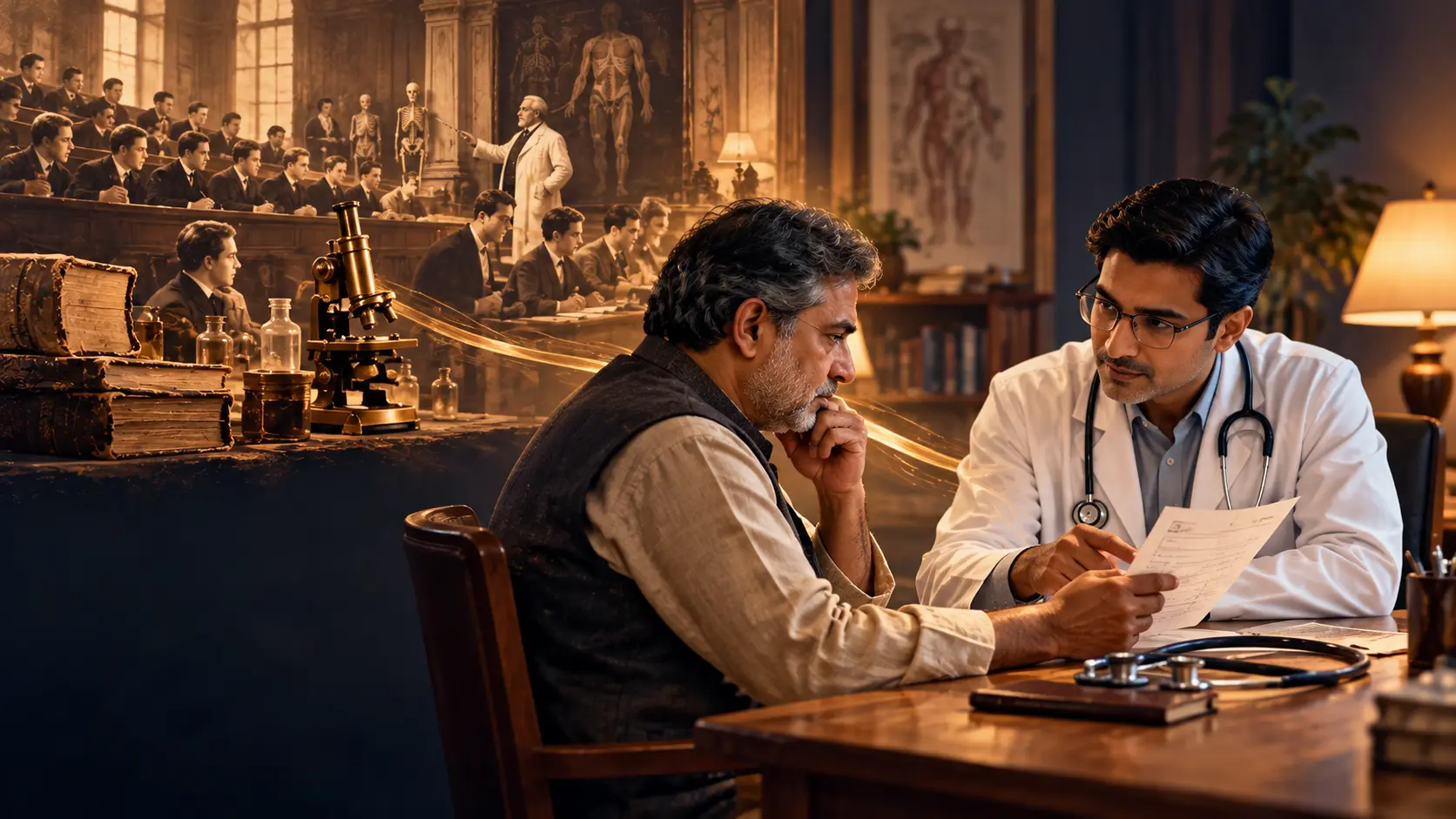
You trust your doctor. Mostly, you should.
But have you ever asked who decided what that doctor was taught
and who funded that decision?
History of modern medicine is older
and more tangled than any family-group forward will tell you.
Let us begin with what is not in dispute. Modern medicine has saved millions of lives: vaccines, safer surgery, emergency care that did not exist for our grandparents. This is not an article against it.
The question is smaller, and sharper. When money helps build a system, whose way of healing gets built into it?
A Businessman in the History of Modern Medicine
In the early 1900s, medical training in America was uneven. Some schools were little more than shops selling degrees. In 1910, educator Abraham Flexner, commissioned by the Carnegie Foundation, published a report that asked for real laboratories, university-based teaching and scientific standards. Weak schools closed. Medicine became more rigorous.
MORE READ : – Wellness or Medicine? The Blurred Line Behind Mental Health Apps
Philanthropy then followed those standards. John D. Rockefeller was an oil magnate, not a doctor, yet foundations linked to him poured substantial funds into universities, medical schools and research. Historian Paul Starr’s account of American medicine shows how the profession gained its authority in these very years.
There was a price. Homeopathic and other schools that did not fit the new model struggled to survive.
Be careful here, though. The record does not prove that Rockefeller set out to sell patented drugs or bury natural therapies. Money can steer a system without any grand plot, much as a canal carries water wherever it was dug.
When ordinary life gets a diagnosis
Sociologist Peter Conrad calls this process medicalization: everyday experiences slowly come to be treated as medical conditions. Think of ageing, poor sleep, sadness, tiredness.
Sometimes that is right. Constant tiredness can be anaemia or a thyroid problem, and it deserves a doctor. Sometimes it is overreach. Three things are worth watching:
- Wider definitions of illness, which can bring more people under a diagnosis. Occasionally this is better science; occasionally it is overdiagnosis.
- Medicines prescribed out of habit, when the patient’s actual need should decide.
- Commercial incentives, when marketing, pricing or selective evidence quietly shapes a decision.
None of this means every diagnosis is unnecessary. It means decisions deserve scrutiny.
Your side of the table
Hospitals, laboratories, insurers and drug makers are businesses. That is not a sin; research costs money. The trouble starts only when the balance sheet outweighs the patient.
Most of us know both extremes. One family says, “Doctor sahab ne kaha hai, bas.” Another says, “Dawai se kuch nahi hota.” Both stop asking questions. So ask them:
- What could be causing this?
- Are my sleep, food, stress or activity playing a part?
- What are the benefits, risks and alternatives of this treatment?
- Is there reliable evidence behind it?
Good habits support recovery, but they cannot replace necessary treatment. The same goes for traditional remedies: judge them by evidence, safety and possible interactions, especially if you already take regular medicines.
You do not have to distrust modern medicine to ask who benefits. Your health is not a market opportunity. It is your life, and it deserves informed choices, honest answers and respect. The history of modern medicine reflects humanity’s ongoing efforts to understand disease, improve treatments and make healthcare more effective.
Editorial note: This article examines historical and commercial influences on healthcare. It does not suggest that modern medicine is harmful, or that traditional treatments are automatically safe or effective.
References
- Flexner, A. (1910). Medical Education in the United States and Canada. Carnegie Foundation. Link: http://www.archive.org/details/medicaleducation00flexiala
- Duffy, T. P. (2011). The Flexner Report: 100 years later. Yale Journal of Biology and Medicine, 84(3), 269–276. https://pmc.ncbi.nlm.nih.gov/articles/PMC3178858/
- Conrad, P. (2007). The Medicalization of Society. Johns Hopkins University Press.
- Starr, P. (1982). The Social Transformation of American Medicine. Basic Books.
Medical disclaimer This article is for general information and awareness only. It is not medical advice and should not replace consultation with a qualified doctor. Please do not start, stop or change any medicine or treatment without speaking to your healthcare professional. If you have persistent or worrying symptoms, seek medical care promptly.

KYB India is a Better Life Platform helping people understand the connections between Body, Brain, Being and Business. Through practical insights, ethical storytelling and the questions others often overlook, we make health, human behaviour and modern life easier to understand and better choices easier to make.