


Key Takeaways
- Tai Chi Walking focuses on the footwork of traditional Tai Chi, using slow, controlled steps and gradual weight transfer.
- Research on traditional Tai Chi suggests meaningful benefits for balance and fall prevention in older adults. Tai Chi Walking itself has received far less direct scientific study.
- It may complement an active lifestyle, but should not replace brisk walking, strength training or medical care.
- People with dizziness, frequent falls or significant balance difficulties should seek professional guidance before trying it.
Visit a city park early in the morning and you will see how differently people approach the simple act of walking. Some move briskly along the pathways, checking their fitness watches or counting laps. Others prefer a leisurely pace, occasionally stopping to exchange a few words with friends. In one corner, a group may be practising yoga or pranayama, while elsewhere an older walker takes careful, measured steps. Each person has a different reason for being there, but the activity itself is so familiar that few of us give much thought to how walking actually works.
We walk around our homes, cross streets, climb stairs and move through our daily routines almost automatically. Unless something goes wrong with our balance or mobility, the process seems effortless. Yet every step involves remarkable coordination between our muscles, joints, nervous system and senses. Even a short walk requires the body to repeatedly shift its weight, maintain an upright position and respond to changes in the ground beneath our feet.
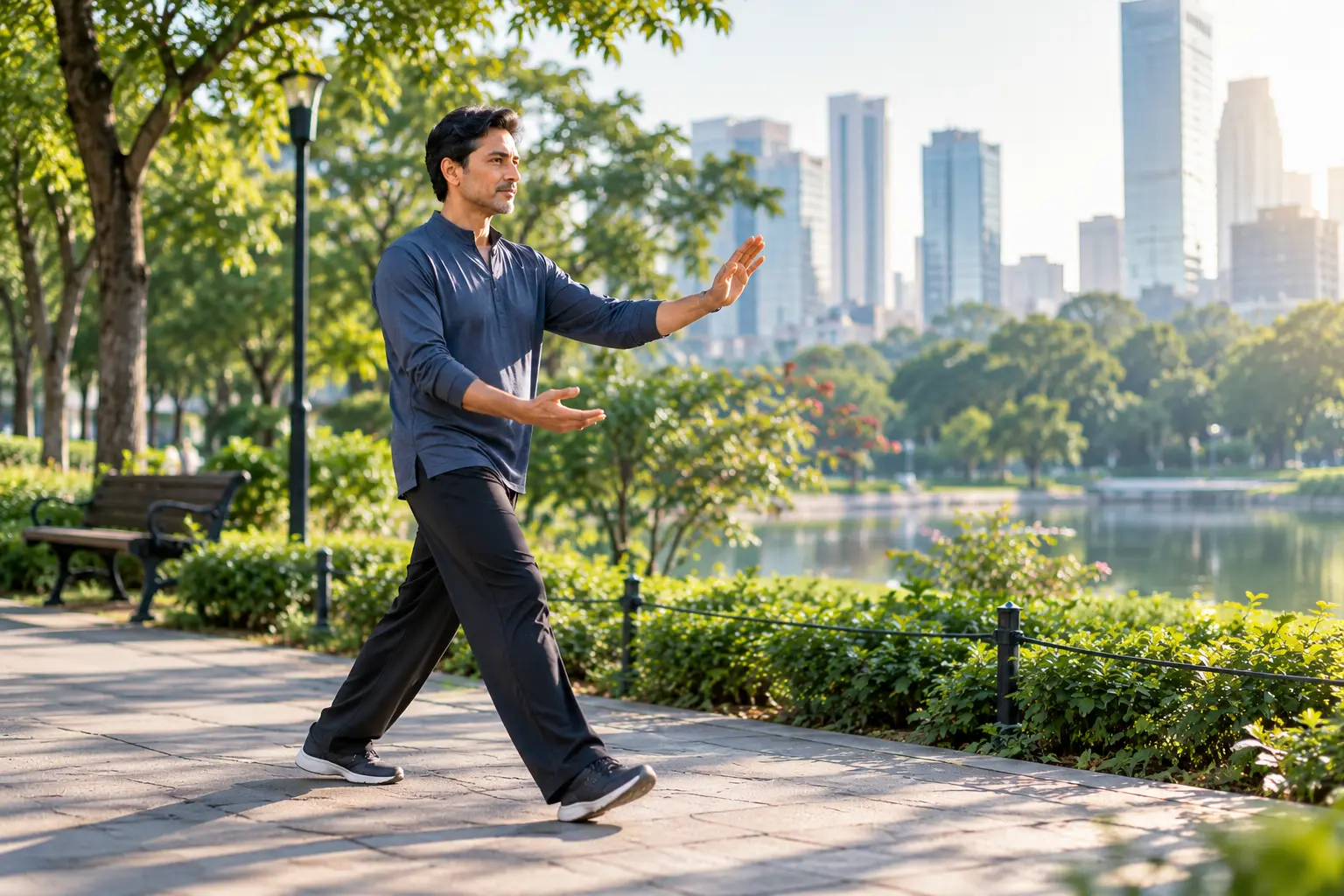
Now imagine slowing that process down deliberately. You place one foot carefully, transfer your weight gradually and pay attention to how your body responds. A familiar movement suddenly requires greater concentration. This is the basic idea behind Tai Chi Walking, a practice drawn from the traditional Chinese movement art of Tai Chi.
Its appeal is easy to understand. The practice requires little space, no expensive equipment and far less memorisation than a complete Tai Chi routine. Social media has also helped bring attention to slower forms of exercise, sometimes promoting them with impressive promises about weight loss and fitness. That makes it worth examining what Tai Chi Walking can realistically offer, how it differs from ordinary walking and what scientific research actually tells us.
What Is Tai Chi Walking, and How Is It Different From Traditional Tai Chi?
Tai Chi originated in China as a martial art and gradually developed into a widely practised form of mind-body exercise. It combines controlled physical movements, coordinated breathing, upright posture and focused attention. Although its movements may appear effortless, traditional Tai Chi involves carefully organised sequences known as forms. These can include changes in direction, shifting body positions and coordinated movements of the arms and legs, all of which take time and practice to perform correctly.
READ MORE : Always Tired Despite Sleeping Well? What Your Body May Be Telling You
Tai Chi Walking concentrates on one part of this larger practice: its footwork. A beginner can focus on stepping slowly, shifting weight deliberately and maintaining stability without first learning an entire sequence. As explained in a September 2026 article published by Harvard Health, the stepping component can provide an accessible introduction to Tai Chi.
During ordinary walking, the body moves continuously forward, with momentum helping us progress from one step to the next. Tai Chi Walking gives greater attention to the way weight moves between the supporting legs. The advancing foot is placed carefully before weight is gradually transferred onto it, while the person maintains control of posture and movement.
This can make the exercise surprisingly demanding, despite its gentle appearance. It requires awareness of the feet, ankles, knees, hips and overall body position. Distance and speed become less important than the quality of each step. For someone accustomed to brisk morning walks, the slower pace may initially feel unusual, even awkward. The challenge lies in resisting the natural urge to hurry and learning to move with greater control.
Why Moving Slowly Can Challenge Your Balance
Balance is one of those abilities we tend to appreciate only when it begins to decline. Standing upright and walking safely depend on a continuous exchange of information between the brain and body. Our eyes help us understand our surroundings, the inner ear provides information about head movement and orientation, and sensory receptors in our muscles and joints tell us where different body parts are positioned. The nervous system brings this information together and makes constant adjustments to keep us stable.
Walking adds another challenge because body weight must repeatedly shift from one leg to the other. During ordinary walking, these adjustments happen quickly and automatically. When movement slows considerably, each transfer of weight becomes more noticeable. We spend longer supporting ourselves on one leg while controlling the body’s position as the other foot moves forward.
Tai Chi Walking uses this process deliberately. The gradual transfer of weight encourages attention to stability, while small adjustments around the ankles, knees and hips help manage the movement. Greater awareness of how the feet contact the ground can also make it easier to notice where body weight is being placed.
This becomes particularly relevant when we think about older adults. A person who once walked confidently may gradually become more cautious on uneven pathways, wet surfaces or crowded pavements. Sometimes the concern is physical instability; at other times, fear of falling can itself make movement more hesitant. Controlled stepping exercises may have a place in balance training, although the difficulty must be appropriate for the individual.
There is a reasonable biomechanical explanation for why this type of movement might help. However, challenging balance during an exercise does not automatically produce lasting improvement. Results depend on how the activity is performed, how frequently it is practised and the abilities of the person doing it. To understand the potential benefits, we need to examine the research.
What Does Scientific Research Tell Us?
Scientific interest in Tai Chi is well established. Researchers have investigated its effects on balance, mobility, falls, pain and several other health outcomes, particularly among older adults. Many studies have reported encouraging results, with some of the clearest evidence relating to balance and fall prevention.
A systematic review and meta-analysis published in Frontiers in Public Health in September 2023 examined 24 randomised controlled trials involving older adults. Eighteen of these reported the number of people who experienced at least one fall. In that analysis, the relative risk was 0.76 (95% CI 0.71–0.82), corresponding to an estimated 24% relative reduction in the proportion of people who fell. Improvements were also reported in several measures of balance and physical performance.
That figure deserves careful interpretation. It represents a relative reduction observed across the studies included in the analysis. It does not mean that every person practising Tai Chi will reduce their individual risk of falling by exactly 24%, nor does it establish the same benefit for Tai Chi Walking.
Falls are an important public health concern, particularly in later life. A fall can lead to fractures, hospitalisation, reduced mobility or a loss of confidence in everyday movement. For an older person who lives independently, even the fear of falling can influence ordinary decisions, such as going for a walk, climbing stairs or visiting a nearby market. Protecting balance and mobility can therefore make a meaningful difference to quality of life.
The US National Institutes of Health, through its National Center for Complementary and Integrative Health (NCCIH), also reports that Tai Chi may improve balance and reduce falls among older adults. The evidence varies by health condition and outcome, and researchers have explored Tai Chi in people with Parkinson’s disease and other mobility-related conditions. These findings are useful, but they cannot be applied equally to everyone.
The Important Difference Between Tai Chi and Tai Chi Walking
Most clinical trials have investigated traditional Tai Chi programmes involving organised movement sequences, supervised instruction and repeated sessions over several weeks or months. Tai Chi Walking, practised independently as a simplified stepping exercise, has received considerably less direct research attention.
The two practices share important principles, particularly controlled weight shifting and postural awareness. However, they differ in complexity, duration and the range of movements involved. Practising a few slow steps in a hallway may provide a different physical challenge from attending structured Tai Chi classes several times a week.
READ MORE : Why Meditation Apps Are Losing Users in an Age of Endless Stress
Connection: mindfulness, stress and mental well-being.
Traditional Tai Chi has meaningful evidence supporting its role in balance training and fall prevention. Tai Chi Walking draws on some of the same principles and may offer an accessible starting point. More direct research is needed to determine its independent benefits, the most effective duration and frequency of practice, and which groups of people are most likely to benefit.
For readers encountering enthusiastic claims on social media, this distinction is worth remembering. A promising exercise technique can be useful without every advertised benefit having been established through clinical research.
Can Tai Chi Walking Strengthen Muscles and Improve Mobility?
Every step involves muscular work, even when the movement appears gentle. The muscles of the feet, ankles, legs and hips support body weight, control joint movement and help maintain stability. When weight is transferred slowly, these muscles must coordinate their effort over a longer period, changing the demands of the movement.
For beginners, particularly those who have been physically inactive, becoming comfortable with controlled stepping may be a useful starting point. The emphasis on posture and weight transfer can also draw attention to movement habits that normally go unnoticed. Someone who spends much of the working day seated may find that even simple movements require more concentration than expected.
There is, however, a difference between using muscles and developing substantial muscular strength. Strength gains generally require appropriate resistance and progressive challenge. Tai Chi Walking is unlikely to provide the same training effect as exercises designed to strengthen major muscle groups. Claims that it can rapidly build muscle or replace conventional strength training lack convincing scientific support.
Bone health deserves similar caution. Weight-bearing movement contributes to maintaining healthy bones, but its effects depend on the forces involved and the individual’s circumstances. Some studies have examined traditional Tai Chi in relation to bone health, yet this does not establish that Tai Chi Walking alone can significantly increase bone density or prevent osteoporosis.
For people interested in improving overall fitness, the sensible approach is to consider Tai Chi Walking as one possible addition to an active routine. Walking, strength exercises and other suitable activities continue to have important roles.
The Connection Between Movement and Mindfulness
There is another aspect of Tai Chi Walking that deserves attention. Most of us walk while thinking about something else. We plan the next task, listen to a conversation, check a phone or move through familiar surroundings without noticing the process. Our minds are often occupied with where we are going or what we need to do next.
Tai Chi Walking asks for a different kind of attention. The person notices how the foot touches the ground, how the body shifts and whether the next step can be taken without losing control. Breathing remains comfortable and natural, while attention repeatedly returns to the movement. This resembles the basic principle of mindfulness: deliberately observing what is happening in the present moment.
For Indian readers, the idea may sound familiar. Yoga and pranayama have long been part of many people’s understanding of physical and mental well-being. During yoga practice, attention may be directed towards posture, breathing and bodily sensations. Pranayama places particular emphasis on regulating the breath. Tai Chi Walking has its own movement techniques, but its emphasis on awareness can make the experience relatable to someone familiar with these practices.
The comparison helps explain the idea, although the practices should not be treated as interchangeable. Their origins, techniques and research evidence differ. The fact that two activities encourage focused attention does not mean they produce identical health outcomes.
Traditional Tai Chi has been studied as a mind-body practice, and some research suggests possible psychological benefits, including reductions in anxiety. The NCCIH notes that differences in study methods, participants and outcomes make firm conclusions difficult for certain effects. Research specifically examining the psychological benefits of Tai Chi Walking remains limited.
Still, concentrating on a familiar movement may provide an opportunity to step away from habitual distraction. In a routine filled with screens, notifications and competing demands, paying attention to a few deliberate steps may be an appealing experience. Its value need not depend on claims that it can treat anxiety, cure insomnia or produce dramatic changes in mental health.
Tai Chi Walking or Brisk Walking: Do We Need to Choose?
The morning park offers a useful way to understand the difference. One walker may be trying to improve cardiovascular fitness and therefore maintains a brisk pace. Another may prefer a gentler routine because of age, physical limitations or personal comfort. Someone else may combine walking with stretching, yoga or breathing exercises. Their routines reflect different needs, and the most suitable activity depends on the individual.
Brisk walking is a well-established form of aerobic exercise. When performed at sufficient intensity, it increases heart rate and breathing and contributes to cardiovascular fitness. Regular walking also supports physical function and helps people meet recommended activity levels, with benefits supported by a substantial body of research.
Tai Chi Walking is generally slower and more controlled. Its emphasis is on balance, posture, weight transfer and body awareness. A gentle session should not automatically be counted as equivalent to brisk walking or another moderate-intensity aerobic workout.
The US Centers for Disease Control and Prevention (CDC) recommends that adults aged 65 and above include aerobic activity, muscle-strengthening exercise and balance-focused activity in their weekly routines. These activities contribute to different aspects of physical health. The CDC also recognises that practices such as Tai Chi and yoga may involve more than one type of physical activity, depending on how they are performed.
This leaves room for a practical combination. Someone who enjoys a regular morning walk can continue that routine while exploring Tai Chi Walking as an additional activity. The aim is to build a balanced approach to movement that suits the person’s health, abilities and preferences.
Who Should Consider Tai Chi Walking?
Tai Chi Walking may appeal to people looking for a gentle introduction to mindful movement, especially those who find complex exercise routines difficult to learn. It requires little equipment and can be practised in a relatively small space, making it accessible to people who may not have the time or opportunity to attend organised fitness classes.
Older adults may find its emphasis on balance and controlled stepping particularly relevant. With age, changes in muscle strength, sensory function, mobility and reaction time can make balance harder to maintain. Activities that appropriately challenge balance are an important part of healthy ageing, and traditional Tai Chi is among the practices supported by research.
Beginners interested in learning Tai Chi may also use the walking component to become familiar with weight shifting and posture before attempting more complex forms. For people who spend long hours sitting, it may provide another opportunity to move during the day.
However, some people should avoid beginning independently. Those who experience dizziness, frequent falls, significant balance difficulties or problems bearing weight may be at risk during slow weight transfers or movements involving support on one leg. Anyone recovering from surgery or living with a condition affecting mobility should seek guidance from a qualified healthcare professional or physiotherapist.
It is also important to recognise that a slower exercise is not necessarily safer for every person. Moving slowly can increase the time spent balancing on one leg, which may be challenging for someone who is already unstable. The exercise should be adapted to individual ability rather than performed according to a fixed routine found online.
How to Begin Tai Chi Walking Safely
The basic principles are straightforward, although developing good technique takes practice. Beginners may benefit from learning with an experienced instructor who can demonstrate how to shift weight without unnecessary strain. A reliable instructional video may help explain the movement, but it cannot provide individual feedback or determine whether an exercise is safe for a particular person.
Begin in a quiet area with a flat, non-slip surface and enough room to move comfortably. Wear supportive footwear and clear away obstacles. Stand upright with your feet comfortably apart and your knees relaxed rather than locked. Before taking a step, gently shift some weight from one leg to the other and notice how your body maintains stability.
Once you feel steady, place one foot a short distance forward without immediately transferring your full weight onto it. Gradually shift your weight towards that foot, keeping the movement smooth and controlled. Avoid leaning excessively, forcing the knees into uncomfortable positions or taking unusually long steps. Maintain a comfortable pace that allows you to remain balanced throughout.
Continue only while the movement feels comfortable and stable. There is no need to begin with a demanding routine or a fixed number of repetitions. Stop if you experience dizziness, pain or instability. People at high risk of falling should seek professional guidance before attempting unsupported stepping exercises.
These principles provide a basic introduction rather than a complete lesson. Traditional Tai Chi footwork includes specific techniques that are best learned through proper demonstration. Anyone planning to practise regularly may benefit from qualified instruction to develop a safer and more accurate understanding of the movement.
What Tai Chi Walking Cannot Do
The growing popularity of Tai Chi Walking has also created opportunities for exaggerated marketing. Some online promotions suggest that a few minutes of slow walking can produce dramatic weight loss, build substantial muscle, reverse ageing or replace a complete exercise programme. Current scientific evidence does not support such promises.
This matters because weight loss remains one of the strongest selling points in the fitness industry. People who have struggled with demanding exercise routines may understandably be attracted to the idea of achieving similar results through a gentler activity. The promise is appealing, but the evidence must be strong enough to support it.
Tai Chi Walking has not been established as an effective weight-loss treatment or a treatment for chronic disease. It should not replace medical care, prescribed rehabilitation, aerobic exercise or strength training. Even the benefits associated with traditional Tai Chi depend on the outcomes studied, the duration and quality of practice, and the characteristics of the participants.
Understanding these limitations allows people to approach the practice with realistic expectations. Learning to shift weight more carefully, becoming aware of posture and developing greater confidence in movement may be worthwhile goals. They deserve attention on their own terms, without the pressure of unrealistic fitness promises.
A Different Way to Think About Everyday Movement
We increasingly measure fitness through numbers: steps taken, distance walked, time spent and calories burned. Fitness watches and mobile applications make these measurements readily available, and they can be useful when they encourage people to remain active. Yet they tell us relatively little about how well the body performs an ordinary movement.
Consider two people who complete the same number of steps during a morning walk. Their fitness levels, walking patterns, balance and physical limitations may be very different. The step count alone cannot explain these differences. Movement quality, confidence and control also matter, particularly when people begin experiencing changes in mobility with age.
Tai Chi Walking invites attention to this less visible aspect of physical activity. How steadily do we stand? How comfortably do we transfer weight? How much control do we have as we move from one step to the next? These everyday abilities contribute to mobility and independence, even though they rarely feature in conversations about fitness goals.
There is something practical about an activity that can be explored without expensive equipment or an elaborate routine. People have different physical abilities, preferences and reasons for exercising. A simple movement practice can find a meaningful place in daily life when its purpose is clear, its limitations are understood and it is performed safely.
Tai Chi Walking draws attention to an aspect of walking that often goes unnoticed: the coordination required to move safely and comfortably. Every step involves balance, sensory awareness, muscular control and a continuous exchange of information between the brain and body. Slowing the movement offers an opportunity to observe these processes more closely.
The KYB Perspective
The research gives us a useful basis for understanding its potential. Traditional Tai Chi has credible evidence supporting improvements in balance and fall prevention, particularly among older adults. Tai Chi Walking shares important elements of that practice, although its independent benefits have not been studied to the same extent. This distinction should guide both public expectations and the claims made by those promoting it.
For people who can practise safely, Tai Chi Walking may be a worthwhile addition to regular physical activity. Its emphasis on controlled movement can sit alongside brisk walking, strength training and other suitable exercises. The choice should reflect individual needs rather than the latest fitness trend.
Perhaps its most useful lesson is also its simplest. We pay considerable attention to how far and how fast we walk, yet rarely consider how well we move. Tai Chi Walking gives us a reason to pay attention to that difference.
References and Further Reading
- Harvard Health Publishing (14 September 2026). Tai chi walking: What is it and does it work?.
- National Center for Complementary and Integrative Health (NIH). Tai Chi: What You Need to Know.
- Frontiers in Public Health (2023). Tai Chi for fall prevention and balance improvement in older adults: a systematic review and meta-analysis of randomized controlled trials.
- National Center for Complementary and Integrative Health (NIH). 5 Tips: What You Should Know About Tai Chi for Health.
- Centers for Disease Control and Prevention (CDC). Older Adult Activity: An Overview.
Medical Disclaimer: This article is intended for general educational and informational purposes only. It does not constitute medical advice, diagnosis or treatment. Exercise needs and physical abilities vary from person to person. Individuals with balance difficulties, recurrent falls, mobility limitations, recent injuries or other medical conditions should consult a qualified healthcare professional before beginning Tai Chi Walking or any unfamiliar exercise practice. Information in this article should not be used as a substitute for professional medical care.