


Imagine opening a healthcare app, answering a few questions, and receiving a refill for your blood pressure medicine without speaking to a doctor. It may sound like the future, but in some parts of the world, it is already becoming reality. The bigger question is whether India should follow the same path.
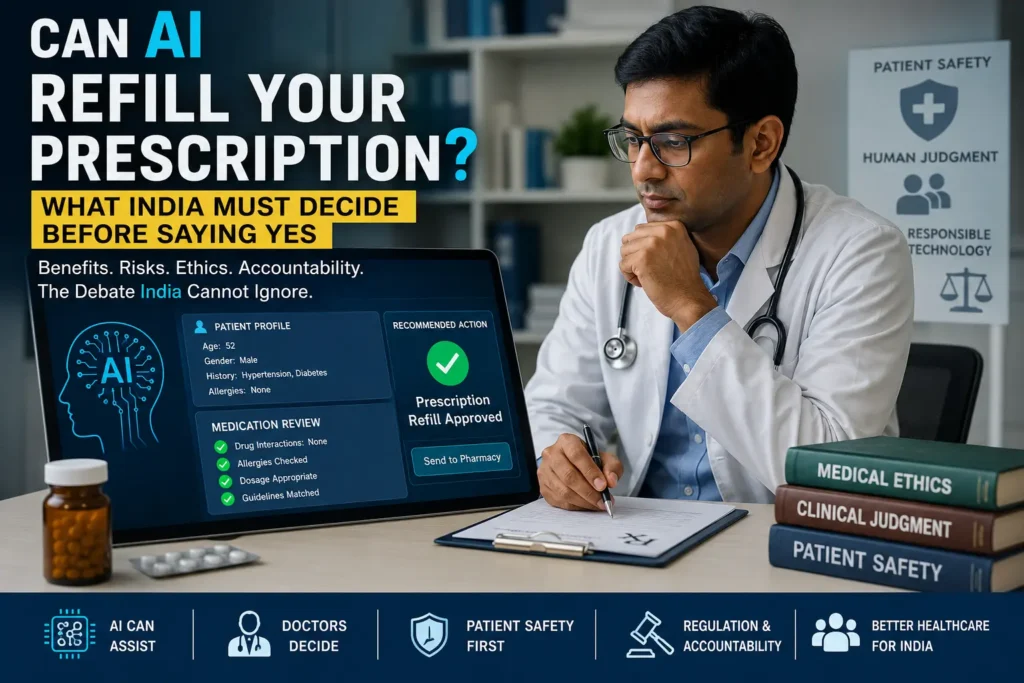
Artificial intelligence has rapidly entered hospitals, clinics, and diagnostic laboratories. Today, AI can detect diseases in medical scans, summarize patient records, predict health risks, and even assist doctors in choosing treatment options. As these technologies become more capable, one new question is attracting global attention:
Can AI safely refill a patient’s prescription?
The debate intensified after a pilot program in the United States allowed eligible patients to renew certain prescriptions through an AI-powered chatbot under a regulated framework. Supporters argue that such systems could reduce waiting times, improve access to healthcare, and help doctors focus on patients with complex medical needs. Critics, however, warn that prescribing medicines is not simply a technical process—it is a clinical judgment that carries legal, ethical, and life-threatening consequences.
For India, the question is especially relevant.
The country is rapidly expanding its digital health ecosystem through electronic health records, telemedicine services, and the Ayushman Bharat Digital Mission. At the same time, millions of Indians continue to face shortages of doctors, long travel distances to healthcare facilities, and overcrowded hospitals. AI appears to offer a practical solution to many of these challenges.
But convenience alone cannot become the foundation of healthcare policy.
Before India allows AI to play a larger role in prescribing medicines, it must answer a more fundamental question: Can technology improve medical care without weakening patient safety, professional accountability, and public trust?
Why the World Is Exploring AI Prescriptions
Healthcare systems across the globe are under pressure.
Populations are ageing. Chronic diseases such as diabetes, hypertension, and heart disease require continuous monitoring and regular prescription renewals. Meanwhile, healthcare professionals face increasing workloads, administrative burdens, and shortages in many regions.
Artificial intelligence promises to ease some of this pressure.
Modern AI systems can quickly review medical histories, identify possible drug interactions, verify allergies, compare treatment guidelines, and analyse large volumes of clinical information within seconds. Tasks that once required significant administrative time can now be completed much faster with the assistance of machine learning.
This does not necessarily mean AI is replacing doctors.
Instead, many healthcare experts see AI as a clinical decision-support tool—one that helps physicians make faster and more informed decisions while allowing them to spend more time communicating with patients.
Some technology companies now believe that AI can safely manage routine prescription renewals for stable patients who have already been diagnosed and are taking long-term medications.
On paper, the idea appears efficient.
If a patient has experienced no side effects, has followed the prescribed treatment, and meets predefined safety criteria, an AI system could theoretically verify the information and process a refill without requiring a full medical consultation every few months.
For patients living in remote areas, this could save both time and money.
For hospitals, it could reduce overcrowding.
For doctors, it could free valuable hours for patients who genuinely require medical expertise.
Yet healthcare is rarely as predictable as computer algorithms assume.
India’s Healthcare Reality Makes the Debate More Complex
India’s healthcare challenges are unique.
The country serves more than 1.4 billion people with significant differences in healthcare access between urban and rural regions. While major cities increasingly offer advanced hospitals and specialist care, many smaller towns and villages continue to struggle with shortages of qualified medical professionals.
Digital healthcare has grown rapidly in recent years. Telemedicine consultations have become more common, online pharmacies have expanded their reach, and electronic health records are gradually becoming part of India’s healthcare infrastructure.
These developments naturally create opportunities for AI-assisted healthcare.
However, India’s diversity also creates complexity.
Medical histories are often incomplete. Patients may visit multiple clinics without maintaining consistent records. Self-medication remains common, and many people purchase medicines directly from pharmacies without adequate follow-up. In such an environment, even seemingly routine prescription renewals may involve hidden clinical risks.
This is precisely why the debate should not focus only on what AI can do, but also on what AI should be allowed to do.
The Benefits India Cannot Ignore
Despite the concerns, dismissing AI altogether would be a mistake.
India’s healthcare system faces enormous pressure. Millions of patients require regular follow-ups for chronic illnesses such as diabetes, hypertension, asthma, thyroid disorders, and high cholesterol. Many of these patients visit doctors primarily to renew long-term prescriptions rather than because their condition has changed.
If implemented responsibly, AI could simplify many routine tasks.
For example, an AI-assisted system could review a patient’s digital health records, verify laboratory results, check medication adherence, identify potential drug interactions, and alert doctors to unusual findings before a prescription is renewed. Rather than replacing physicians, such systems could reduce administrative work and allow doctors to focus on diagnosis, emergencies, and complex cases that demand human expertise.
The potential is particularly significant in rural India, where access to specialists remains limited. Combined with telemedicine and electronic health records, AI could improve continuity of care and reduce unnecessary travel for patients living far from healthcare facilities.
However, efficiency should never become the only measure of good healthcare.
The Risks Doctors Are Right to Raise
A prescription is more than a list of medicines.
Every prescription reflects a doctor’s assessment of a patient’s current condition, lifestyle, recent symptoms, test reports, medical history, and even emotional well-being. Two patients with the same disease may receive different treatments because their circumstances differ.
That is where AI still faces important limitations.
A patient prescribed blood-thinning medication six months ago may now have developed stomach ulcers, experienced internal bleeding, or started another medicine that changes the safety profile of the original prescription. Unless the AI has complete, accurate, and up-to-date information—and knows when uncertainty requires human intervention—it may overlook risks that an experienced physician would identify during a consultation.
India presents additional challenges. Many patients consult multiple doctors, maintain incomplete medical records, or self-medicate without informing healthcare providers. These realities make automated prescription decisions considerably more complex than they may appear.
The question is not whether AI is intelligent.
The question is whether it possesses the clinical judgment, contextual understanding, and accountability expected in medical practice.
What Should India Do?
India does not need to choose between doctors and artificial intelligence.
It needs to build a healthcare system where both work together responsibly.
The National Medical Commission, digital health authorities, policymakers, technology developers, and healthcare professionals should establish clear national standards before AI is allowed to perform higher-risk medical functions.
These standards should answer fundamental questions.
Who is legally responsible if an AI-generated prescription harms a patient?
How should AI systems be independently tested before entering clinical practice?
How will patient consent and personal health data be protected?
Which medicines, if any, should qualify for AI-assisted prescription renewals?
Most importantly, AI should remain a tool—not an independent decision-maker. Final clinical responsibility must continue to rest with qualified medical professionals.
Innovation deserves encouragement.
Public trust deserves even greater protection.
KYB Insight
The real question is not whether AI is capable of prescribing medicines. The real question is whether society is prepared to decide who remains accountable when technology influences life-and-death decisions.
Today’s Better Life Action
If you use digital healthcare services, never treat AI-generated medical advice as a substitute for professional consultation. Keep your medical records updated, understand your medications, and consult a qualified doctor whenever your symptoms, health condition, or treatment changes.
Better Life Takeaway
Artificial intelligence is becoming one of healthcare’s most powerful assistants.
It can analyse information faster than humans, reduce repetitive administrative work, and improve access to medical services for millions of people.
But medicine has always been more than data.
Every prescription carries responsibility, uncertainty, and the possibility that one overlooked detail could change a patient’s life.
India’s healthcare future should embrace AI with confidence—but also with caution.
Technology may recommend.
Algorithms may calculate.
Yet when it comes to prescribing medicines, human judgment, ethical responsibility, and patient trust must remain at the heart of every decision.
Editor’s Note
Artificial intelligence is reshaping healthcare worldwide. This article examines the broader ethical, legal, and public health implications of AI-assisted prescription systems in the Indian context. Its purpose is to encourage informed discussion rather than promote or oppose any specific technology or healthcare provider.
Disclaimer
This article is intended solely for educational and informational purposes. It does not constitute medical, legal, or professional advice. Readers should always consult qualified healthcare professionals before starting, stopping, or changing any medication or treatment. References to AI technologies and healthcare systems are presented to support public understanding and should not be interpreted as endorsements.
Continue Reading
- AI Can Predict. Humans Must Decide.
- Why Information Doesn’t Create Intelligence
- Your Attention Is Becoming a Business
External References
World Health Organization (WHO) – Digital Health
Global guidance on digital health and responsible adoption of health technologies.
Ayushman Bharat Digital Mission (ABDM)
India’s official digital health ecosystem, including health records and interoperability.
National Medical Commission (NMC)
India’s medical regulator responsible for medical education and professional standards.
Ministry of Health & Family Welfare, Government of India
Official health policies, programmes, and national healthcare initiatives.
About KYB India
KYB India (Know Your Body • Know Your Brain • Know Your Business) is an independent knowledge platform dedicated to helping people build healthier bodies, sharper minds, ethical workplaces, and better lives through evidence-based journalism and practical insights.
Build Your Better Life
Better decisions begin with better understanding.
At KYB India, we believe technology should strengthen human potential—not replace human responsibility. As artificial intelligence becomes part of everyday healthcare, informed citizens, ethical innovation, and accountable institutions will shape a healthier future for everyone.
