

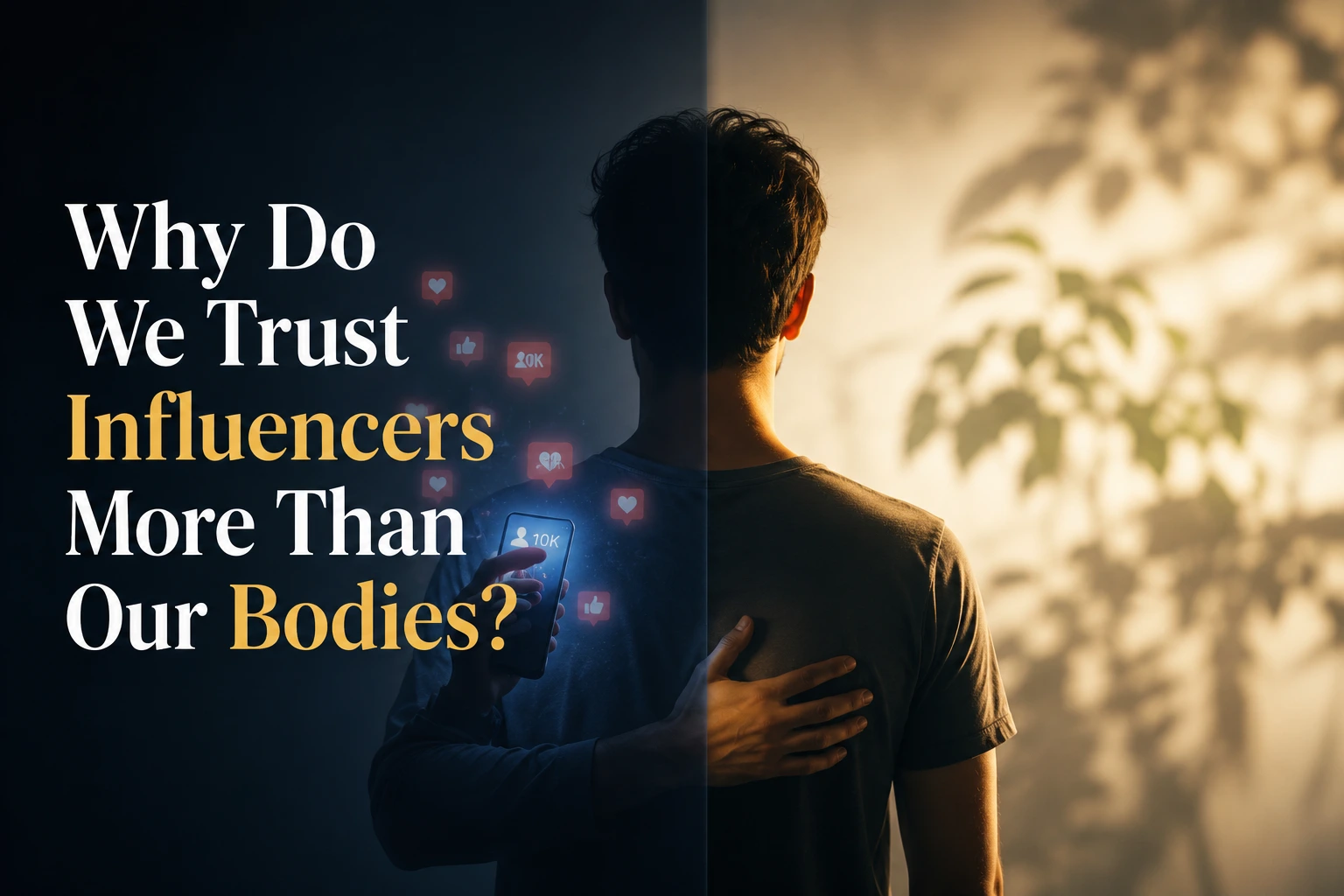
The internet keeps telling us what our bodies need. But when did we stop asking our bodies directly?
Why We Trust Influencers More Than…
A strange scene plays out every day.
Someone wakes up tired despite sleeping for eight hours.
Their body is signaling something.
But instead of asking, “Why am I exhausted?”, they open Instagram.
A fitness influencer says they need a new supplement.
A productivity expert says they need a better morning routine.
A wellness creator recommends a detox drink.
Within minutes, advice arrives from everywhere except the one place where the problem actually started—the body itself.
How did we become so willing to trust strangers on a screen while becoming increasingly disconnected from our own physical experience?
What We See
Modern Indians have more health information than any previous generation.
We have fitness apps, smartwatches, health podcasts, nutrition channels, online doctors, wellness coaches, and thousands of influencers discussing every possible aspect of health.
Yet confusion seems to be growing.
One influencer promotes fasting.
Another warns against it.
One recommends high-protein diets.
Another argues for traditional eating.
One says coffee is beneficial.
Another calls it harmful.
The result is a strange paradox.
People are consuming more health content while feeling less certain about what their own bodies need.
What We Don’t Notice
The hidden issue may not be misinformation.
It may be something deeper.
Many of us have gradually outsourced self-awareness.
Instead of observing our hunger, we follow diet trends.
Instead of noticing our fatigue, we chase productivity hacks.
Instead of understanding our stress, we search for quick solutions.
The body speaks through sensations.
The internet speaks through certainty.
And certainty often feels more comforting.
Listening to the body requires patience.
Listening to an influencer requires only a swipe.
Over time, one habit becomes easier than the other.
The Bigger Question
Perhaps this is not really a health story.
Perhaps it is a trust story.
For generations, people learned about themselves through direct experience.
They noticed what foods suited them.
They understood when they needed rest.
They recognized emotional patterns.
Today, many decisions arrive pre-packaged.
Algorithms constantly suggest what to eat, how to exercise, when to sleep, what supplements to buy, and even how to feel.
The more advice becomes available, the less confidence people sometimes have in their own observations.
A subtle question emerges:
If we no longer trust our own signals, what happens to our relationship with ourselves?
The Human Story
Consider Rajesh, a 38-year-old professional working in Noida.
For months, he felt tired during the day.
His smartwatch showed acceptable sleep scores.
Social media suggested everything from protein deficiency to burnout.
He tried supplements.
He changed his diet.
He bought wellness products.
Nothing changed.
Eventually, after encouragement from his family, he consulted a doctor.
The actual issue was sleep apnea.
His body had been sending signals for months.
The signals were real.
But they were drowned out by endless external advice.
Rajesh’s story is becoming increasingly common.
The challenge is not the absence of information.
It is the abundance of competing information.
The Death of Deep Thinking: Why Modern Attention Spans Are Collapsing
What Research Suggests
Behavioral scientists have long studied why people trust external voices.
One reason is called social proof.
When thousands of people appear to follow someone, the advice automatically feels more credible.
Another factor is repetition.
The more often we encounter an idea, the more familiar and trustworthy it begins to feel, regardless of whether it is correct.
Research also suggests that humans tend to prefer simple explanations over uncertainty.
Our bodies are complex.
An influencer often offers a clear answer.
The body says, “Pay attention.”
The influencer says, “Do this.”
One requires reflection.
The other promises clarity.
Modern digital platforms are designed to reward confidence, not necessarily accuracy.
The loudest voice is not always the most informed voice.
Nor is the most popular advice always the most suitable advice for an individual body.
Where Health Meets Identity
There is another layer worth examining.
Health content today is rarely just about health.
It is often tied to identity.
People do not merely follow advice.
They join tribes.
Biohackers.
Fitness enthusiasts.
Productivity communities.
Wellness followers.
Traditional health advocates.
Each group offers belonging.
And belonging is a powerful human need.
Sometimes people continue following a trend not because it improves their health, but because it reinforces who they believe they are.
The body may disagree.
The community may not.
And that creates a conflict many people never consciously notice.
The Cost of Ignoring Internal Signals
When body awareness declines, consequences often appear gradually.
Sleep problems remain unnoticed.
Stress becomes normalized.
Digestive discomfort becomes routine.
Mental fatigue is mistaken for laziness.
Burnout gets confused with lack of motivation.
Relationships suffer because emotional exhaustion is misunderstood.
Work performance declines because recovery is neglected.
The issue extends beyond health.
It affects how people think, work, relate, and make decisions.
The body is not separate from life.
It is the foundation on which life operates.
India’s Sleep Crisis: The Country That Never Rests Anymore
Questions Worth Sitting With
- When was the last time I trusted my body’s signals before searching online?
- Do I consume more health advice than I practice?
- Which health beliefs do I hold because of evidence, and which because of popularity?
- How often do I pause long enough to notice what my body is trying to tell me?
- Am I following a health trend or understanding my own health?
- What symptoms have I normalized without investigating?
- If social media disappeared for a month, how would I decide what my body needs?
Key Takeaways
- More health information does not automatically create better self-awareness.
- Influencers often provide certainty, while the body communicates through subtle signals.
- Popular advice may not be personalized advice.
- Self-observation remains one of the most underused health skills.
- Health decisions involve identity, belonging, and psychology—not just information.
- The ability to listen to your body may become increasingly valuable in an age of constant external guidance.
KYB Insight
Modern life has created an unusual paradox: we have never had more experts to follow, yet many of us have never felt less connected to ourselves. The future of health may depend not only on better information, but on rebuilding our ability to listen.
KYB Thought
Perhaps the most overlooked expert in our lives is not a doctor, a coach, an app, or an influencer.
It is the quiet conversation happening inside us every day.
The question is not whether the body is speaking.
The question is whether we have become too distracted to hear it.
FAQs
Q1. Why do influencers have so much impact on health decisions?
Because people naturally rely on social proof and familiar voices when making decisions, especially in areas where uncertainty exists.
Q2. Is following health influencers always harmful?
No. Many creators share useful information. Problems arise when influencer advice replaces personal observation or professional medical guidance.
Q3. How can I improve body awareness?
Pay attention to sleep quality, energy levels, hunger, stress, mood changes, and recurring symptoms before seeking external explanations.
Q4. Why do people ignore body signals?
Busy schedules, digital distractions, and information overload often make people prioritize external advice over internal awareness.
Q5. What is the connection between social media and health confusion?
Constant exposure to conflicting advice can create uncertainty and make individuals less confident in their own experiences.
Disclaimer: This article is intended for educational and informational purposes only. It explores behavioral and health-related themes through a journalistic lens and should not be considered medical advice. Readers should consult qualified healthcare professionals for diagnosis, treatment, or personal health decisions.
KYB India is a Better Life Platform helping people understand the connections between Body, Brain, Being and Business. Through practical insights, ethical storytelling and the questions others often overlook, we make health, human behaviour and modern life easier to understand and better choices easier to make.