


Modern neuroscience suggests that it can. Through neuroplasticity…
Bikas Pandey, Chief Editor – KYB India
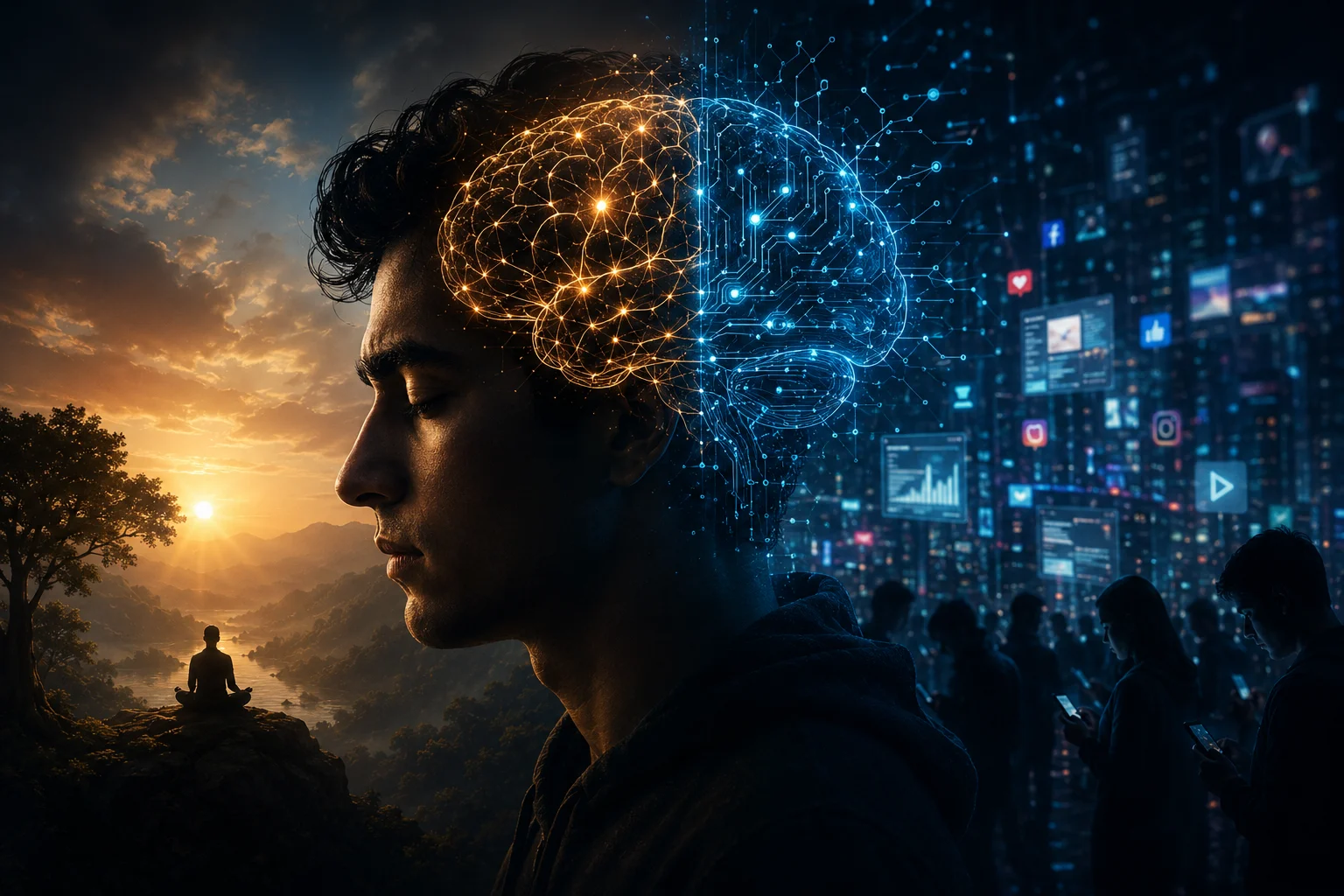
Can the human brain rewrite its own future? Modern neuroscience suggests that it can. Through neuroplasticity, the human brain constantly adapts to what we repeatedly think, feel, learn, and experience. In today’s digital age, smartphones, artificial intelligence, social media, and endless notifications are influencing not only our attention but also the way our brains develop over time. Understanding how neuroplasticity works may become one of the most important life skills of the twenty-first century.
Humanity is entering an era where technology is no longer just changing the world around us. It is changing the world inside us. Technology is slowly changing the human brain itself.
Every scroll, every notification, every burst of stress, every late-night video and every algorithmic recommendation is shaping the architecture of the human brain in ways most people still do not fully understand.
Most people believe they are simply using technology.
In reality, technology may already be redesigning human behavior in real-time.
What Is Neuroplasticity and Why Does It Matter?
For decades, scientists believed that the human brain became largely fixed after a certain age. Intelligence, emotional tendencies, personality, and behavioral patterns were considered relatively stable.
Modern neuroscience has challenged that belief through a powerful concept known as Neuroplasticity.
Neuroplasticity is the brain’s extraordinary ability to reorganize, adapt, and rewire itself throughout life.
In simple terms, your brain changes according to what you repeatedly think, feel, consume, practice, fear, and experience.
Repetition is not just building habits.
It is physically redesigning neural pathways inside the brain.
Every repeated action strengthens a mental pathway. Every emotional experience leaves a biological imprint. Every habit gradually becomes part of the brain’s internal wiring.
This changes everything.
How Digital Technology Is Reshaping the Human Brain
For centuries, humanity feared external control through politics, military power, or economic systems.
Today, we may be witnessing something far more intimate.
The engineering of human attention.
The digital world is no longer competing only for human time. It is competing to reshape the human mind itself.
Short-form videos, dopamine-driven feedback loops, endless scrolling, instant validation systems, and hyper-personalized algorithms are continuously conditioning human behavior.
Attention spans are shrinking.
Patience is collapsing.
Emotional reactions are becoming faster, sharper, and more impulsive.
Millions of people wake up and reach for a device before reconnecting with themselves.
For many people, silence itself has started to feel uncomfortable.
For children, the glow of a smartphone screen is becoming more familiar than silence, reflection, or uninterrupted human conversation.
This is not merely a cultural shift.
It is a neurological transformation.
Why India Faces a Unique Brain Health Challenge
Perhaps nowhere is this transformation more visible than in countries like India.
India is one of the youngest nations in the world. It is rapidly digitizing while simultaneously carrying centuries of philosophical, spiritual, and psychological traditions.
Smartphones have reached villages faster than emotional awareness programs.
Artificial intelligence is entering classrooms before many students fully understand mental resilience.
The result is a deeply complex psychological landscape.
Millions of students preparing for UPSC, NEET, IIT-JEE, and government recruitment examinations spend years under relentless cognitive pressure.
Young professionals navigate comparison culture, uncertainty, burnout, loneliness, and economic instability.
Social media has intensified invisible competition, where people constantly compare their lives with carefully curated digital realities.
The pressure to succeed has become permanent.
And permanent pressure changes the brain.
Chronic stress, emotional suppression, sleep deprivation, digital overstimulation, and fear of failure are not simply unpleasant experiences.
Over time, they can physically influence neural pathways, emotional regulation, memory systems, and behavioral responses.
A generation living in constant stimulation eventually begins to normalize anxiety.
Where Modern Neuroscience Meets Ancient Wisdom
Yet Neuroplasticity is not only a story of danger.
It is also a story of hope.
If destructive patterns can rewire the brain negatively, healthy practices can reshape it positively as well.
Human beings are far more adaptable than earlier generations imagined.
This is where modern neuroscience unexpectedly intersects with ancient Indian wisdom.
Long before neuroscience existed as a scientific discipline, Indian traditions explored practices centered around attention, breath, silence, repetition, mindfulness, and disciplined awareness.
Meditation, yoga, contemplative practices, and breath control were not merely spiritual rituals.
They were systems designed to influence human consciousness and inner balance.
Today, scientific research increasingly studies how meditation, physical exercise, focused learning, emotional connection, quality sleep, and mindfulness strengthen healthier neural patterns.
In many ways, modern science is rediscovering what ancient traditions intuitively understood centuries ago.
Repeated mental states shape human behavior.
Who Controls Human Attention in the AI Era?
The challenge humanity faces today is unprecedented.
Artificial intelligence, behavioral algorithms, predictive systems, and personalized digital ecosystems are evolving faster than human self-awareness.
Technology companies now understand human attention with astonishing precision.
Every click, pause, reaction, search, and emotional trigger feeds systems designed to predict and influence future behavior.
Algorithms are no longer passive technologies.
They are becoming behavioral architects.
The most powerful technologies of the future may not control machines first.
They may control human behavior first.
The future battle may not simply be about automation or artificial intelligence replacing jobs.
It may become a struggle over who controls human attention, emotional patterns, cognitive habits, and psychological vulnerability.
The human brain is now one of the most contested spaces on Earth.
Platforms compete for attention.
Corporations compete for engagement.
AI systems compete for behavioral prediction.
Meanwhile, millions of people remain unaware that their daily habits are slowly shaping the biological structure of their own minds.
This raises a deeply uncomfortable question:
If human behavior can be conditioned, influenced, and rewired at scale, what happens to free thought, emotional independence, and authentic identity?
Neuroplasticity Is Reshaping Humanity…
Can the Human Brain Still Rewrite Its Future?
Despite all these concerns, Neuroplasticity also offers one of the most hopeful discoveries of modern science.
It means no human being is permanently fixed.
A distracted mind can relearn focus.
A fearful mind can rebuild confidence.
A traumatized mind can gradually heal.
An exhausted mind can rediscover balance.
But none of this happens automatically.
The brain reshapes itself according to repetition.
What humanity repeatedly consumes, practices, fears, believes, avoids, scrolls through, and emotionally experiences eventually becomes part of its neurological identity.
The future of humanity may ultimately depend on whether we consciously train our own minds — or silently allow algorithms, platforms, and digital systems to train them for us.
The question is no longer whether the brain changes.
The real question is:
Who is shaping the future of human consciousness?
KYB Insight
The brain is constantly learning, whether we realize it or not. The real question is not whether your mind is changing. The question is who is teaching it every single day.
Better Life Takeaway
Your brain is constantly becoming the person you repeatedly train it to be. Every habit, every distraction, every moment of focus, and every conscious choice leaves its mark. In a world designed to compete for your attention, protecting your mind may become one of the most important investments you ever make. A better brain is not built overnight. It is built one conscious decision at a time.
Frequently Asked Questions
What is neuroplasticity?
Neuroplasticity is the brain’s remarkable ability to reorganize and rewire itself throughout life. Every thought, habit, learning experience, emotion, and repeated behavior helps strengthen or reshape neural pathways. In simple terms, the brain is not permanently fixed. It continuously adapts to how we live, learn, think, and interact with the world around us.
Can smartphones change the human brain?
Excessive smartphone use may influence attention, emotional regulation, and habitual behavior through repeated neural stimulation. Healthy digital habits can help maintain better cognitive balance.
Can adults rewire their brains?
Yes. Research suggests that learning, meditation, physical activity, quality sleep, and consistent practice can strengthen healthier neural pathways throughout adulthood.
Why is neuroplasticity important in the digital age?
Because every repeated digital behavior—whether productive or distracting—can gradually influence how the brain processes information, attention, and emotions.
Disclaimer
The views and opinions expressed in this article are based on editorial analysis and informational research. This content is intended for awareness and educational purposes only and should not be considered medical, psychological, legal, or professional advice.
Continue Your Better Life Journey
🌿 Read more practical insights on Body

💚 Discover smarter ideas for your Brain

🧠 Build a stronger Being

💼 Grow your Business with ethical leadershipRelated Reading
Continue Exploring
External References
1. NIH (National Institutes of Health)
2. Harvard Medical School
3. WHO
About KYB India
KYB India is a Better Life Platform exploring how health, the human brain, ethics, and emerging technologies are shaping the future of modern life. Through evidence-based insights and practical knowledge, we help readers strengthen their Body, Brain, Being, and Business so they can make better decisions and build a better life.
Keywords
- Neuroplasticity
- Brain Rewiring
- Digital Brain
- Human Consciousness
- Brain Health
- Attention Economy
- Digital Wellness
- AI and Human Brain
