


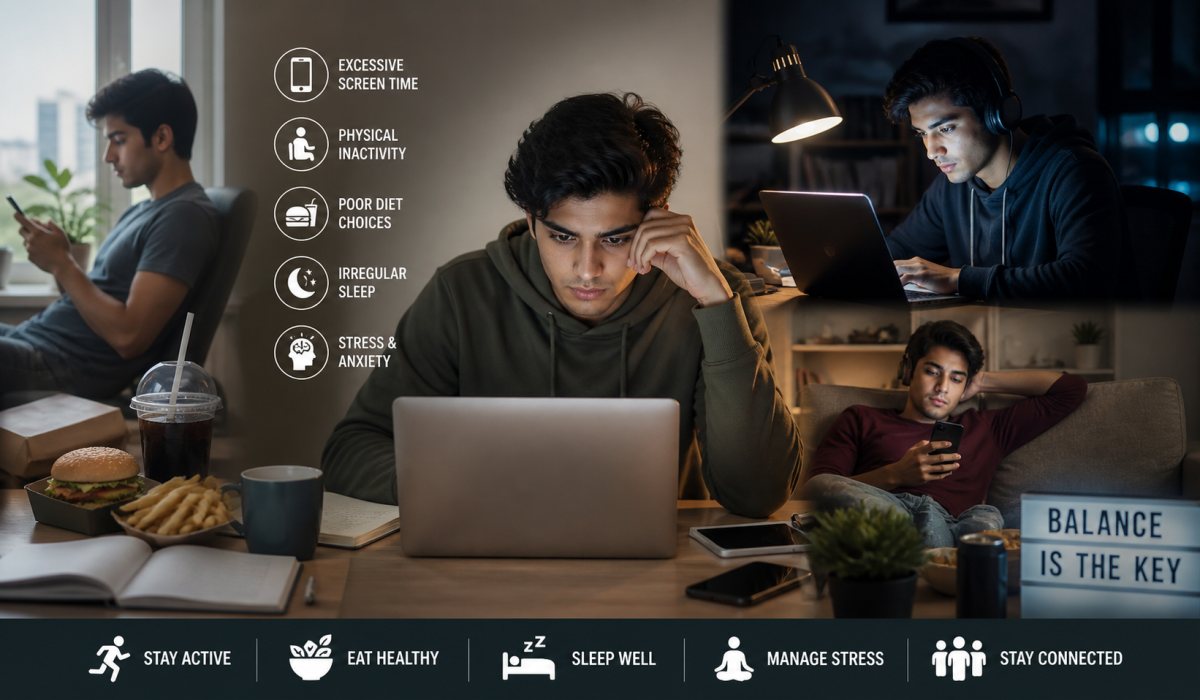
The lifestyle of young adults has changed dramatically over the past decade. While technology and convenience have improved daily life, they have also introduced new challenges that are quietly affecting health and well-being. Modern lifestyle…
Think about a normal Tuesday for a 26-year-old. The alarm goes off, and the phone is in hand before the eyes are fully open. Then comes a laptop, a chair, and eight or nine hours of screen. Lunch is eaten at the desk. The evening gets spent on the couch, scrolling through reels until 1 a.m. Nothing about this day looks unusual. That is exactly the problem. Modern lifestyle…
Our bodies were not built for this kind of routine, and young adults are the first generation to live it from start to finish.
We are sitting far more than we realise
Work moved to screens. So did entertainment, shopping, and even friendships. The result is that a lot of us can go an entire day without moving much beyond the walk to the kitchen.
The body notices even when we don’t. Weight creeps up. Tiredness shows up even after a full night in bed. The neck and lower back start to ache, and posture slowly folds forward toward the screen. Many people in their twenties now complain of back pain that once belonged to their parents’ generation.
The phone never really goes away
Smartphones and social media have made life easier in many ways. We can talk to anyone, learn almost anything, and work from anywhere. But the same device that connects us also keeps the mind on alert all day.
Notifications break concentration. Bad news arrives without warning. And the last thing many of us see before sleep is a bright screen, which makes it harder to fall asleep and harder to stay asleep. Poor sleep then feeds stress and anxiety, and stress makes us reach for the phone again. It becomes a loop.
The routine has quietly fallen apart
Late-night work, skipped breakfasts, dinner at 11 p.m., and a weekend spent catching up on sleep: this has become an ordinary pattern for many young people. Each of these habits seems harmless alone. Together, they confuse the body’s internal clock, which likes regular times for sleeping, eating, and waking. When that rhythm keeps getting disturbed, the effects show up later as digestive trouble, low energy, hormonal imbalance, and a higher risk of long-term illness.
The pressure inside the mind
Then there is the part that is hardest to see. Young adults today compare themselves with more people in a single day than earlier generations did in a year. Someone is always getting promoted, travelling, getting married, or starting a company. Add to that the pressure of building a career and the uncertainty about where the world is heading.
Many young adults tell us they feel tired, restless, or low, and cannot explain why. That is not weakness. It is what constant comparison and constant pressure do to a mind that has no space to rest.
But this is not a hopeless story
There is good news here. People are more aware than before. More young adults are talking openly about stress, sleep, and burnout, and more of them are asking what balance actually looks like.
The answer is rarely dramatic. It does not need a new diet, an expensive gym membership, or a complete life overhaul. A few small habits, repeated often enough, do most of the work:
- Sleep and wake up at roughly the same time every day.
- Keep the phone away from the bed, at least for the last half hour before sleep.
- Stand up and move for a few minutes every hour, and walk daily even if it’s short.
- Take some time to sit quietly, breathe, or simply be without a screen.
None of this has to be perfect. Missing a day is fine. What matters is coming back to the habit the next day.
Why the twenties matter so much
Young adulthood is when habits settle in. The way we sleep, eat, move, and handle stress in these years tends to follow us into our thirties and forties. Health problems that show up later often have their roots in choices made much earlier, when nothing seemed to be wrong.
Modern life gives us real opportunities, and it also brings real risks. We cannot step out of it, but we can decide how we live inside it. Small, conscious choices for the body and the mind, made early, are among the best gifts a young person can give their future self.
KYB India Team
Comtinuing Reading
Why Healthy Employees Build Strong Companies | Workplace Wellness I KYB India
KYB India is a Better Life Platform helping people understand the connections between Body, Brain, Being and Business. Through practical insights, ethical storytelling and the questions others often overlook, we make health, human behaviour and modern life easier to understand and better choices easier to make.