


The Hidden Cost of Chasing Health Instead of Living It
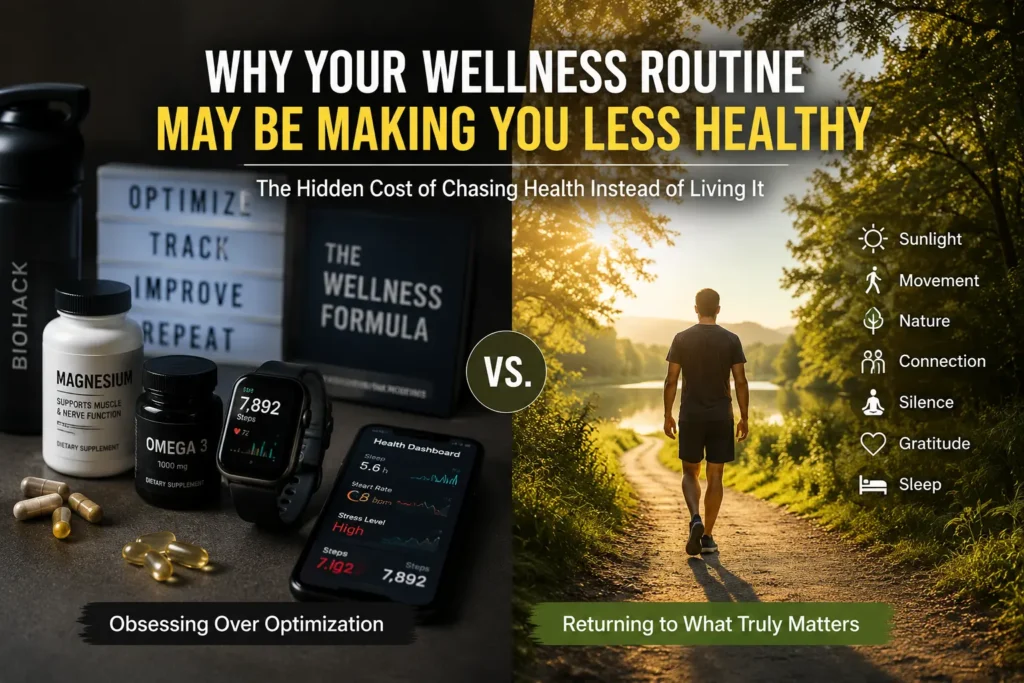
The Dangerous Myth That Wellness Must Be Purchased
We spend more on wellness than ever before. So why are we becoming less healthy?
A strange belief has quietly taken over modern life.
Many people now think that good health is expensive.
They believe they need supplements, smart watches, expensive gym memberships, health apps, advanced medical tests, biohacking gadgets, and endless wellness products to stay healthy.
The wellness industry certainly encourages this belief.
Every day, social media introduces a new health trend.
A new supplement promises more energy.
A new device promises better sleep.
A new therapy claims to slow aging.
A new expert claims to have discovered the secret to optimal health.
The message is clear:
If you want to be healthy, you need to buy something.
But what if that message is only half true?
What if some of the most powerful health practices available to us cost absolutely nothing?
And what if our obsession with health products is distracting us from the very habits that make us healthy in the first place?
The Billion-Dollar Wellness Illusion
The global wellness industry is worth trillions of dollars.
There is nothing wrong with innovation.
Many health products and treatments have genuine value.
Technology has improved diagnosis, treatment, and disease prevention in remarkable ways.
The problem begins when wellness becomes more about consumption than behaviour.
Some people spend thousands on supplements while sleeping only five hours a night.
Others track every health metric imaginable but rarely step outside for fresh air.
Many invest in expensive health plans while living under constant stress.
The result is a strange contradiction.
We are investing more money in health than previous generations.
Yet stress, anxiety, burnout, loneliness, obesity, and lifestyle diseases continue to rise.
Perhaps the issue is not that we lack health solutions.
Perhaps the issue is that we are neglecting the basics.

The Health Habits We Forgot Because They Were Free
Imagine a doctor writing the following prescription:
- Eight hours of sleep
- Twenty minutes of sunlight
- A daily walk
- Deep breathing
- Time in nature
- Meaningful conversations
- Gratitude
- Less screen time
- More laughter
- Moments of silence
Total cost: ₹0.
Most people would agree that these habits are beneficial.
Yet many struggle to practice them consistently.
Why?
Because modern culture often confuses simplicity with weakness.
We assume that if something is free, it cannot be powerful.
But the human body does not work that way.
Sleep remains one of the most effective recovery tools known to science.
Sunlight helps regulate our biological clock.
Movement improves circulation, mood, and metabolic health.
Strong relationships improve emotional well-being.
Time in nature reduces mental fatigue and stress.
These are not alternative health practices.
They are the foundations of human health.
The Real Health Crisis Is Behavioural
Most people already know what they should do.
They know they need better sleep.
They know they should move more.
They know excessive screen time is harmful.
They know stress affects health.
The challenge is not a lack of information.
The challenge is behaviour.
Modern life constantly pulls our attention away from healthy habits.
We stay awake longer.
We spend more time indoors.
We replace movement with convenience.
We replace connection with notifications.
We replace rest with productivity.
Over time, these small choices accumulate.
The body keeps the score.
What appears to be a medical problem often begins as a behavioural problem.
This does not mean that all illness can be prevented through lifestyle.
Many health conditions require medical care and professional treatment.
However, it does mean that daily habits continue to play a powerful role in long-term well-being.
Why Expensive Solutions Feel More Attractive
There is also a psychological reason behind our attraction to costly wellness products.
We often believe that expensive means effective.
If a solution costs money, it feels valuable.
If it is free, we tend to underestimate it.
This bias influences many areas of life.
People may hesitate to spend thirty minutes walking in a park.
Yet they may willingly spend thousands on a health gadget that promises similar benefits.
The irony is difficult to ignore.
Sometimes the simplest solution is also the most effective.
But simplicity rarely generates headlines.
Reclaiming the Foundations of Health
Improving health does not always begin with buying more.
Sometimes it begins with removing what no longer serves us.
It begins with going to bed earlier.
It begins with stepping outside.
It begins with turning off notifications.
It begins with taking a walk.
It begins with spending time with people who matter.
It begins with creating moments of stillness in a noisy world.
These actions may not look impressive on social media.
They may not come with sophisticated technology.
They may not be marketed as revolutionary breakthroughs.
Yet they have supported human health for generations.
The Question We Need to Ask
Perhaps the most important question is not:
“What should I buy to become healthier?”
Perhaps the better question is:
“What healthy habits have I stopped practicing?”
The answer may reveal more than any health gadget ever could.
Because the foundation of health was never hidden behind a paywall.
It was never locked inside a subscription.
It was never reserved for the wealthy.
It was always available in ordinary human behaviours that modern life encouraged us to ignore.
The wellness industry may continue to grow.
New products will continue to appear.
New trends will continue to dominate headlines.
But the fundamentals remain unchanged.
Sleep.
Movement.
Sunlight.
Nature.
Connection.
Gratitude.
Rest.
These are not old-fashioned ideas.
They are timeless ones.
And perhaps the greatest investment we can make in our health is not spending more money.
It is paying more attention.
Death Is Not the Problem. An Unlived Life Is.
Key Takeaway
Health is not something we purchase. It is something we practice. The most powerful habits often cost nothing, yet they may be worth more than everything we buy in the pursuit of wellness.
Disclaimer : This article is intended for educational and informational purposes only. It should not be considered medical advice, diagnosis, or treatment. Readers should consult qualified healthcare professionals for personalized medical guidance.
KYB India is a Better Life Platform helping people understand the connections between Body, Brain, Being and Business. Through practical insights, ethical storytelling and the questions others often overlook, we make health, human behaviour and modern life easier to understand and better choices easier to make.