


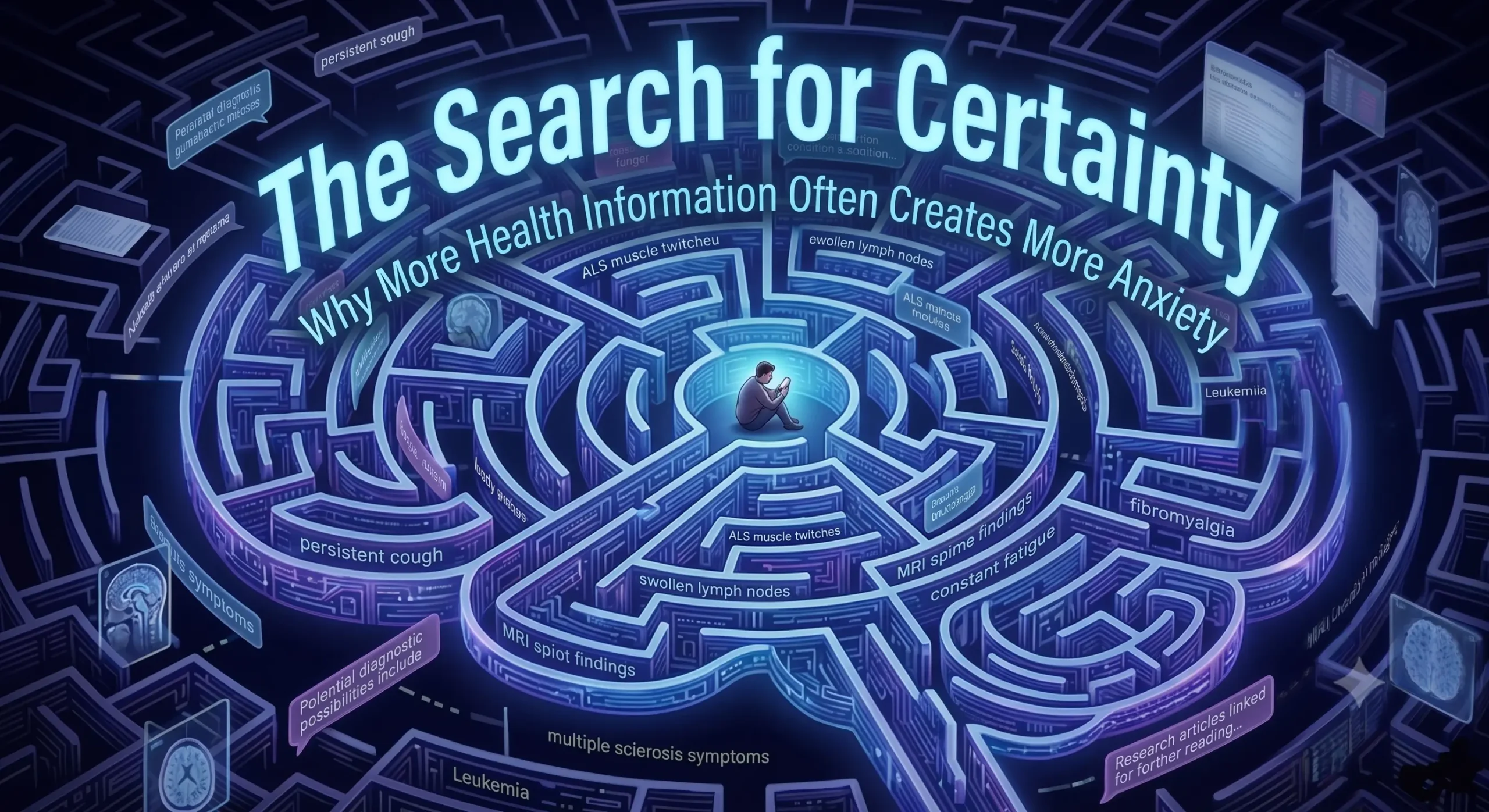
Why More Health Information Often Creates More Anxiety
Health anxiety rarely begins with a diagnosis. More often, it begins with uncertainty—and an increasingly familiar habit of searching for answers online. In the age of AI, that search can quickly become an endless conversation.
A strange headache.
An unusual pain in the neck.
A tingling sensation in the fingers.
A blood test result that requires a follow-up investigation.
For millions of people, these moments trigger a familiar response. They reach for their phone and begin searching for answers.
For years, Google was the first stop.
Now, increasingly, that role belongs to AI.
People are asking ChatGPT questions they once reserved for doctors, therapists, friends, or family members. Sometimes the experience is reassuring. Sometimes it is educational.
But sometimes it becomes something else entirely.
A conversation that starts with curiosity slowly transforms into a cycle of fear, reassurance-seeking, and emotional dependency.
What emerges is not a medical problem.
It is a human behavior problem.
And it may become one of the most important mental wellness challenges of the AI age.
The Birth of a New Anxiety Loop
Imagine receiving a message from a diagnostic lab.
Additional testing is recommended.
Nothing is confirmed.
Nothing is ruled out.
You are left with uncertainty.
The human brain has never been particularly comfortable with uncertainty.
In fact, uncertainty is one of the most powerful psychological triggers known to science.
When people do not know what is happening, the brain begins generating possibilities.
Some possibilities are harmless.
Others are frightening.
The more uncertain the situation feels, the more attention the brain gives to worst-case scenarios.
This is where AI enters the picture.
A chatbot is available twenty-four hours a day.
It responds instantly.
It never becomes impatient.
It never says, “Let’s discuss this tomorrow.”
And because it can generate endless explanations, it can unintentionally transform uncertainty into an ongoing conversation.
The Digital Mirror Effect
Many people think AI provides answers.
In reality, conversational AI often acts like a mirror.
If a person approaches it with curiosity, it reflects curiosity.
If a person approaches it with fear, it may reflect fear.
This happens because chatbots are designed to engage with user concerns rather than challenge them aggressively.
The system follows the conversation.
It explores possibilities.
It expands scenarios.
It answers follow-up questions.
For an anxious person, that process can feel validating.
The fear becomes the topic.
The topic becomes the focus.
The focus becomes the obsession.
Over time, users may mistake the existence of many possible explanations for evidence that something serious is actually wrong.
Understanding Cyberchondria: The Google Problem That AI May Intensify
Long before ChatGPT existed, psychologists were studying a phenomenon known as cyberchondria.
Cyberchondria refers to the escalation of health anxiety caused by repeated online health searches.
A person experiences a symptom.
They search online.
They discover a list of potential conditions.
The information increases anxiety.
The increased anxiety leads to more searching.
The cycle repeats.
AI changes the dynamics of cyberchondria in an important way.
Search engines provide information.
Chatbots provide interaction.
Google gives you links.
AI gives you a conversation.
That difference matters because conversations create emotional engagement.
People naturally trust information more when it arrives through a coherent narrative rather than a list of disconnected search results.
As a result, AI has the potential to make health information feel more personal, more relevant, and sometimes more alarming.
Why Do We Trust Influencers More Than Our Bodies?
Why Reassurance Often Makes Anxiety Worse
Most people assume anxiety disappears when reassurance increases.
Psychology suggests something more complicated.
Imagine someone worried about a symptom.
They ask ChatGPT if it is dangerous.
The chatbot provides a balanced answer.
The person feels relief.
Ten minutes later another question appears.
“What if the symptom changes?”
“What if the test missed something?”
“What if this is a rare condition?”
The individual returns for reassurance.
Again and again.
Each conversation temporarily reduces anxiety.
But it also teaches the brain an important lesson:
Whenever you feel uncertain, seek reassurance.
Over time, reassurance becomes a habit.
And habits become dependencies.
The result is what psychologists often describe as a reassurance-seeking loop.
The Neuroscience of the Symptom Spiral
Ironically, the very behavior intended to reduce anxiety ends up maintaining it.
The symptom spiral is not simply a matter of imagination.
It involves real neurological processes.
The human brain evolved to detect threats.
When uncertainty appears, regions associated with threat monitoring become more active.
The brain begins scanning for danger.
Every physical sensation becomes meaningful.
Every bodily change becomes a potential signal.
This process is known as hypervigilance.
The more attention we give to bodily sensations, the more sensations we notice.
The more sensations we notice, the more reasons we find to worry.
AI can unintentionally amplify this process because it offers endless opportunities to examine, interpret, and re-interpret symptoms.
Instead of reducing attention toward the body, the conversation keeps directing attention back to it.
The mind becomes trapped in a cycle of observation and interpretation.
Is Success Making Indians Sick?
Why Intelligent People Are Often More Vulnerable
Health anxiety is frequently misunderstood.
Many assume it affects people who lack information.
In reality, highly intelligent and analytical individuals can be especially vulnerable.
Why?
Because they are skilled researchers.
They enjoy solving problems.
They seek patterns.
They gather evidence.
When faced with uncertainty, they naturally investigate.
But health information is different from most other forms of information.
Medicine rarely offers perfect certainty.
There are probabilities.
There are risk factors.
There are individual differences.
An analytical person may continue asking questions because they believe the next answer will finally resolve the uncertainty.
Unfortunately, medical uncertainty often cannot be eliminated.
It can only be managed.
How AI Builds Trust Without Meaning To
One of the most fascinating aspects of modern AI is its ability to create trust.
Not because it claims authority.
But because it behaves in ways humans naturally associate with trustworthiness.
It listens.
It responds quickly.
It remembers context.
It explains complex ideas clearly.
It appears patient.
It never judges.
These characteristics activate powerful social instincts.
Humans evolved to trust conversational partners.
When a system communicates in a human-like way, people often begin responding to it as though it possesses human understanding.
This does not mean users are foolish.
It means they are human.
The challenge is that conversational fluency can sometimes be mistaken for expertise.
A chatbot may sound confident.
That does not mean it has enough information to evaluate an individual’s health.
The Indian Context: Why This Issue May Be Growing Faster Than We Realize
In India, this trend deserves special attention.
Healthcare access remains uneven.
Specialist consultations may involve long waiting periods.
Many families still hesitate to discuss mental health concerns openly.
Meanwhile, smartphone adoption continues to expand rapidly.
The result is predictable.
When people experience uncertainty, AI becomes the most accessible source of immediate answers.
For younger users, asking ChatGPT may feel easier than scheduling a medical appointment.
For older users, it may feel less intimidating than searching through complex medical websites.
The convenience is undeniable.
The risk is that convenience can gradually replace professional judgment.
A society that increasingly consults AI for health guidance must also develop the skills required to use it responsibly.
AI Is Not the Villain
It is important to avoid a simplistic conclusion.
The problem is not AI itself.
In many situations, AI can be extremely useful.
It can explain medical terminology.
It can help patients understand treatment options.
It can improve health literacy.
It can encourage people to seek professional care.
The danger emerges when information becomes reassurance, and reassurance becomes dependency.
Technology is most helpful when it supports decision-making.
It becomes less helpful when it replaces it.
Why Do Educated Indians Ignore Their Own Health?
Five Signs You May Be Caught in a Symptom Spiral
You may want to pause and reflect if:
- You repeatedly ask AI about the same symptom.
- Temporary reassurance lasts only a short time.
- You spend more time researching symptoms than discussing them with professionals.
- Every answer generates another fear-based question.
- Your anxiety increases despite receiving reassuring information.
These signs do not indicate illness.
They may indicate a relationship with uncertainty that has become unhealthy.
The Bigger Ethical Question
As AI becomes more conversational, a new ethical challenge emerges.
Should AI simply answer questions?
Or should it sometimes recognize when answering another question may be feeding a harmful pattern?
Future AI systems may need to become better at distinguishing between information-seeking and reassurance-seeking.
That will not be easy.
But it may become essential.
The next generation of digital wellness may depend less on how much information AI can provide and more on whether it knows when to stop providing it.
KYB Thought
The story of the ChatGPT Symptom Spiral is not really a story about technology.
It is a story about the human mind.
Artificial intelligence did not invent health anxiety.
It did not invent fear.
It did not invent uncertainty.
What it has done is create a new environment where all three can interact continuously, twenty-four hours a day.
A symptom is not a diagnosis.
A possibility is not a prediction.
And a conversation is not a medical examination.
The most important skill of the AI age may not be learning how to ask better questions.
It may be learning when to stop asking them.
Disclaimer: This article is intended for educational and informational purposes only. It does not provide medical advice, diagnosis, or treatment. Readers should consult qualified healthcare professionals for any health-related concerns or decisions.
KYB India Editorial Note: This article is part of the “Untold The Truth” series, which explores hidden psychological, behavioral, and ethical dimensions behind contemporary social and technological trends.
KYB India is a Better Life Platform helping people understand the connections between Body, Brain, Being and Business. Through practical insights, ethical storytelling and the questions others often overlook, we make health, human behaviour and modern life easier to understand and better choices easier to make.